All species › Passerines › New World sparrows › Black-fronted Brushfinch
Black-fronted Brushfinch | Atlapetes nigrifrons
Zwartvoorhoofdstruikgors | Atlapetes frentinegro | Tico-tico-de-testa-preta
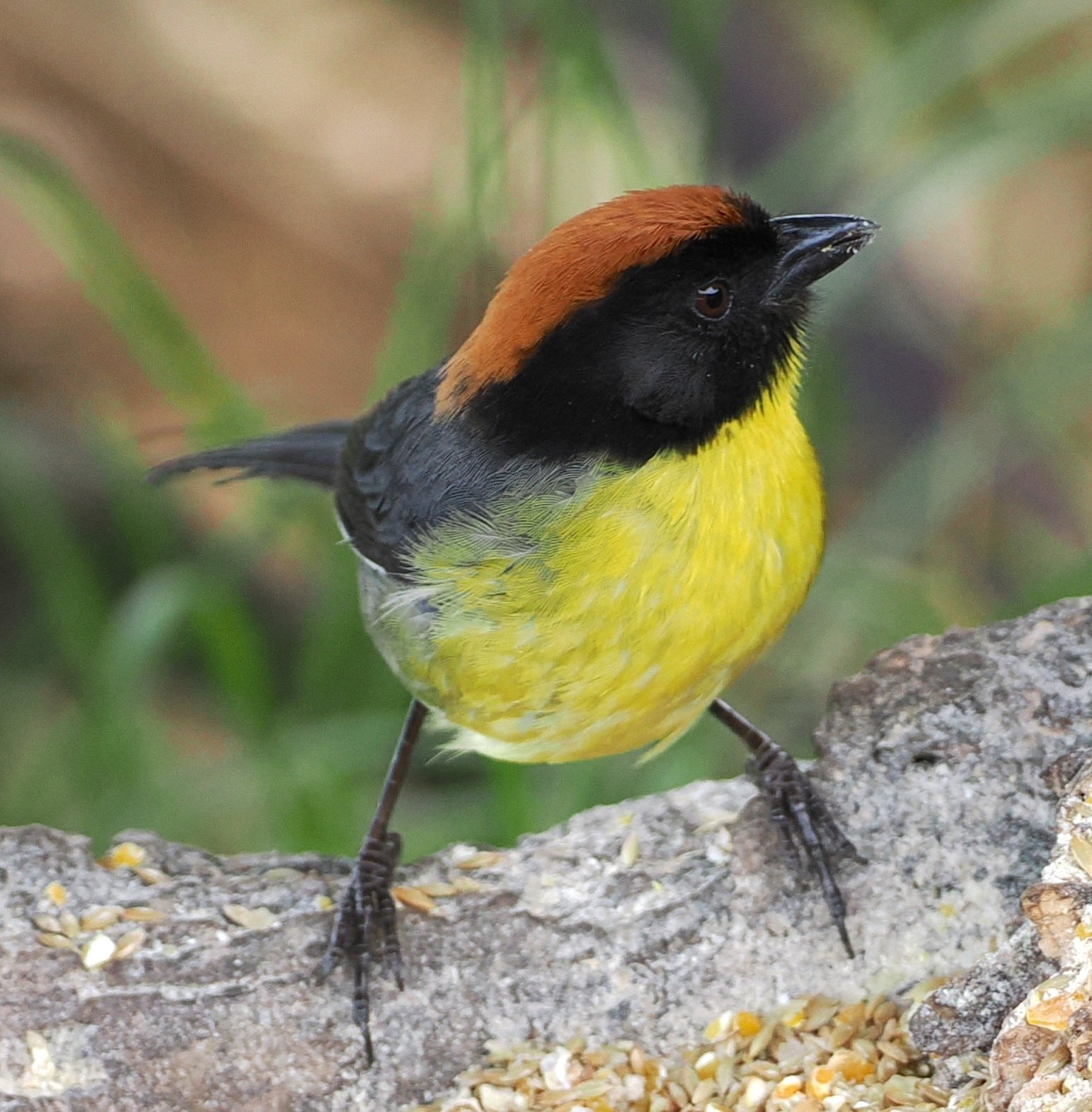
The Black-fronted Brushfinch is a yellow-bellied brushfinch found only in the Serranía de Perijá, the mountain range on the border of Colombia and Venezuela. It was long treated as a subspecies within the Bolivian and Yellow-breasted Brushfinch group and has only recently been widely treated as a separate species. It lives in pairs or family groups in shrubbery at forest edges.
Voice
The dawn song begins with a series of chip or tink notes, followed by faster, usually lower trills. During the day a short, simple song of a few downslurred notes. Excited pairs give high upslurred notes that turn into a buzzing chatter. Calls chip, seet and swit.
Recording: Ross Gallardy — CC BY-NC-SA 4.0 · xeno-canto
Identification
17 cm. The forehead is black, the crown and nape are rufous to orange-rufous, and the face is mostly black, with a dark grey wash on the cheeks. The upperparts are dark slate-grey, the wings and tail slightly darker; the outer primaries have thin white edges and white bases. The throat, breast, belly and undertail coverts are yellow, with an olive or greyish wash on the breast sides and flanks. The iris is deep reddish brown, the bill black. The sexes are alike. Juveniles have an olive-grey head with grey cheeks and no rufous.
Confusion species
Perija Brushfinch Arremon perijanus lives in the same mountains, but has a black-and-grey striped head and a white throat, without any yellow. Yellow-breasted Brushfinch Atlapetes latinuchus is very similar, but does not occur in the Perijá; range is decisive. Chestnut-capped Brushfinch Arremon brunneinucha has a chestnut crown, a white throat with a narrow black breast band and an olive-green back.
Habitat
Humid montane forest, especially shrubby forest edges and second growth; it tolerates disturbed ground. In Colombia roughly between 1400 and 2500 m. It forages in pairs or small groups low in shrubbery and on the ground for insects, seeds and fruit. Birds in breeding condition have been found from January to June; little is known about the nest.
Where the bird is most at home, classified by the vegetation units of the Andes and the west coast.


Range and movements
In Colombia only on the Colombian side of the Serranía de Perijá, in the departments of Cesar and La Guajira. Absent from Ecuador, Peru, Bolivia and the Galápagos. Outside the guide area on the Venezuelan side of the Perijá, there from about 1100 m.
- Resident
- dark = core range, pale = thinly spread
How and when to look
Search forest edges and shrubbery on the slopes of the Perijá, where Perija Brushfinch also occurs. Pairs sing mainly in the early morning; look for the rufous crown above the black face and the yellow underparts.
Conservation status
Least Concern. The range is small, but the population appears stable and the species tolerates disturbed forest. At lower elevations forest is lost to logging, farming, ranching and mining; the higher forest is largely intact.
Scientific name
Atlapetes nigrifrons | Phelps & Gilliard, 1940
Phelps & Gilliard described the species in 1940 and placed it straight away in the genus where it still stands. The genus Atlapetes was introduced in 1831 by Wagler. The genus name comes from Greek: the mythical titan Atlas and petēs, 'flyer'. The species name comes from Latin niger, 'black', and frons, 'forehead', for the black forehead. The specimen the first description was based on came from La Sabana, Río Negro, Sierra de Perijá, Zulia, Venezuela.