All species › Passerines › New World sparrows › White-winged Brushfinch
White-winged Brushfinch | Atlapetes leucopterus
Witvleugelstruikgors | Atlapetes aliblanco | Tico-tico-de-asa-branca
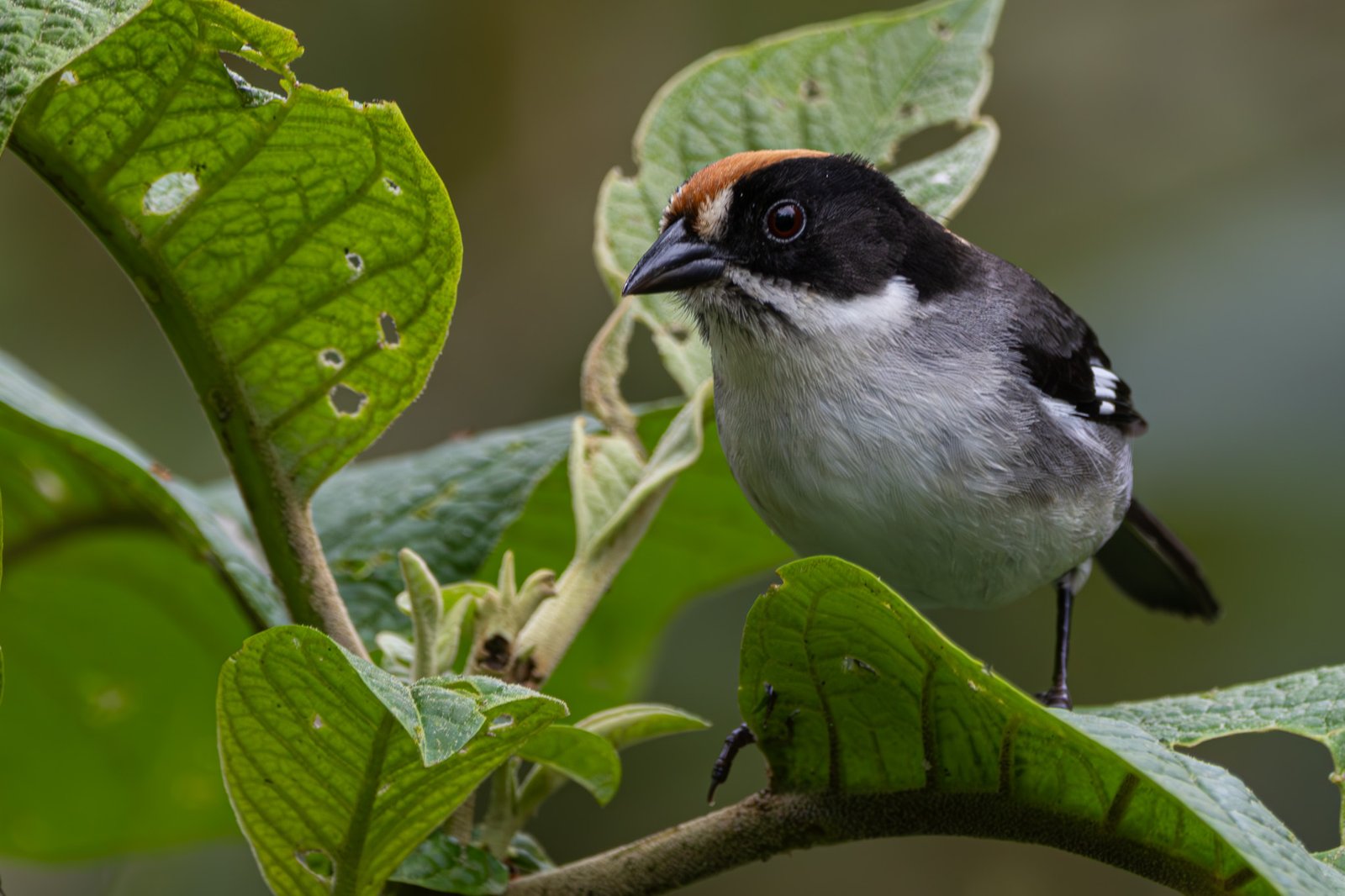
The White-winged Brushfinch is a small grey-and-white brushfinch of dry woodland and scrub in Ecuador and north-western Peru, with a rufous crown stripe and a white wing patch. Three forms are recognised. The eastern-slope form paynteri, with a cream-coloured hindcrown, is treated as a separate species by some authors.
Voice
The song of the south-western form is a high, two-part series of thin notes; the call a high, descending tseeu. The form paynteri sings a musical chew-chew tee-tee and calls a high ti. It sings mainly at dawn, from a high perch.
Recording: Paul Coopmans — CC BY-NC-SA 4.0 · xeno-canto
Identification
15–16 cm. The nominate form has a rufous stripe from forecrown to nape, darkest in front, and a mostly blackish face with a pale spot above the lores and a broad white lower cheek. The upperparts and tail are dark grey; the white bases of the primaries form an obvious wing patch. The underparts are whitish, with a buffy-grey wash on the breast sides and flanks. The form dresseri has a black forehead and a variable amount of white on the face. The form paynteri has a black forecrown, a creamy to white hindcrown and nape, pale grey underparts and a distinctly longer tail. The sexes are alike.
Confusion species
Bay-crowned Brushfinch Atlapetes seebohmi also has a rufous crown and a black face, but lacks the white wing patch and has a grey breast band. White-headed Brushfinch Atlapetes albiceps has much white on the head and face and lives lower in the dry south-west. Pale-headed Brushfinch Atlapetes pallidiceps has a pale head without rufous or black and occurs only in the Yunguilla Valley. Yellow-breasted Brushfinch Atlapetes latinuchus has yellow underparts.
Habitat
In most of Ecuador dry woodland and scrub on the slopes of the inter-Andean valleys, also plantations and gardens, and to a small extent moister woodland on the western slope, mostly between 1000 and 2600 m. In the far south of Ecuador and in north-western Peru in and along dry forest, there between about 400 and 2000 m. The form paynteri lives at the edges of humid montane forest between 1700 and 2200 m. It forages low in the vegetation for insects and seeds, in pairs or small groups.
Where the bird is most at home, classified by the vegetation units of the Andes and the west coast.


Range and movements
In Ecuador the nominate form in the central valleys and on the western slope, from Imbabura to northern Azuay; dresseri in El Oro and Loja; paynteri on the eastern slope in southern Zamora-Chinchipe. In Peru dresseri in Tumbes and Piura and paynteri on the eastern slope south to southern Cajamarca. Absent from Colombia, Bolivia and the Galápagos. Does not occur outside the guide area.
- Resident
- dark = core range, pale = thinly spread
How and when to look
In the dry valleys of northern and central Ecuador you will find it in scrub, hedgerows and gardens; birds often stay low, but sing at dawn from a high perch. In flight look for the white wing patch.
Conservation status
Not Evaluated in the classification followed here. The global Red List assesses White-winged Brushfinch in the narrow sense and the form paynteri separately; both are Least Concern. Fairly common to common in Ecuador; paynteri is rare to locally fairly common in Peru.
Scientific name
Atlapetes leucopterus | (Jardine, 1856)
Jardine described the species in 1856 as Arremon leucopterus; because it was later moved to another genus, the author and year stand in brackets. The genus Atlapetes was introduced in 1831 by Wagler. The genus name comes from Greek: the mythical titan Atlas and petēs, 'flyer'. The species name comes from Greek leukos, 'white', and pteron, 'wing', for the white wing patch. The specimen the first description was based on came from Eastern Cordillera, Ecuador.