All species › Passerines › Ovenbirds and woodcreepers › Parker's Spinetail
Parker's Spinetail | Cranioleuca vulpecula
Parkers stekelstaart | Curutié de Parker | Arredio-de-parker
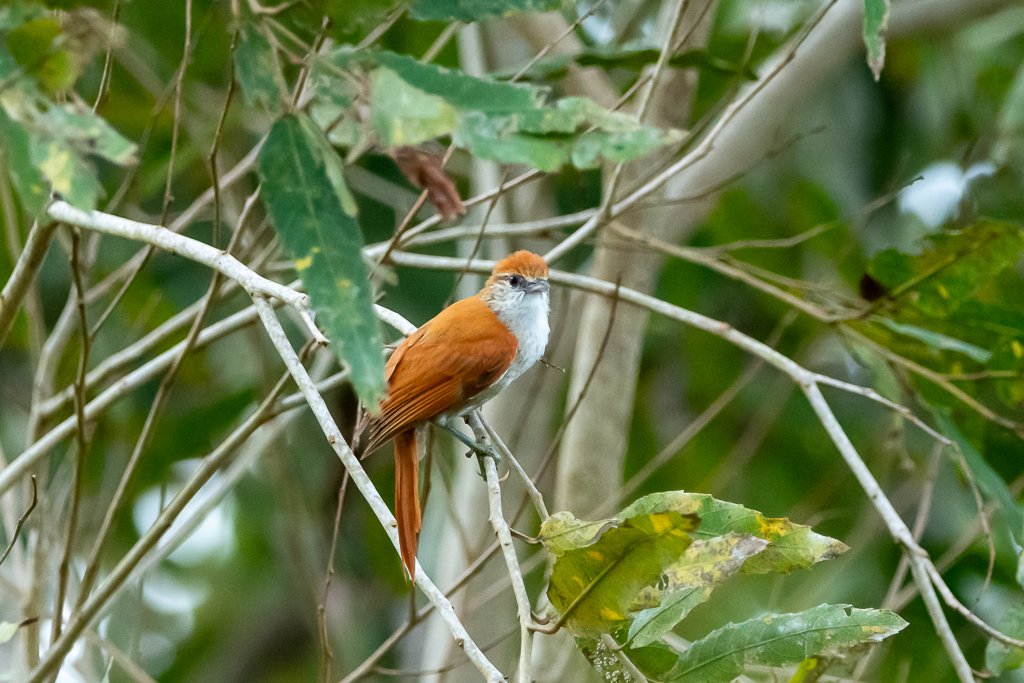
Parker's Spinetail is a rufous spinetail of young vegetation on river islands in the upper Amazon and its tributaries. It is named after the American ornithologist Theodore Parker and was long treated as a subspecies of Rusty-backed Spinetail. It is one of the birds that live almost exclusively on river islands.
Voice
A fast, high, rattling series of notes, often by both partners. Calls with short, sharp notes.
Recording: John V. Moore — CC BY-NC-SA 4.0 · xeno-canto
Identification
14–15 cm, with a straight, pointed bill and a graduated tail with spiny feather tips. The crown, back, wings and tail are rufous. A pale supercilium; the face is greyish. The throat and breast are whitish, the flanks and belly pale buff. The sexes are alike.
Confusion species
Rusty-backed Spinetail Cranioleuca vulpina is almost identical, but lives elsewhere, in the llanos and eastern Bolivia. Red-and-white Spinetail Certhiaxis mustelinus on the same islands has black lores and pure white underparts and lives in grass and reeds at the water's edge. Plain Softtail Thripophaga fusciceps is larger and darker, with brownish underparts, and lives in forest.
Habitat
Young vegetation on river islands and sandbars: scrub, willow-like shrubs, cane and young Cecropia, up to about 200 m. Pairs search for insects in dense shrubs and vines while hitching along branches. The nest is a globe of plant material in a shrub.
Where the bird is most at home, classified by the vegetation units of the Andes and the west coast.


Range and movements
Colombia: in the far south, on islands in the Amazon near Leticia. Ecuador: locally on islands in the Napo in the east. Peru: in the north-east, on islands in the Amazon, Marañón, Ucayali and Napo. Bolivia: absent. Absent from the Galápagos. Outside the guide area in western Brazilian Amazonia.
- Resident
- dark = core range, pale = thinly spread
How and when to look
Visit a river island with young shrubs and cane, for example near Iquitos or Leticia, preferably early in the morning. Listen for the rattling song from dense scrub.
Conservation status
Least Concern. River islands change constantly through erosion and deposition; the species depends on young vegetation that keeps forming anew.
Scientific name
Cranioleuca vulpecula | (Sclater & Salvin, 1866)
Sclater & Salvin described the species in 1866 as Synallaxis vulpecula; because it was later moved to another genus, the author and year stand in brackets. The genus Cranioleuca was introduced in 1853 by Reichenbach. The genus name comes from Greek kranion, 'skull', and leukos, 'white'. The species name is Latin vulpecula, 'little fox', referring to the foxy colour. The specimen the first description was based on came from Río Ucayali, Peru.