All species › Passerines › Ovenbirds and woodcreepers › Crested Spinetail
Crested Spinetail | Cranioleuca subcristata
Kuifstekelstaart | Curutié copetón | Arredio-de-crista
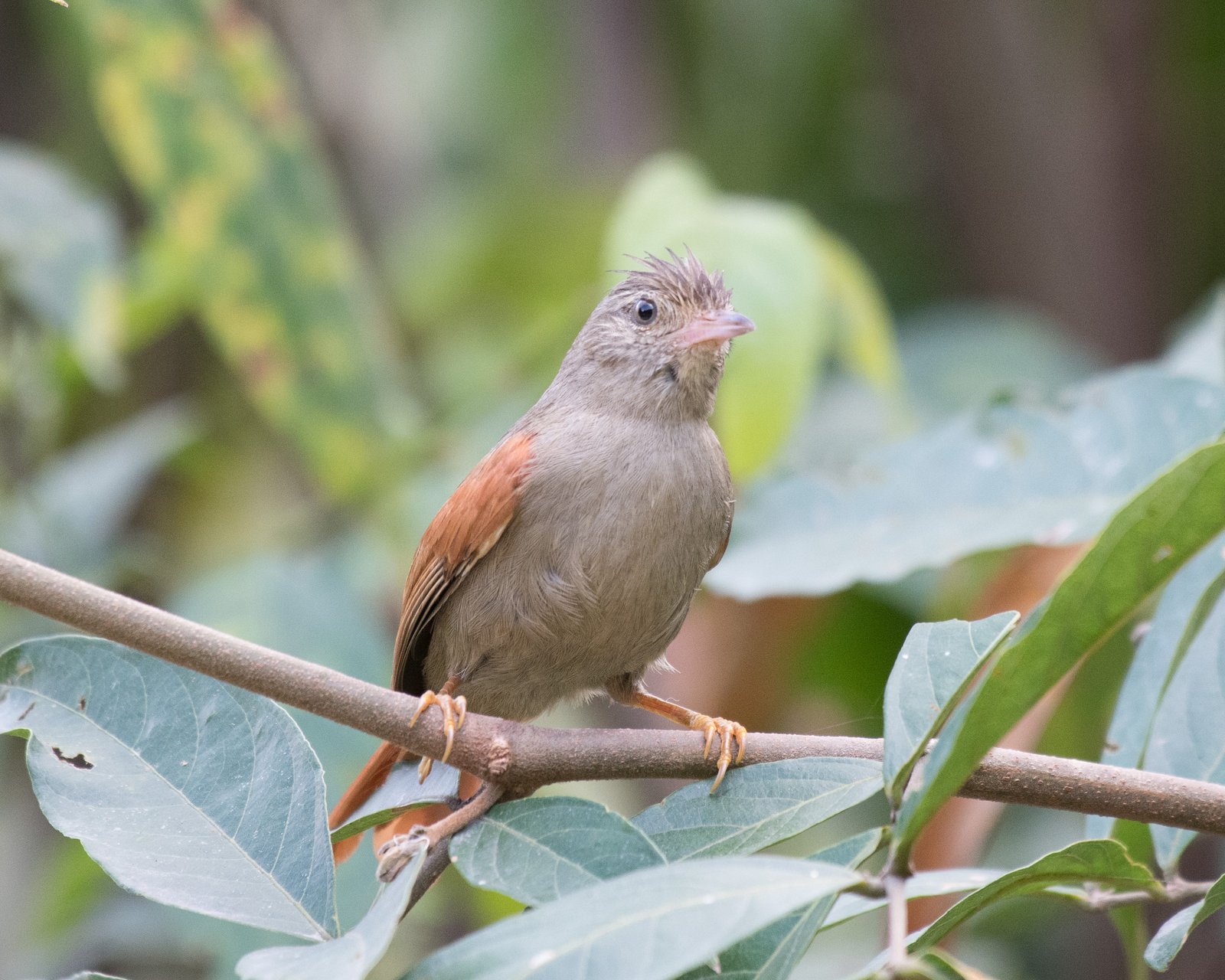
The Crested Spinetail is a small, olive-brown ovenbird of montane forest in the far north-east of Colombia and in Venezuela. It forages like a tit in the canopy and among vines and moss for insects, often with mixed flocks. It can raise its crown feathers into a short crest; the tail feathers end in bare, spiny tips, as in all species of the genus Cranioleuca.
Voice
The song consists of three high, shrill notes followed by a descending, chattering trill. Calls are a sharp tsink and a low rattle.
Recording: Nick Athanas — CC BY-NC-SA 3.0 · xeno-canto
Identification
14–15 cm, with a pointed, straight bill and a fairly long, graduated, rufous tail with spiny tips. The crown is brown with fine dark streaks and can be slightly raised; in the Serranía del Perijá the crown streaks are blacker and bolder. A faint, pale brown eyebrow and a dull brown cheek. Back and rump are olive-brown, the wings dark rufous with dark tips to the flight feathers. The underparts are dull tawny-brown. The sexes are alike; juveniles are greyer, with mottled underparts.
Confusion species
Streak-capped Spinetail Cranioleuca hellmayri of the Sierra Nevada de Santa Marta has a rufous, black-streaked crown, a narrow whitish eyebrow and a whitish throat; the two species do not occur together. Pale-breasted Spinetail Synallaxis albescens lives low in grassland and scrub, with a rufous crown patch and a pale breast. Azara's Spinetail Synallaxis azarae has a plain rufous crown, grey underparts and a long tail, and keeps low in dense shrubbery.
Habitat
Humid montane forest, mature secondary forest, forest edges and shaded plantations, from the foothills to about 1950 m. It forages mainly in the middle and upper strata along branches, moss, dead leaves and vines for insects and spiders. The nest is a globe made mostly of grass with an entrance at the bottom, hanging from the tip of a branch.
Where the bird is most at home, classified by the vegetation units of the Andes and the west coast.


Range and movements
In Colombia only in the north-east: in the Serranía del Perijá and adjacent Norte de Santander, scarce in the lowlands. Absent from Ecuador, Peru, Bolivia and the Galápagos. Outside the guide area widespread in the mountains of northern Venezuela, from the Andes and the Maracaibo Basin to the coastal cordillera and the north-east.
- Resident
- dark = core range, pale = thinly spread
How and when to look
Check the middle strata and canopy of forest edges and shade coffee in the Perijá; the species often travels with mixed flocks and gives itself away by its shrill trill.
Conservation status
Least Concern. The species also occurs in secondary forest and shaded plantations; on the Colombian side of the Perijá the forest has been heavily cleared in places.
Scientific name
Cranioleuca subcristata | (Sclater, 1874)
Sclater described the species in 1874 as Synallaxis subcristata; because it was later moved to another genus, the author and year stand in brackets. The genus Cranioleuca was introduced in 1853 by Reichenbach. The genus name comes from Greek kranion, 'skull', and leukos, 'white'. The species name comes from Latin sub, 'somewhat', and cristatus, 'crested'. The specimen the first description was based on came from near Caracas, Venezuela.