All species › Passerines › Ovenbirds and woodcreepers › Stripe-crowned Spinetail
Stripe-crowned Spinetail | Cranioleuca pyrrhophia
Streepkruinstekelstaart | Curutié blanco | Arredio-listrado
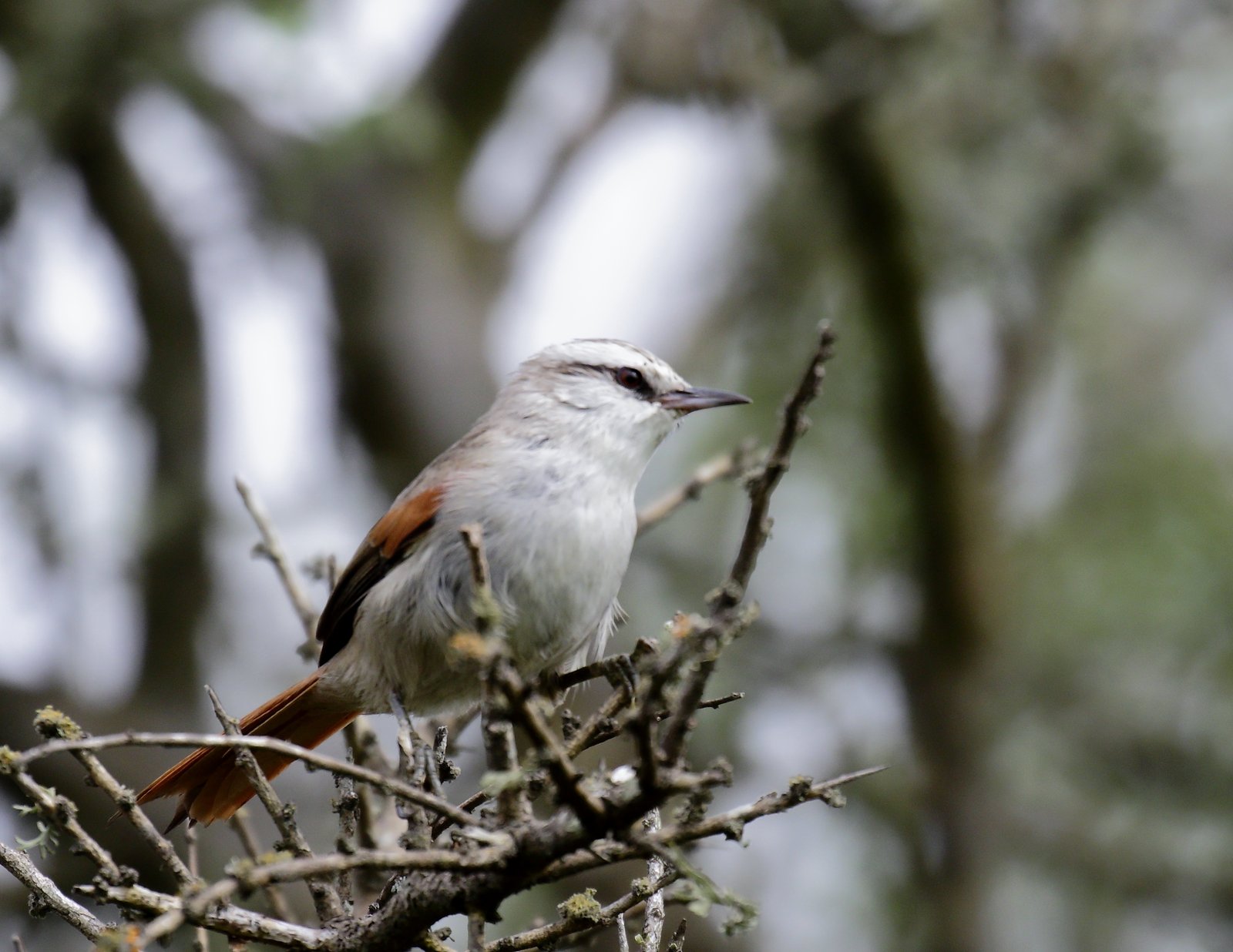
The Stripe-crowned Spinetail is a small ovenbird of dry forest and scrub in southern South America that reaches the guide area only in Bolivia. A long white eyebrow below a black-and-brown streaked crown is its clearest feature. It searches branches like a tit, often hanging, in pairs or with mixed flocks.
Voice
The song is an accelerating, descending trill, or a series of metallic ticks running into rapid, bubbling clicks. Calls are a soft metallic tck and a rolling wrrru.
Recording: Franco Vushurovich — CC BY-NC-SA 4.0 · xeno-canto
Identification
14–16 cm, with a pointed bill and a graduated, rufous tail with spiny tips that looks forked. The crown is streaked blackish and brown, bordered by a long white eyebrow and dark lores. The back is greyish brown, the wing coverts rufous. The throat is white, the breast grey to buffy grey and the belly slightly darker grey. The forms in the Bolivian Andes differ in crown pattern, back tone and paleness of the underparts. The sexes are alike; juveniles have an unstreaked crown and darker, faintly scaled underparts.
Confusion species
Bolivian Spinetail Cranioleuca henricae has a plain rufous crown without streaks, a grey cheek and greyish-olive underparts, and lives only in a few valleys in La Paz and Cochabamba. Light-crowned Spinetail Cranioleuca albiceps has a pale, whitish to buff crown and lives higher, in humid cloud forest. Brown-capped Tit-Spinetail Leptasthenura fuliginiceps has a plain brown cap, a much longer, narrower tail and lives in scrub of the higher valleys.
Habitat
Dry deciduous forest, Chaco woodland, gallery forest, dry montane scrub and semi-humid woodland, in the Andes also alder (Alnus) and Podocarpus woodland; from the lowlands to about 3100 m. It forages in pairs or with mixed flocks among branches, leaves, lichens and epiphytes for insects and spiders. The nest is a ball of twigs and plant fibres hanging from a branch.
Where the bird is most at home, classified by the vegetation units of the Andes and the west coast.


Range and movements
In the guide area only in Bolivia: in the Andes and dry valleys of La Paz and Cochabamba through Santa Cruz south to Tarija, and in the Chaco lowlands of the south-east. Absent from Colombia, Ecuador, Peru and the Galápagos. Outside the guide area in Paraguay, Uruguay, northern and central Argentina and the far south of Brazil.
- Resident
- dark = core range, pale = thinly spread
How and when to look
Follow mixed flocks in dry woodland and alder forest in the valleys of Cochabamba and Tarija, or in Chaco woodland south of Santa Cruz; the white eyebrow and streaked crown stand out as the bird hangs along the branches.
Conservation status
Least Concern. A common species with a large range, which also occurs in degraded and secondary woodland.
Scientific name
Cranioleuca pyrrhophia | (Vieillot, 1818)
Vieillot described the species in 1818 as Dendrocopus pyrrhophius; because it was later moved to another genus, the author and year stand in brackets. The genus Cranioleuca was introduced in 1853 by Reichenbach. The genus name comes from Greek kranion, 'skull', and leukos, 'white'. The species name comes from Greek purrhos, 'flame-coloured, red', and phaios, 'brown'. The specimen the first description was based on came from Paraguay.