All species › Passerines › Ovenbirds and woodcreepers › Bolivian Spinetail
Bolivian Spinetail | Cranioleuca henricae
Boliviaanse stekelstaart | Curutié boliviano | Arredio-boliviano
The Bolivian Spinetail is an endemic ovenbird of a few dry Andean valleys in La Paz and Cochabamba. The species was discovered only in 1993, near Inquisivi in La Paz. It lives in dry deciduous forest and is vulnerable because of its small range.
Voice
The short song is a bouncy, accelerating and descending series of one to two seconds; the long song is faster and irregular and can last more than ten seconds. Calls consist of single, double or triple notes and a short churr.
Recording: Ross Gallardy — CC BY-NC-SA 4.0 · xeno-canto
Identification
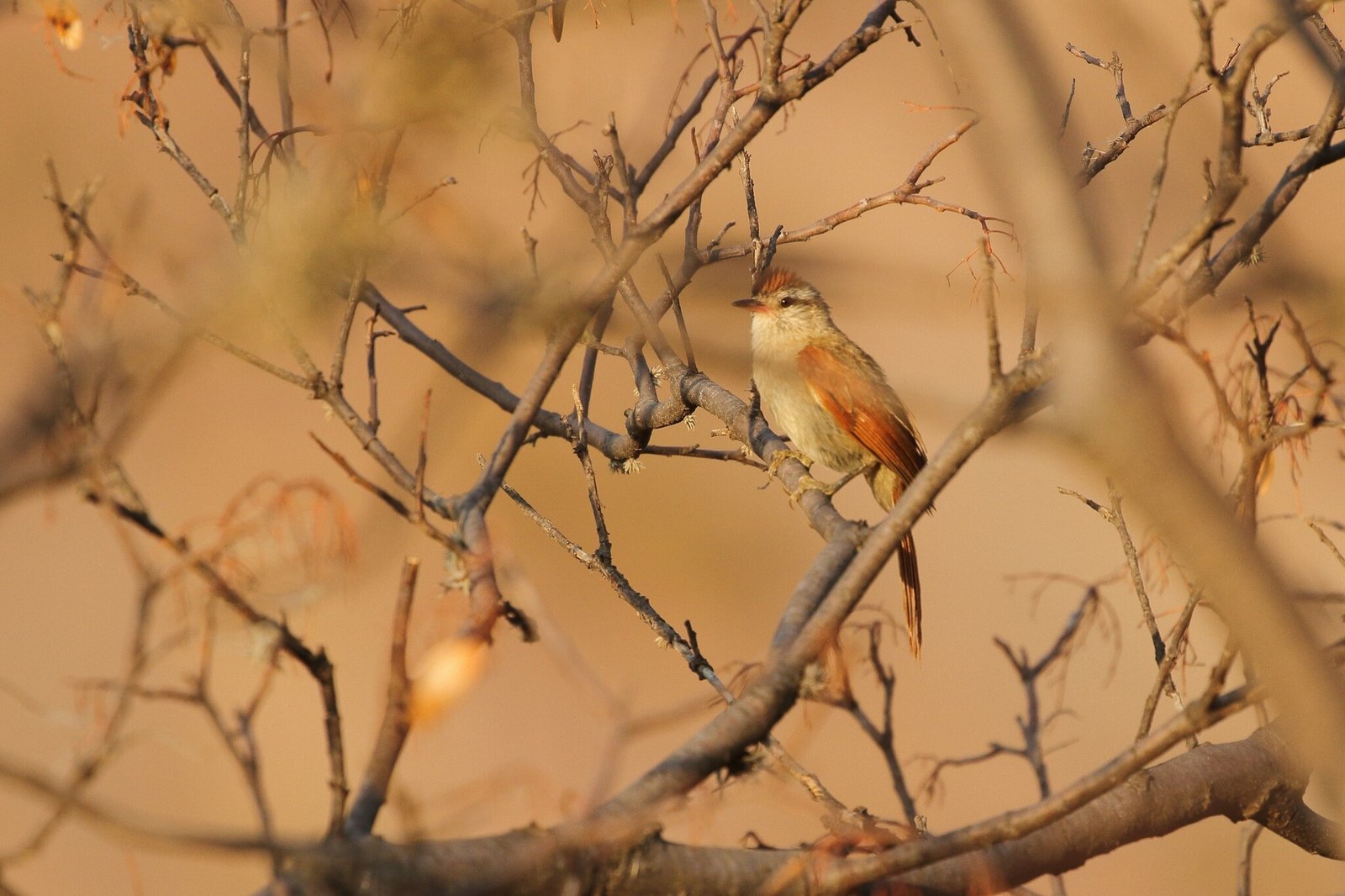
About 15 cm, with a pointed bill and a graduated, rufous tail with spiny tips. The crown is plain rufous, with a white eyebrow, a grey cheek and dirty white lores. The back is light brownish olive, the wings rufous. The underparts are light greyish olive with a faint buff tinge. The sexes are alike.
Confusion species
Stripe-crowned Spinetail Cranioleuca pyrrhophia, which occurs in the same region, has a streaked crown and whiter underparts. Light-crowned Spinetail Cranioleuca albiceps has a pale crown and lives higher, in humid cloud forest. Ash-browed Spinetail Cranioleuca curtata has a chestnut crown with a greyish eyebrow and lives lower, in humid montane forest on the eastern slope.
Habitat
Dry deciduous forest in inter-Andean valleys, sometimes with columnar cacti and low shrubs, with lichens and Tillandsia on the trees; known from about 1600 to 2300 m, possibly up to 3300 m. It forages mainly 1 to 4 m above the ground along branches and among epiphytes for insects. Little is known about the nest.
Where the bird is most at home, classified by the vegetation units of the Andes and the west coast.


Range and movements
Endemic to Bolivia: only in a few valleys in the Andes of La Paz, including around Inquisivi, and Cochabamba. Absent from Colombia, Ecuador, Peru and the Galápagos.
- Resident
- dark = core range, pale = thinly spread
How and when to look
Search the dry valleys around Inquisivi and in Cochabamba, in deciduous woodland with Tillandsia on the branches; listen for the bouncy, accelerating song.
Conservation status
Vulnerable. The range is small and the population is estimated at about 1500 mature individuals, with a declining trend. Threats are logging, conversion of forest to eucalyptus plantations and pasture, fire, landslides and climate change.
Scientific name
Cranioleuca henricae | Maijer & Fjeldså, 1997
Maijer & Fjeldså described the species in 1997 and placed it straight away in the genus where it still stands. The genus Cranioleuca was introduced in 1853 by Reichenbach. The genus name comes from Greek kranion, 'skull', and leukos, 'white'. The species name honours Henrica Gertruida Maijer-van der Werff (1929–2020), mother of the Dutch ornithologist Sjoerd Maijer. The specimen the first description was based on came from Inquisivi, La Paz, Bolivia.