All species › Passerines › Ovenbirds and woodcreepers › Creamy-crested Spinetail
Creamy-crested Spinetail | Cranioleuca albicapilla
Vaalkopstekelstaart | Curutié crestado | Arredio-de-crista-creme
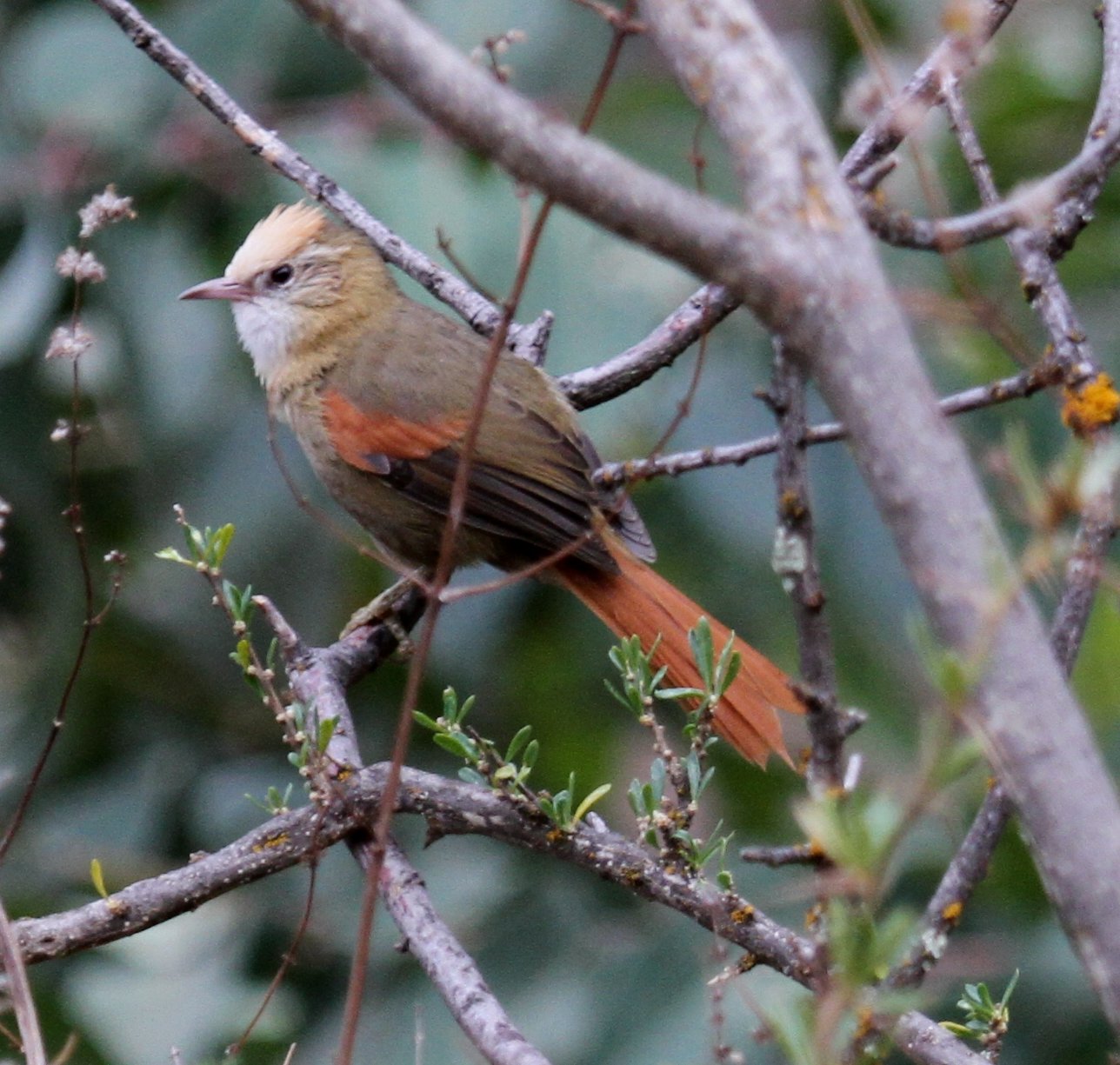
The Creamy-crested Spinetail is a fairly large spinetail found only in the Andes of central and southern Peru. Its creamy-white crown with a short crest separates it from the other spinetails of the genus Cranioleuca in this part of the Andes. Pairs often sing in duet.
Voice
A loud, rising and falling series of semi-musical notes, often given as a duet by a pair. Also shorter calls, including a rising whistle.
Recording: Gilmar Vergara Álvarez — CC BY-NC 4.0 · xeno-canto
Identification
16–17 cm, with a pointed bill and a long, graduated, rufous tail with spiny tips. The crown and short crest are creamy white, the back greyish olive and the wing coverts dark rufous. The underparts are pale grey, the throat paler. There are two subspecies; where they meet, intermediates occur. The sexes are alike.
Confusion species
Line-cheeked Spinetail Cranioleuca antisiensis is smaller, with a rufous crown, a distinct white eyebrow and streaked cheeks. Marcapata Spinetail Cranioleuca marcapatae lives in wetter cloud forest in Cusco and has a rufous crown and back. White-browed Tit-Spinetail Leptasthenura xenothorax shares the Polylepis woodland in Cusco and Apurímac, but has a rufous crown, a white eyebrow and a long, narrow tail.
Habitat
Semi-humid and humid montane forest, cloud forest and Polylepis woodland, also shrubby forest edges, mostly between 2400 and 3650 m, locally to over 4200 m. It forages in pairs or with mixed flocks along branches, moss and epiphytes for insects. The nest is a ball of moss, twigs and bark strips with an entrance at the bottom, usually hanging from the tip of a branch.
Where the bird is most at home, classified by the vegetation units of the Andes and the west coast.


Range and movements
Endemic to Peru: in the Andes from Junín south through Ayacucho and Apurímac to Cusco. Absent from Colombia, Ecuador, Bolivia and the Galápagos.
- Resident
- dark = core range, pale = thinly spread
How and when to look
Search Polylepis groves and shrubby forest edges in the high valleys of Apurímac and Cusco; pairs give themselves away by their loud duets.
Conservation status
Least Concern. The species has a restricted range; logging and fire in Polylepis and montane forest degrade its habitat locally.
Scientific name
Cranioleuca albicapilla | (Cabanis, 1873)
Cabanis described the species in 1873 as Synallaxis albicapilla; because it was later moved to another genus, the author and year stand in brackets. The genus Cranioleuca was introduced in 1853 by Reichenbach. The genus name comes from Greek kranion, 'skull', and leukos, 'white'. The species name comes from Latin albus, 'white', and capillus, 'hair', referring to the pale crown. The specimen the first description was based on came from Maraynioc, Junín, Peru.