All species › Passerines › Ovenbirds and woodcreepers › Red-faced Spinetail
Red-faced Spinetail | Cranioleuca erythrops
Roodwangstekelstaart | Colaespina carirroja | Arredio-de-cara-ruiva
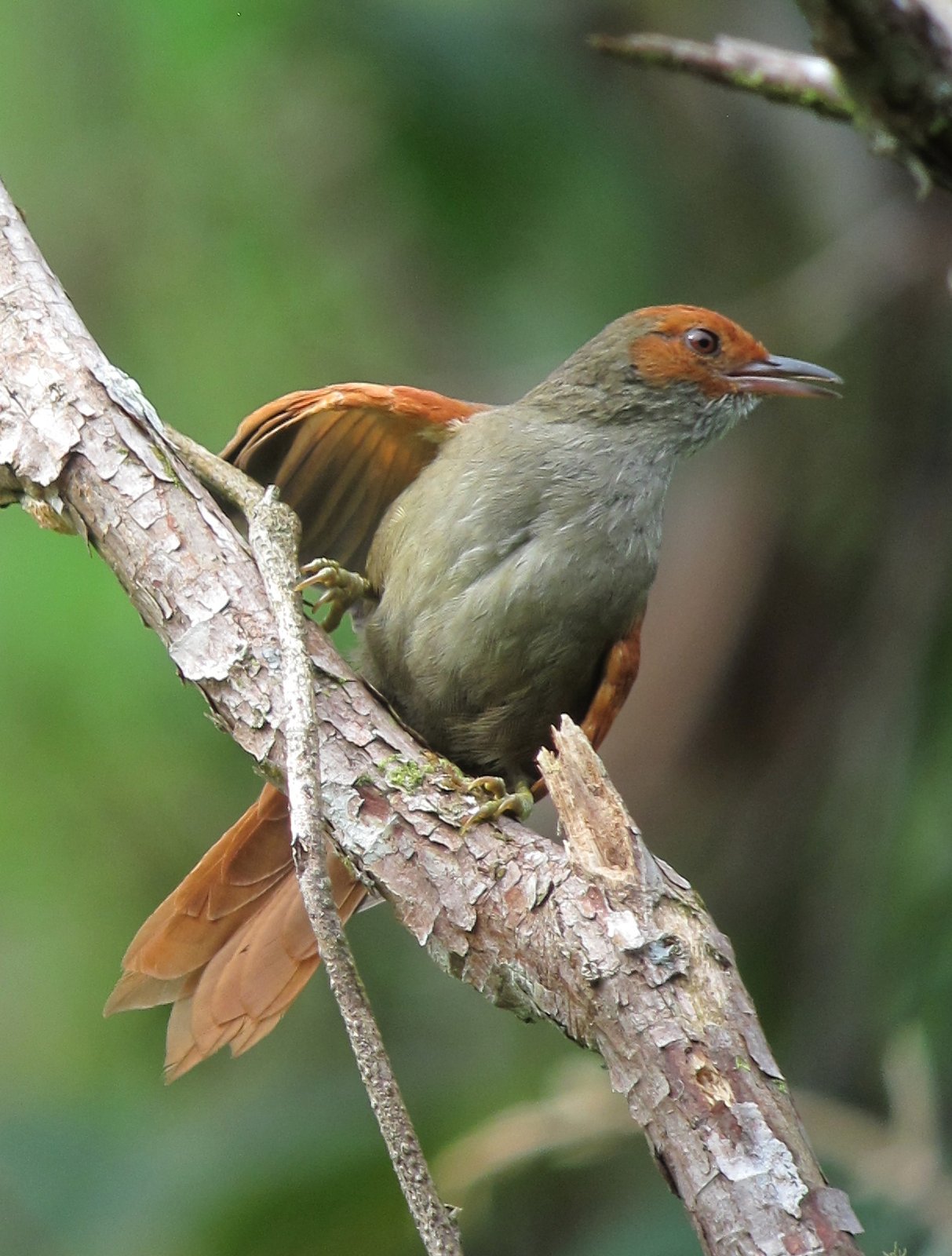
The Red-faced Spinetail is an ovenbird of montane forest on the western side of the Andes of Colombia and Ecuador, and further in Costa Rica and Panama. The rufous face and crown contrast with the olive-brown back and underparts. It forages in the canopy among moss and dead leaves, almost always with mixed flocks.
Voice
The song is a high, fast, scratchy chatter-trill, also described as a rapid series of squeaky notes turning into twittering. Calls are a short, high prrreep and a chi-tik.
Recording: José María Loaiza B. — CC BY-NC-SA 4.0 · xeno-canto
Identification
14–15 cm, with a pointed bill. Face and crown are rufous, nape and back olive-brown, the wings rufous and the tail chestnut with spiny, bare feather tips. The chin is brownish grey, the underparts dull olive-brown. The sexes are alike. Juveniles have an olive-brown crown, an ochre wash on throat and breast and sometimes a narrow buff eyebrow.
Confusion species
Ash-browed Spinetail Cranioleuca curtata has a chestnut crown, but a greyish eyebrow and no rufous face; it lives on the eastern slope and on the western slope of the Eastern Andes. Line-cheeked Spinetail Cranioleuca antisiensis of south-western Ecuador has a distinct white eyebrow, a pale throat and streaked cheeks; young Red-faced Spinetails with a buff eyebrow can resemble it. Rufous Spinetail Synallaxis unirufa is uniformly rufous, with black lores, and keeps low in dense shrubbery.
Habitat
Humid montane forest and mature secondary forest of the subtropical zone, in Colombia mainly between 800 and 2000 m, in Ecuador mostly between 700 and 1500 m; in the Cordillera de Mache almost to sea level, there also in humid and deciduous lowland forest. It forages in the middle strata and canopy among moss, dead leaves and vines for insects. The nest is a ball of moss and vine stems with an entrance at the bottom, 5 to 12 m up at the tip of a thin branch; the birds hang grass and other material around it, so that it looks like random debris.
Where the bird is most at home, classified by the vegetation units of the Andes and the west coast.


Range and movements
In Colombia in the Western Andes south to Nariño, on the western slope of the Central Andes south to Quindío and in the Serranía de San Lucas. In Ecuador on the western slope of the Andes south to Azuay and in the coastal Cordillera de Mache. Absent from Peru, Bolivia and the Galápagos. Outside the guide area in the mountains of Costa Rica and Panama.
- Resident
- dark = core range, pale = thinly spread
How and when to look
Follow mixed flocks in montane forest on the western slope, for example around Mindo in Ecuador or in the Western Andes of Colombia, and watch for birds probing hanging moss and dead leaves.
Conservation status
Least Concern. The species tolerates mature secondary forest, but deforestation of the subtropical zone on the western slope has reduced its habitat locally.
Scientific name
Cranioleuca erythrops | (Sclater, 1860)
Sclater described the species in 1860 as Synallaxis erythrops; because it was later moved to another genus, the author and year stand in brackets. The genus Cranioleuca was introduced in 1853 by Reichenbach. The genus name comes from Greek kranion, 'skull', and leukos, 'white'. The species name comes from Greek eruthros, 'red', and ōps, 'face', referring to the rufous face. The specimen the first description was based on came from Pallatanga, Chimborazo, Ecuador.