All species › Passerines › Ovenbirds and woodcreepers › Streak-capped Spinetail
Streak-capped Spinetail | Cranioleuca hellmayri
Streepkapstekelstaart | Curutié de Santa Marta | Arredio-de-boné-estriado
The Streak-capped Spinetail is an ovenbird found almost only in the Sierra Nevada de Santa Marta in northern Colombia. It lives in the middle strata and canopy of montane forest and often forages with mixed flocks. A single specimen is known from the Venezuelan side of the Serranía del Perijá.
Voice
Poorly described. A weak, high, squeaky trill, also described as a shrill, accelerating trill.
Recording: Jerome Fischer — CC BY-NC-SA 4.0 · xeno-canto
Identification
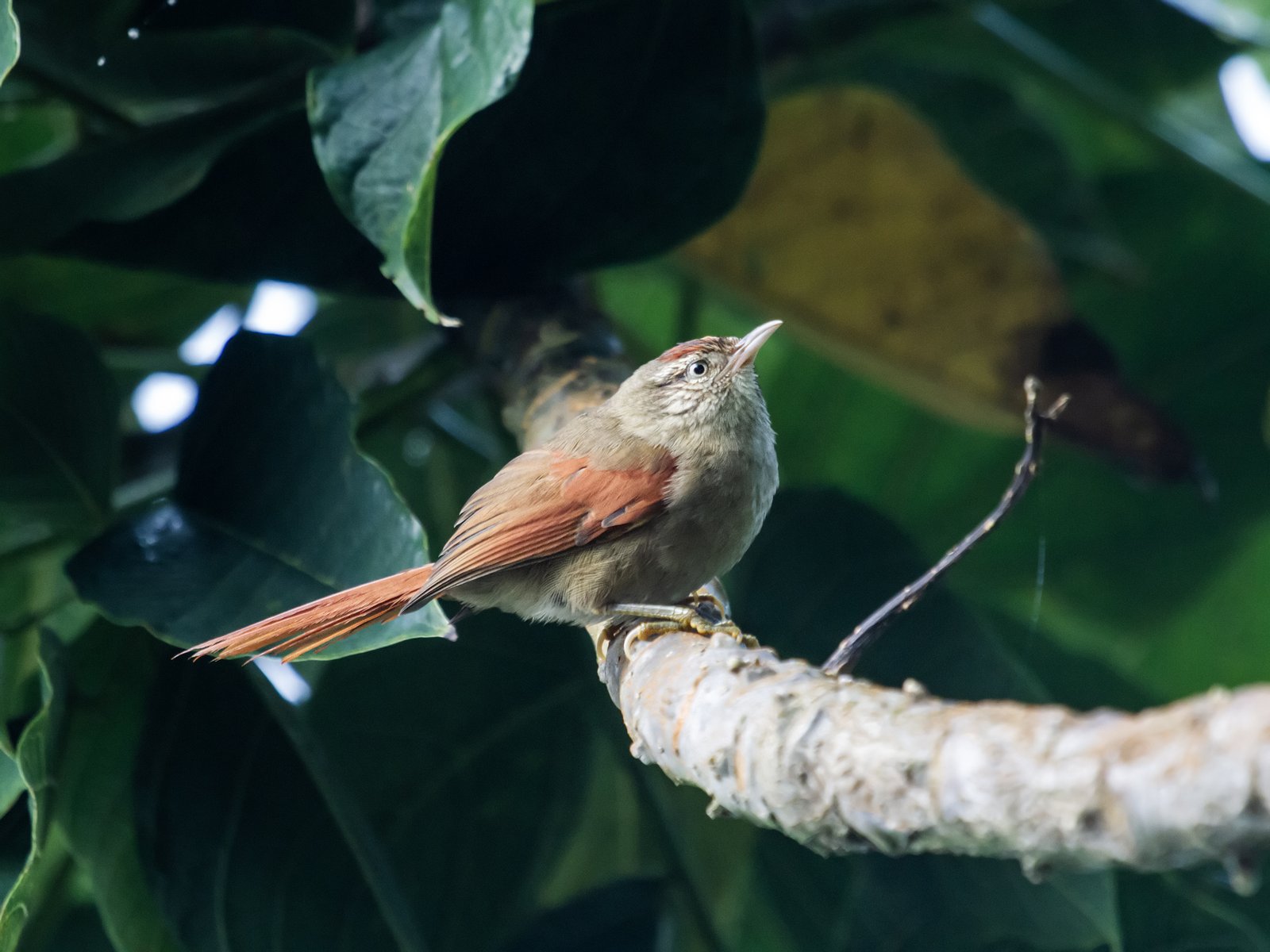
14–15 cm, with a pointed bill and a rufous tail with spiny tips. The crown is rufous with blackish streaks, with a narrow whitish eyebrow; the face is dark brown and buff. The back is brown, the wings mostly rufous. Chin and throat are whitish, breast and belly pale brownish grey to greyish olive. The sexes are alike.
Confusion species
Rusty-headed Spinetail Synallaxis fuscorufa, also endemic to these mountains, has a plain rufous head and breast and keeps low in shrubbery and forest edges. Crested Spinetail Cranioleuca subcristata of the Perijá has a brown, more finely streaked crown, a faint eyebrow and a brown throat; the two species do not occur together.
Habitat
Humid evergreen montane forest, both mature and secondary, in Colombia between 1200 and 3000 m. It forages from the middle strata into the canopy along branches, moss and epiphytes for insects. Little is known about the nest.
Where the bird is most at home, classified by the vegetation units of the Andes and the west coast.


Range and movements
In Colombia almost only in the Sierra Nevada de Santa Marta. Absent from Ecuador, Peru, Bolivia and the Galápagos. Outside the guide area a single specimen is known from the Venezuelan side of the Serranía del Perijá, at 700 m.
- Resident
- dark = core range, pale = thinly spread
How and when to look
In the Sierra Nevada de Santa Marta walk trails through montane forest, such as the road to San Lorenzo above Minca, and watch for mixed flocks in the middle strata.
Conservation status
Least Concern. The range is small and montane forest in the Santa Marta is locally cleared and converted to farmland.
Scientific name
Cranioleuca hellmayri | (Bangs, 1907)
Bangs described the species in 1907 as Siptornis hellmayri; because it was later moved to another genus, the author and year stand in brackets. The genus Cranioleuca was introduced in 1853 by Reichenbach. The genus name comes from Greek kranion, 'skull', and leukos, 'white'. The species name honours Carl Eduard Hellmayr (1878–1944), Austrian ornithologist who published widely on Neotropical birds. The specimen the first description was based on came from Páramo de Macotama, Sierra Nevada de Santa Marta, Colombia.