All species › Passerines › Tanagers and allies › Parrot-billed Seedeater
Parrot-billed Seedeater | Sporophila peruviana
Papegaaisnaveldikbekje | Semillero pico de loro | Papa-capim-de-bico-de-papagaio
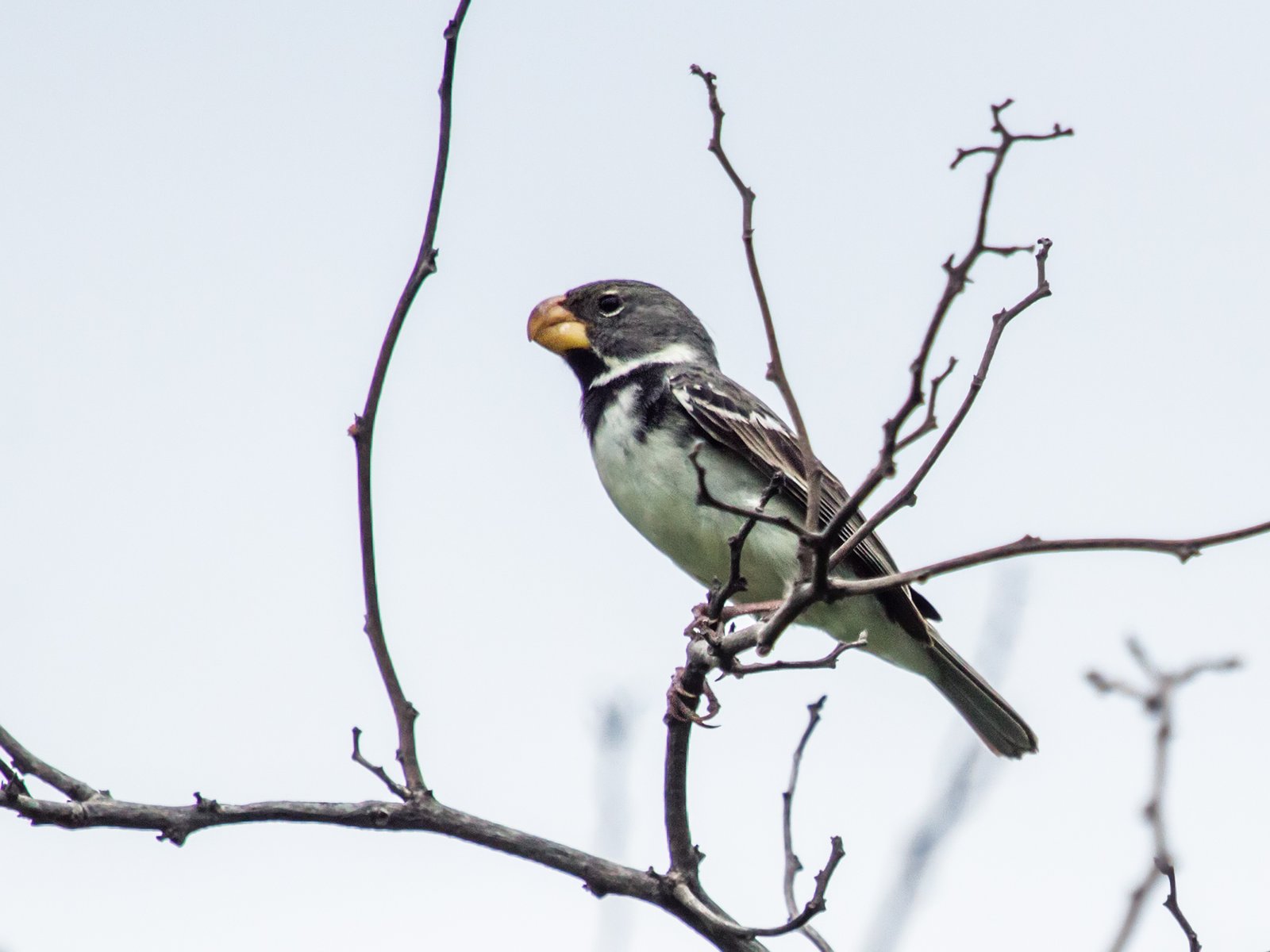
The Parrot-billed Seedeater is a seedeater of the dry Pacific lowlands of Ecuador and Peru, named for its heavy, strongly curved bill. The male is grey with a black throat and a white wing speculum. In dry years the species is locally scarce, and after rain it appears in flocks in rank growth and fields.
Voice
The song is a short, somewhat scratchy series of twittering and whistled notes. The call is a short, nasal cheep.
Recording: John V. Moore — CC BY-NC-SA 4.0 · xeno-canto
Identification
11–12 cm, with a strikingly deep, heavily curved, yellowish to horn-coloured bill. The male is grey-brown above, with a white wing speculum; the throat and centre of the upper breast are black, set off by a white stripe below the cheek; the rest of the underparts is whitish. The female is brown above and paler buff-brown below, with the same heavy bill. Young males at first resemble the female.
Confusion species
Chestnut-throated Seedeater Sporophila telasco has a smaller, dark bill and, in the male, a chestnut chin and throat. Drab Seedeater Sporophila simplex is plain grey-brown, with two pale wing bars and a smaller bill. Female Blue-black Grassquit Volatinia jacarina is streaked below and has a more pointed bill. In females, the heavy, curved bill is the main feature.
Habitat
Dry scrub, rank growth, thickets along rivers, and fields and fallow land in the dry coastal lowlands, from sea level to about 1000 m. It eats mainly seeds of grasses and herbs. The nest is a small cup low in a shrub.
Where the bird is most at home, classified by the vegetation units of the Andes and the west coast.


Range and movements
In Ecuador in the dry west, from Manabí and Santa Elena south to El Oro and Loja. In Peru along the Pacific coast and in the western valleys, from Tumbes south to the centre of the country. Absent from Colombia, Bolivia and the Galápagos. Does not occur outside the guide area.
- Resident
- dark = core range, pale = thinly spread
How and when to look
Search south-western Ecuador and north-western Peru (Tumbes, Piura, Lambayeque) in rank growth and field edges, especially after the rainy season, when seedeater flocks feed on seeding herbs.
Conservation status
Least Concern. The species also occurs in farmland; numbers fluctuate with rainfall, and trapping for the cage-bird trade plays a role locally.
Scientific name
Sporophila peruviana | (Lesson, 1842)
Lesson described the species in 1842 as Callyrhynchus peruvianus; because it was later moved to another genus, the author and year stand in brackets. The genus Sporophila was introduced in 1844 by Cabanis. The genus name combines Greek sporos, 'seed', and philos, 'fond of'. The species name refers to Peru. The specimen the first description was based on came from Callao, Peru.