All species › Passerines › Tanagers and allies › White-bellied Seedeater
White-bellied Seedeater | Sporophila leucoptera
Witbuikdikbekje | Semillero ventriblanco | Chorão
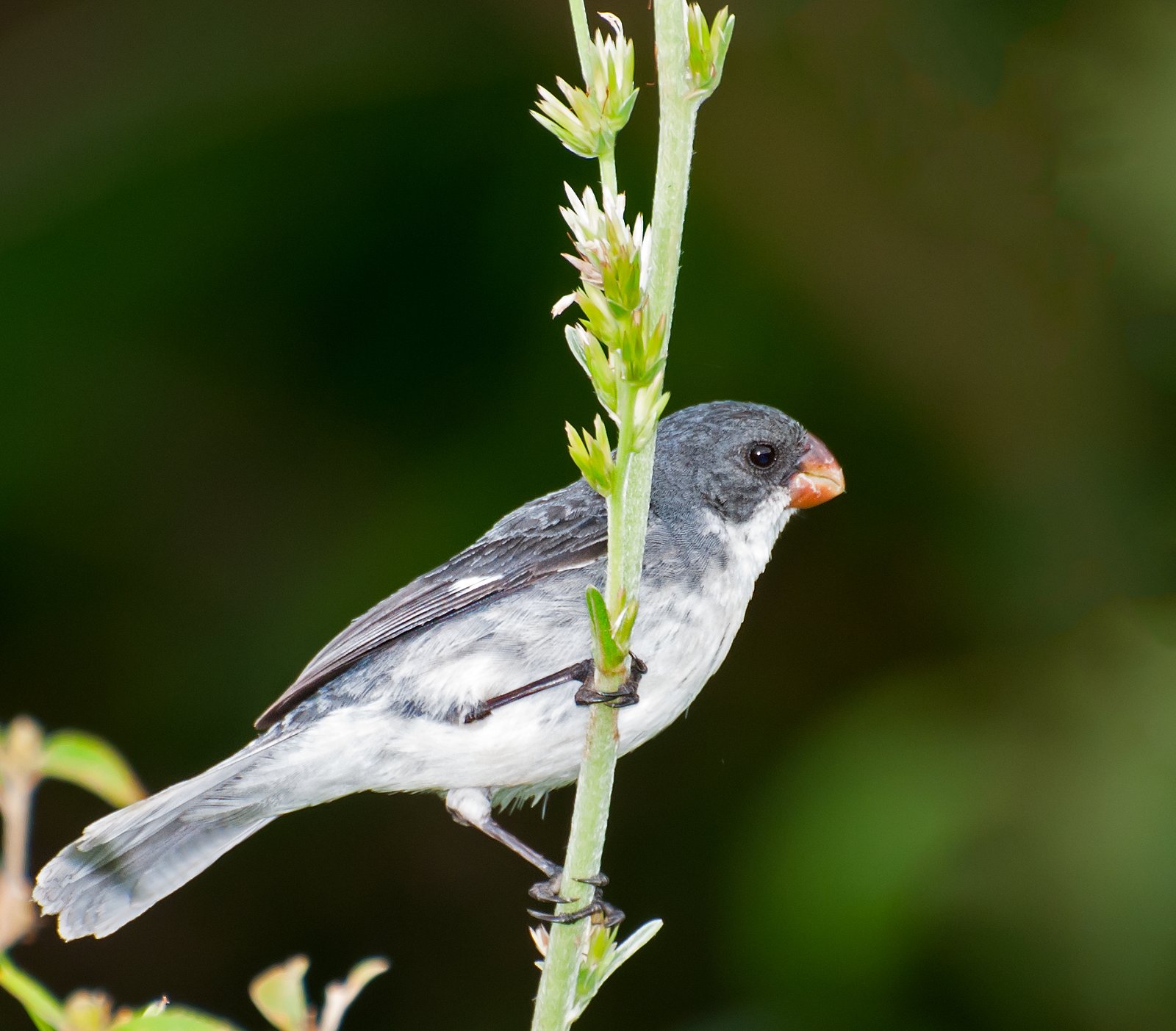
The White-bellied Seedeater is a fairly large, grey-and-white seedeater of wet grassland, marshes and savannas in the interior of South America. The male stands out for its white underparts, a white wing speculum and a dull orangish bill. In the guide area it lives mainly in the savannas of the Bolivian lowlands.
Voice
The song is a slow series of clear, somewhat plaintive whistles that often fall in pitch; the Brazilian name chorão ('weeper') refers to it. The call is a short chip.
Recording: Dante Buzzetti — CC BY-NC-SA 4.0 · xeno-canto
Identification
12–13 cm, with a thick, curved bill, dull orange to pinkish orange in the male. The male is dark grey above (in Bolivia and Peru sometimes almost blackish), with a white wing speculum; the underparts are bright white. The female is brown above and paler buff-brown below, with a darker bill and no or only a small wing speculum. Young males at first resemble the female.
Confusion species
Plumbeous Seedeater Sporophila plumbea is smaller, more uniformly grey, greyer below as well, with a dark bill and a white spot below the bill. Grey Seedeater Sporophila intermedia is grey below, not white. Lined Seedeater Sporophila lineola is smaller, with a black back and head and white malar stripes. Females can be told from those of smaller seedeaters by the larger, heavier bill.
Habitat
Tall grass, rank growth and scrub in and along marshes, wet grassland, lake shores and savannas, also along rivers; in the lowlands, mostly below 500 m. It eats mainly grass seeds. The nest is a cup in scrub or tall grass.
Where the bird is most at home, classified by the vegetation units of the Andes and the west coast.


Range and movements
In Bolivia in the lowlands, mainly in the savannas of Beni and Santa Cruz. In Peru locally in the Amazonian lowlands, mainly in the south-east (Madre de Dios). Absent from Colombia, Ecuador and the Galápagos. Outside the guide area in eastern and central Brazil, Paraguay, north-eastern Argentina and locally in Suriname.
- Resident
- dark = core range, pale = thinly spread
How and when to look
Search the savannas and marshes of Beni in Bolivia, and the Pampas del Heath in Peru, in tall grass and scrub along water. Singing males often perch on top of a shrub or a tall grass stem.
Conservation status
Least Concern. The species is widespread; drainage of marshes, burning and trapping for the cage-bird trade play a role locally.
Scientific name
Sporophila leucoptera | (Vieillot, 1817)
Vieillot described the species in 1817 as Coccothraustes leucoptera; because it was later moved to another genus, the author and year stand in brackets. The genus Sporophila was introduced in 1844 by Cabanis. The genus name combines Greek sporos, 'seed', and philos, 'fond of'. The species name comes from Greek leukos, 'wit', en pteron, 'vleugel', for the white wing patch. The specimen the first description was based on came from Paraguay.