All species › Passerines › Ovenbirds and woodcreepers › Perija Thistletail
Perija Thistletail | Asthenes perijana
Perijádistelstaart | Piscuiz del Perijá | Cauda-de-cardo-do-perijá
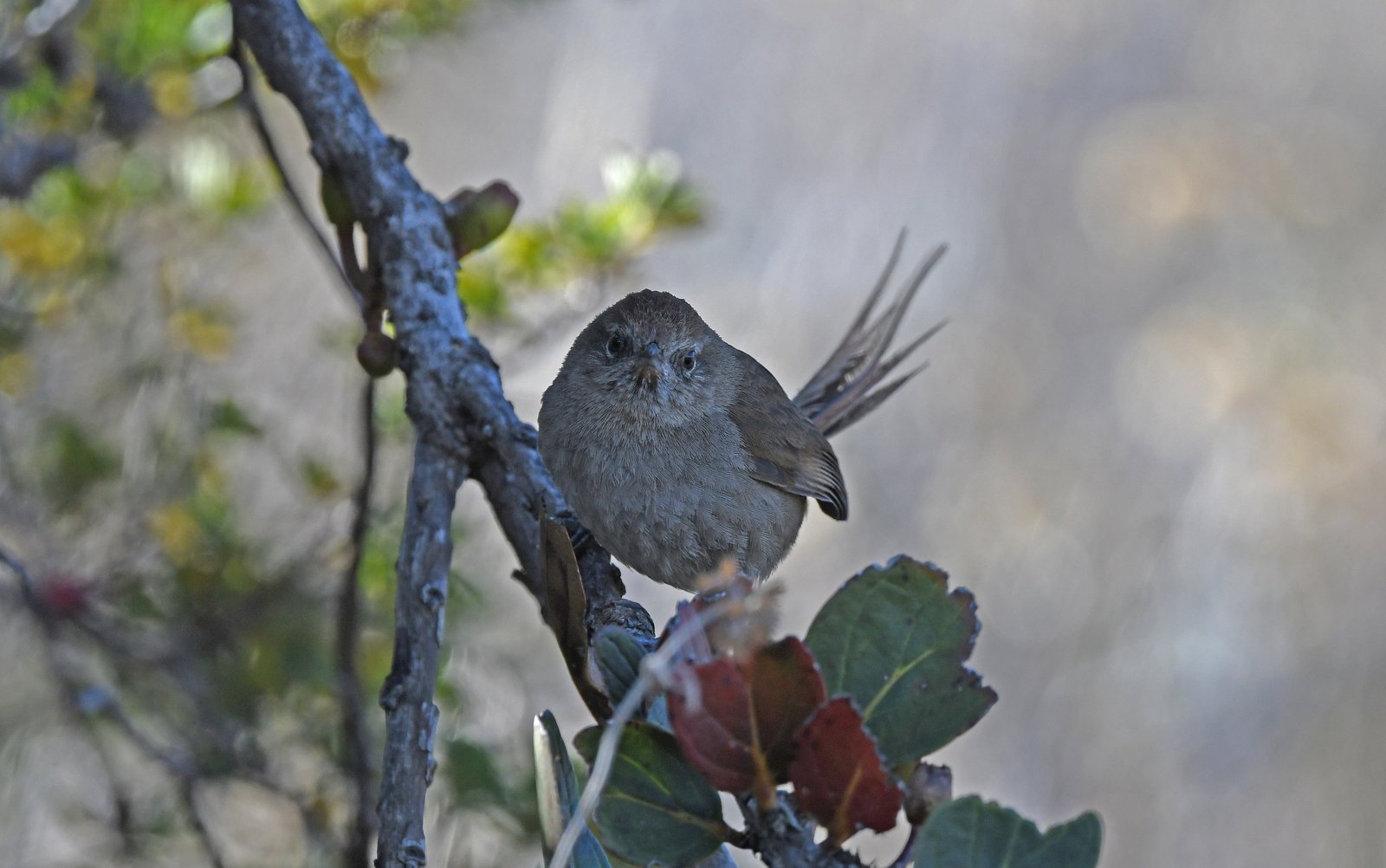
The Perija Thistletail is a greyish-brown thistletail with a long, ragged tail, endemic to the Serranía del Perijá on the border of Colombia and Venezuela. It lives in páramo and at the treeline, high above the montane forest. The species is endangered and has one of the smallest ranges of all thistletails.
Voice
The song consists of a few high, drawn-out notes followed by a short, descending, dry trill.
Recording: Julio Delgado — CC BY-NC-SA 4.0 · xeno-canto
Identification
19–22 cm, with a short, pointed bill and a long, deeply forked tail whose tips look ragged because of the loose barbs. Crown, back, rump and tail are greyish olive-brown, with a faint grey supercilium. The wings show chestnut on the coverts and the bases of the flight feathers. A cinnamon-buff chin patch; throat and underparts are brownish grey. The sexes are alike.
Confusion species
White-chinned Thistletail Asthenes fuliginosa, in the Eastern Andes, has a white chin and a more rufous back, but does not occur in the Perijá. Rufous Spinetail Synallaxis unirufa is uniformly rufous with a shorter tail. White-browed Spinetail Hellmayrea gularis is smaller, with a short tail, a white supercilium and a white throat.
Habitat
Páramo, the upper edge of cloud forest and dense undergrowth at the treeline, between about 2950 and 3400 m. It searches for insects in dense shrubs and grass tussocks. Little is known about the nest.
Where the bird is most at home, classified by the vegetation units of the Andes and the west coast.


Range and movements
Colombia: only in the Serranía del Perijá, in Cesar and La Guajira. Absent from Ecuador, Peru, Bolivia and the Galápagos. Outside the guide area on the Venezuelan side of the same range.
- Resident
- dark = core range, pale = thinly spread
How and when to look
The Colombian part of the Perijá can be reached via the Chamicero del Perijá reserve above Manaure (Cesar); search páramo scrub above the treeline and listen for the high notes with the falling trill.
Conservation status
Endangered. The world population is estimated at a few hundred adult birds and is declining. Lower in the range forest is disappearing through clearance, cattle ranching, illegal crops and mining; on the Venezuelan side protection is limited.
Scientific name
Asthenes perijana | (Phelps, 1977)
Phelps described the species in 1977 as Schizoeaca perijana; because it was later moved to another genus, the author and year stand in brackets. The genus Asthenes was introduced in 1853 by Reichenbach. The genus name comes from Ancient Greek asthenēs, 'insignificant', 'weak'. The species name refers to the Sierra de Perijá on the border of Colombia and Venezuela. The specimen the first description was based on came from Sierra de Perijá, Zulia, Venezuela.