All species › Passerines › Ovenbirds and woodcreepers › Eye-ringed Thistletail
Eye-ringed Thistletail | Asthenes palpebralis
Brildistelstaart | Colicardo de anteojos | Cauda-de-cardo-de-óculos
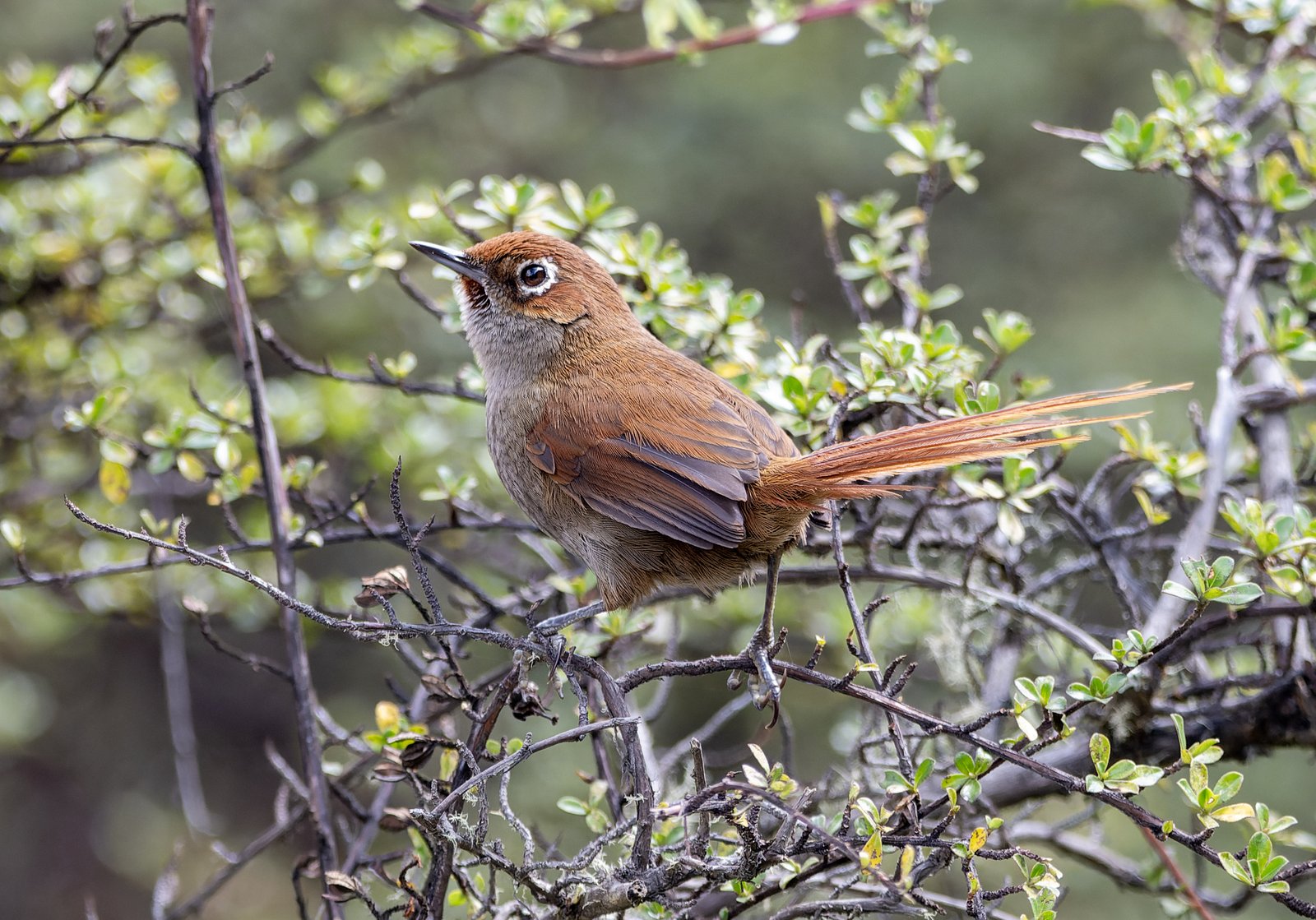
The Eye-ringed Thistletail is a rufous-brown thistletail with a conspicuous white eye-ring, endemic to the Andes of Junín in central Peru. It lives in the narrow transition zone between the upper cloud forest and the elfin forest at the treeline. Among the thistletails it is the only one with such a broad white eye-ring.
Voice
The song is a long, dry chatter or trill that rises and falls sharply towards the end. The call is a sharp, rising peee or weee.
Recording: Ross Gallardy — CC BY-NC-SA 4.0 · xeno-canto
Identification
18–19 cm, with a short, pointed bill and a long, deeply forked, ragged tail. A broad white eye-ring, dark brown lores and a chestnut-brown face. Back, rump and wings are dark chestnut-brown, the tail more rufous. A rusty to orange-rufous chin patch; throat and underparts are grey, the belly paler. The sexes are alike. Juveniles lack the chin patch and have a paler belly and browner flanks.
Confusion species
Vilcabamba Thistletail Asthenes vilcabambae, further south-east, lacks the broad white eye-ring and has a broad pale supercilium. White-chinned Thistletail Asthenes fuliginosa, north of Junín, has a white chin and a narrower eye-ring. Rufous Spinetail Synallaxis unirufa is uniformly rufous, without grey underparts and chin patch.
Habitat
The transition from the upper cloud forest to the elfin forest at the treeline, often with a dense understorey of Chusquea bamboo, roughly between 3000 and 3600 m. It searches for insects low in dense vegetation. Little is known about the nest.
Where the bird is most at home, classified by the vegetation units of the Andes and the west coast.


Range and movements
Endemic to Peru: only in the Andes of Junín, on the eastern slope. Absent from Colombia, Ecuador, Bolivia and the Galápagos.
- Resident
- dark = core range, pale = thinly spread
How and when to look
Search the treeline on the eastern slope of Junín, for example along the roads that descend from the highlands towards Satipo and Comas; listen for the falling trill from the bamboo.
Conservation status
Least Concern. The range is small; fires and grazing at the treeline locally degrade the habitat.
Scientific name
Asthenes palpebralis | (Cabanis, 1873) (GBIF: Schizoeaca palpebralis)
Cabanis described the species in 1873 as Schizoeaca palpebralis; because it was later moved to another genus, the author and year stand in brackets. The genus Asthenes was introduced in 1853 by Reichenbach. The genus name comes from Ancient Greek asthenēs, 'insignificant', 'weak'. The species name comes from Latin palpebra, 'eyelid', for the pale eye-ring. The specimen the first description was based on came from Maraynioc, Junín, Peru.