All species › Passerines › Ovenbirds and woodcreepers › Peruvian Recurvebill
Peruvian Recurvebill | Syndactyla ucayalae
Ucayalikrombekbladspeurder | Ticotico picolezna peruano | Limpa-folha-de-bico-virado
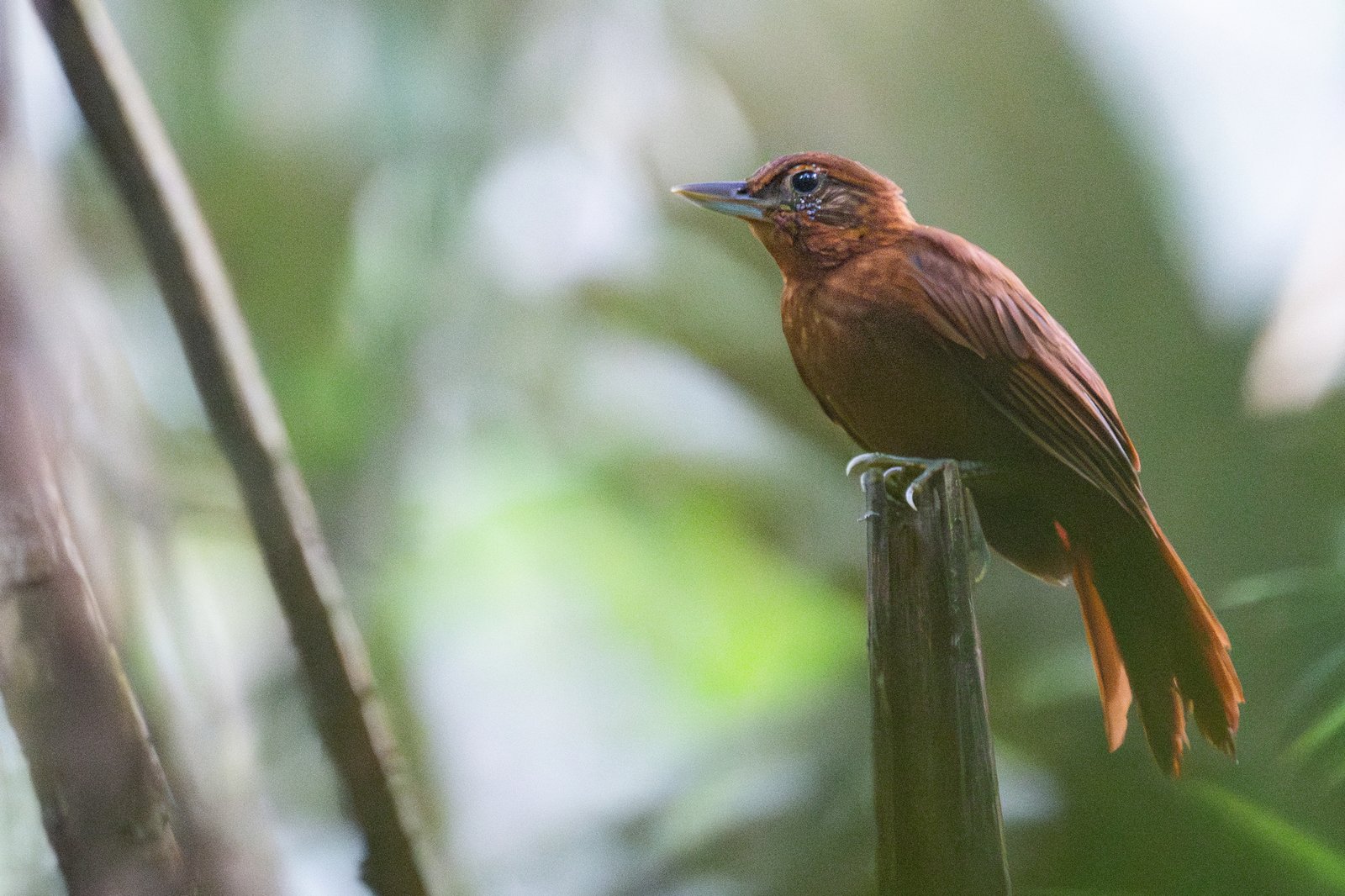
The Peruvian Recurvebill is a bulky, rufous-brown foliage-gleaner of western Amazonia, specialized in dense stands of Guadua bamboo. It uses its heavy, laterally compressed bill with an upturned lower mandible to break open bamboo stems and dead stalks in search of insect larvae. Together with the Bolivian Recurvebill it was formerly placed in a separate genus, Simoxenops.
Voice
The song is a short, loud, harsh, ascending rattle of 2 to 3 seconds, sometimes with a lower final note. The call is a loud, hoarse, low chack. When foraging the cracking of bamboo being broken open is sometimes audible.
Recording: Jacob Wijpkema — CC BY-NC-SA 4.0 · xeno-canto
Identification
19–20 cm, with a heavy, wedge-shaped, laterally compressed bill with a clearly upturned lower mandible. The crown and upperparts are dark rufous-brown, the wings dark rufous-brown and the tail dark reddish chestnut. The throat and breast are orange-rufous with faint pale streaks, and there is a faint rufous supercilium. The sexes are alike. Juveniles have a brighter supercilium, a darker crown with rufous spots and paler underparts with dark scaling.
Confusion species
Bolivian Recurvebill Syndactyla striata lives higher, in the foothills of Bolivia and far south-eastern Peru, and has a lightly streaked crown and back. Bamboo Foliage-Gleaner Anabazenops dorsalis also lives in bamboo, but is slimmer, with a straight bill, a pale throat and a pale supercilium. Chestnut-crowned Foliage-Gleaner Automolus rufipileatus has a straight bill, a rufous crown and an olive-brown back.
Habitat
Evergreen lowland and riverine forest in and near dense Guadua bamboo, locally also in Gynerium cane, up to about 1300 m. It forages low to mid-height in the bamboo, breaking open stems and dead leaf sheaths for insects and their larvae. Little is known of the nest.
Where the bird is most at home, classified by the vegetation units of the Andes and the west coast.


Range and movements
Colombia and Ecuador: absent. Peru: locally in the east and south-east, in the lowlands of Ucayali, Cusco and Madre de Dios among others. Bolivia: in the north, in Pando and northern La Paz. Absent from the Galápagos. Outside the guide area in western Brazil (Acre), with isolated populations farther east in Amazonian Brazil.
- Resident
- dark = core range, pale = thinly spread
How and when to look
Search extensive Guadua bamboo in south-eastern Peru, such as in Madre de Dios. Listen for the harsh, rising rattle and for the cracking of stems in the bamboo.
Conservation status
Least Concern in the current assessment, although the species is also given as Near Threatened. The population is fairly small and highly fragmented and suffers from the loss of bamboo forest; it tolerates selective logging and occurs in several protected areas.
Scientific name
Syndactyla ucayalae | (Chapman, 1928)
Chapman described the species in 1928 as Anachilus ucayalae; because it was later moved to another genus, the author and year stand in brackets. The genus Syndactyla was introduced in 1853 by Reichenbach. The genus name comes from Greek sun 'together' and daktulos 'finger' or 'toe', after the partly fused front toes. The species name refers to the Ucayali River in Peru. The specimen the first description was based on came from Lagarto, Río Ucayali, Peru.