All species › Passerines › Ovenbirds and woodcreepers › Rufous-necked Foliage-Gleaner
Rufous-necked Foliage-Gleaner | Syndactyla ruficollis
Roodnekbladspeurder | Ticotico cuellirrufo | Trepador-de-pescoço-ruivo
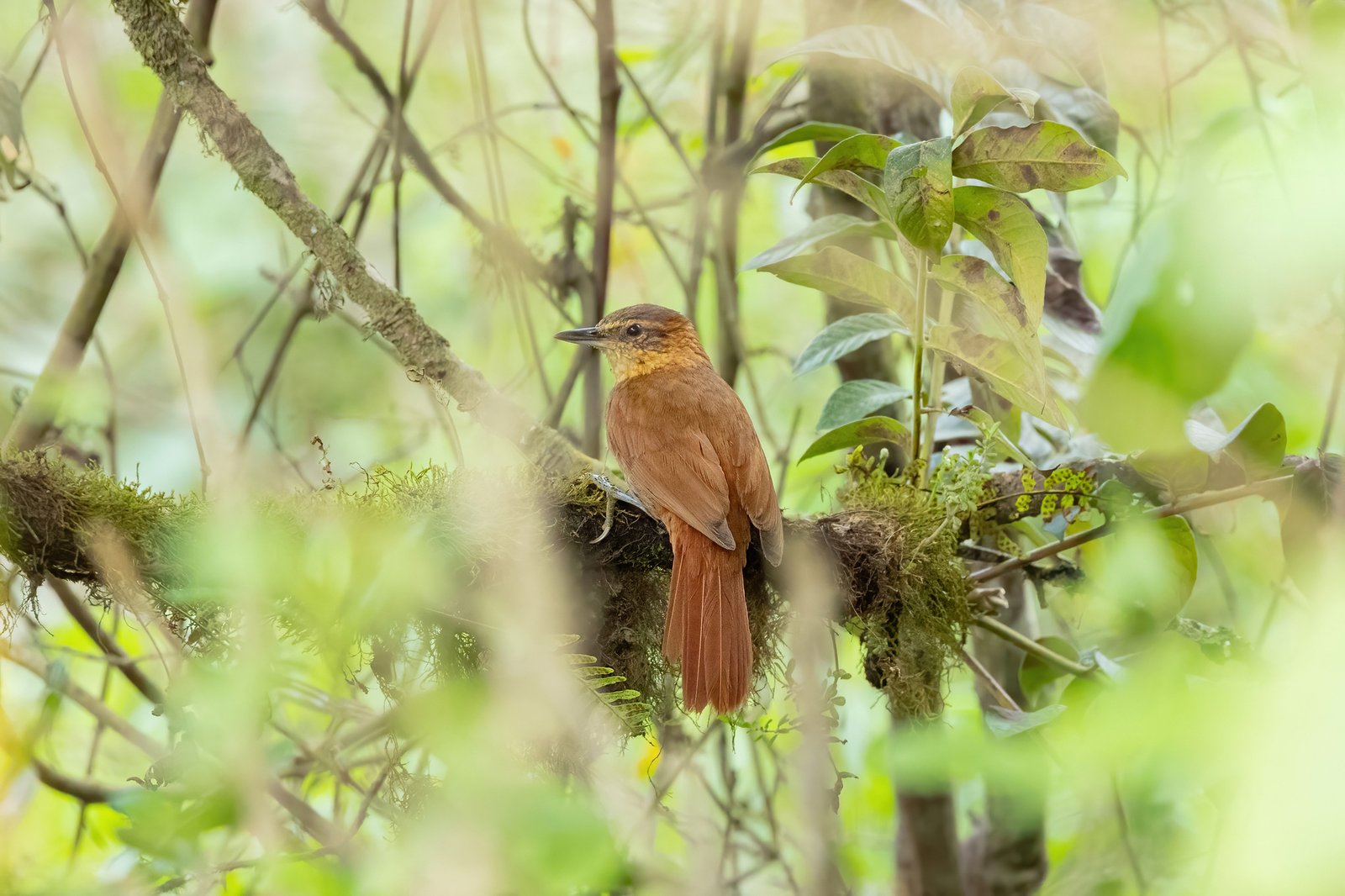
The Rufous-necked Foliage-Gleaner occurs only in the Tumbesian region of south-western Ecuador and north-western Peru, and so lives entirely within the guide area. An orange-rufous supercilium that continues into rufous neck sides sets it apart from other foliage-gleaners. Its population is small and fragmented by the clearing of the region's forests.
Voice
The song is a harsh, nasal series, chick, chick, che-che, tirrrrr, lasting 2 to 3 seconds, with a downslurred final note. The contact call is a sharp, nasal ank or chech.
Recording: Ross Gallardy — CC BY-NC-SA 4.0 · xeno-canto
Identification
18–19 cm, with a fairly stout bill with a slightly upturned lower mandible. An orange-rufous supercilium continues into rufous neck sides; the crown is brown. The back and wings are warm rusty brown, and the uppertail coverts and tail bright chestnut. The throat is pale ochre and the breast olive-brown with pale streaks. The sexes are alike. Juveniles are duller, with a darker crown.
Confusion species
Henna-hooded Foliage-Gleaner Clibanornis erythrocephalus, which lives in the same region, has an entirely rufous head and a greyer body, and keeps more to the ground or just above it. Lineated Foliage-Gleaner Syndactyla subalaris lives on the western slope south to El Oro and is darker, with pale streaks on the back and no rufous neck.
Habitat
Evergreen montane forest and deciduous woodland, especially with bamboo, along streams and in shady ravines, mostly between 1000 and 2600 m, sometimes from 400 m and up to 2900 m. It forages in the undergrowth and middle stratum, among dead leaves and epiphytes, often in mixed flocks. It is thought to breed in the wet season, from January to May; little is known of the nest.
Where the bird is most at home, classified by the vegetation units of the Andes and the west coast.


Range and movements
Colombia: absent. Ecuador: in El Oro and Loja, in the coastal hills and on the western slope of the Andes. Peru: in the north-west, in Tumbes, Piura and Cajamarca, south to Lambayeque. Absent from Bolivia and the Galápagos. Does not occur outside the guide area.
- Resident
- dark = core range, pale = thinly spread
How and when to look
Search forest remnants with bamboo and shady ravines on the western slope in Loja and in the highlands of Piura. Follow mixed flocks and look for the rufous supercilium and neck.
Conservation status
Least Concern in the current assessment, but long listed as Vulnerable. The population is small, fragmented and probably declining through clearing and grazing of the Tumbesian forests.
Scientific name
Syndactyla ruficollis | (Taczanowski, 1884)
Taczanowski described the species in 1884 as Anabazenops ruficollis; because it was later moved to another genus, the author and year stand in brackets. The genus Syndactyla was introduced in 1853 by Reichenbach. The genus name comes from Greek sun 'together' and daktulos 'finger' or 'toe', after the partly fused front toes. The species name comes from Latin rufus 'rufous' and collis 'neck', after the rufous neck. The specimen the first description was based on came from Paucal (Nancho), Peru.