All species › Passerines › Ovenbirds and woodcreepers › Buff-browed Foliage-Gleaner
Buff-browed Foliage-Gleaner | Syndactyla rufosuperciliata
Geelbrauwbladspeurder | Ticotico cejudo | Trepador-quiete
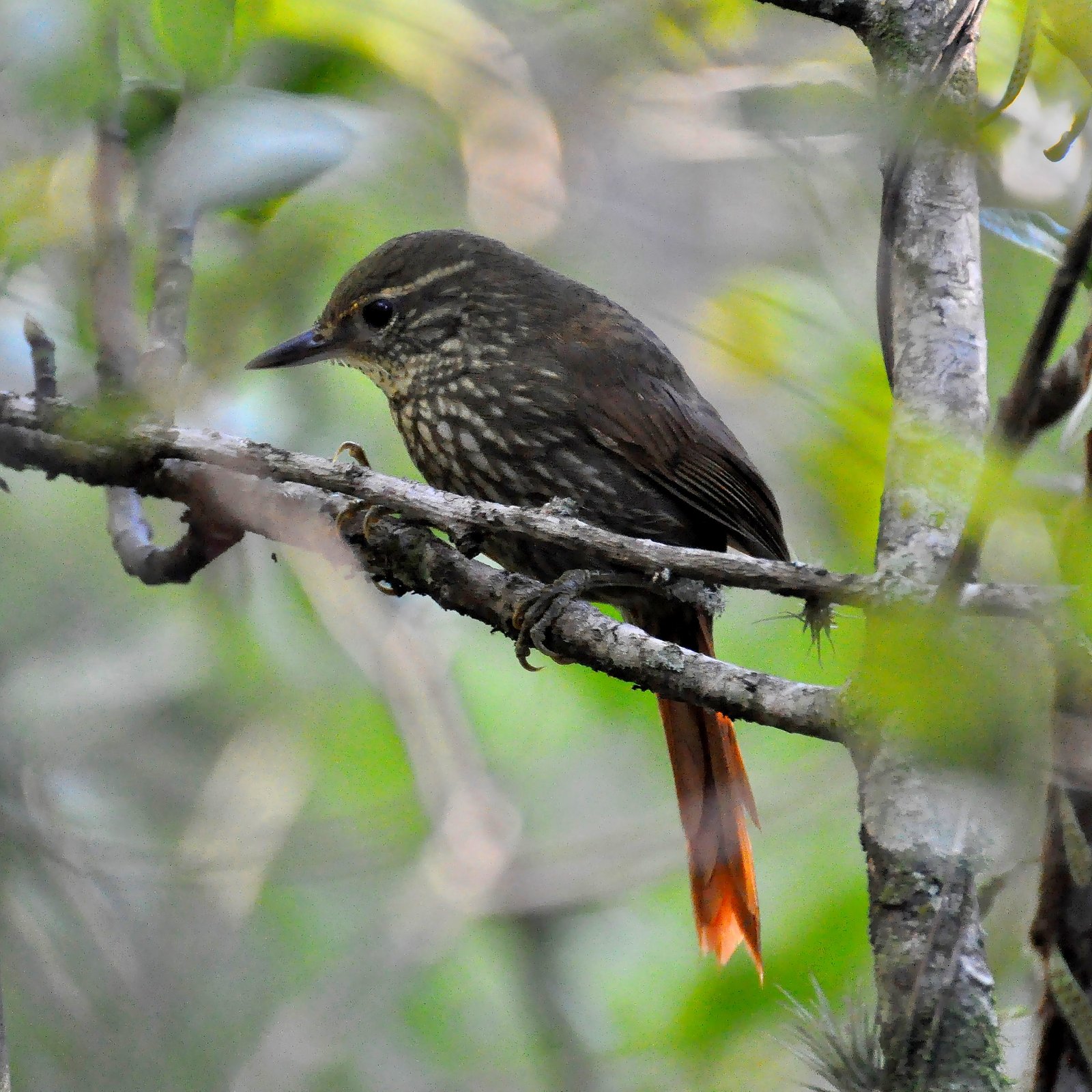
The Buff-browed Foliage-Gleaner is a foliage-gleaner with an ochre-buff eyering and supercilium and a scaled breast, with two widely separated ranges: the eastern slope of the Andes from southern Ecuador to Argentina, and south-eastern South America. In the guide area it lives in the undergrowth of montane forest, often among Chusquea bamboo. Its song varies little across this whole range.
Voice
The song is a loud, fast series that starts softly, rises and grows louder, then quavers or descends. The contact call is a short kssr, the alarm call set or set-et.
Recording: Ricardo José Mitidieri — CC BY-NC-SA 4.0 · xeno-canto
Identification
17–18 cm, with a straight bill with a paler lower mandible. An ochre-buff eyering and a paler supercilium mark the head. The upperparts are olive-brown and the tail dull rufous. The throat is pale; the breast is buffy with olive scaly edges, and the belly has broad, blurry streaks. Andean birds are warmer and more ochraceous than those of the south-east. The sexes are alike. Juveniles have spotted rather than streaked underparts.
Confusion species
Lineated Foliage-Gleaner Syndactyla subalaris, which shares the same area in Peru, is darker, with pale streaks on the back and crown. Montane Foliage-Gleaner Anabacerthia striaticollis is smaller, with a shorter bill, whitish spectacles and throat, and forages higher. Bolivian Recurvebill Syndactyla striata is bulkier, with a heavy, upturned bill and an orange-rufous throat.
Habitat
Evergreen montane forest and mature secondary forest, often with Chusquea bamboo, in the Andes roughly between 1300 and 2500 m, in Bolivia locally from 1000 m. It forages in the undergrowth and middle stratum, often in mixed flocks, among dead leaves and moss for insects. Nests have been found in holes in rotting branches and old woodpecker holes; the nest is a cup of twigs.
Where the bird is most at home, classified by the vegetation units of the Andes and the west coast.


Range and movements
Colombia: absent. Ecuador: only in the far south-east, in the Cordillera del Cóndor. Peru: along the eastern slope, scarce in the north and more numerous to the south. Bolivia: on the eastern slope of the Andes south to the border with Argentina. Absent from the Galápagos. Outside the guide area in north-western Argentina, and separately in southern Brazil, Paraguay, Uruguay and north-eastern Argentina.
- Resident
- dark = core range, pale = thinly spread
How and when to look
Search undergrowth with bamboo in the Yungas montane forest of Peru and Bolivia. Follow mixed flocks in the lower strata and look for the ochre-buff eyering and the scaled breast.
Conservation status
Least Concern. The species is widespread and tolerates mature secondary forest, but declines locally through deforestation.
Scientific name
Syndactyla rufosuperciliata | (de Lafresnaye, 1832)
De Lafresnaye described the species in 1832 as Xenops rufosuperciliatus; because it was later moved to another genus, the author and year stand in brackets. The genus Syndactyla was introduced in 1853 by Reichenbach. The genus name comes from Greek sun 'together' and daktulos 'finger' or 'toe', after the partly fused front toes. The species name comes from Latin rufus 'rufous' and supercilium 'eyebrow', after the pale eyebrow stripe. The specimen the first description was based on came from Rio de Janeiro, Brazil.