All species › Passerines › Ovenbirds and woodcreepers › Lineated Foliage-Gleaner
Lineated Foliage-Gleaner | Syndactyla subalaris
Gestreepte bladspeurder | Limpiafronda lineada | Trepador-lineado
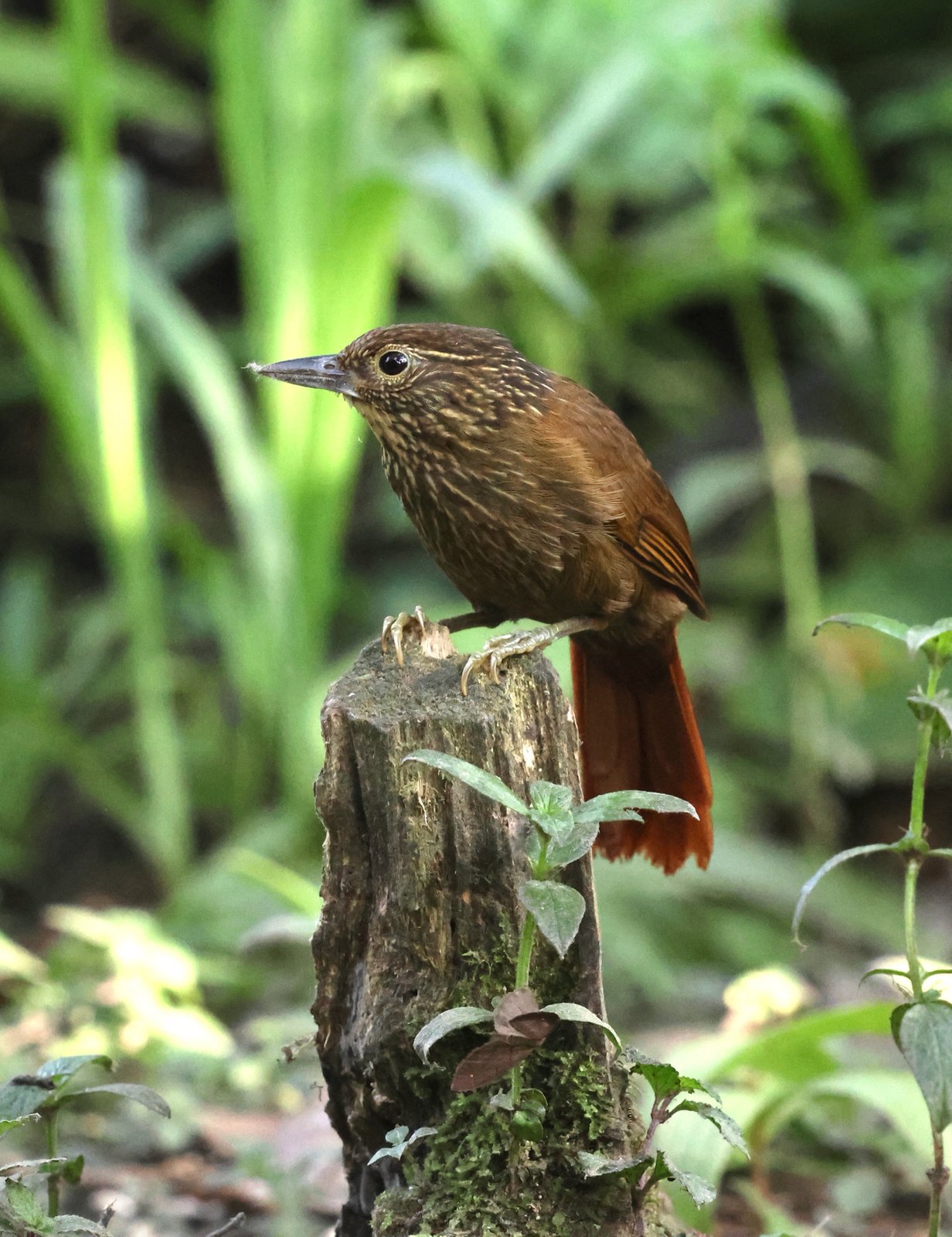
The Lineated Foliage-Gleaner is a dark brown foliage-gleaner of the undergrowth and middle stratum of montane forest, with fine pale streaks on the crown, back and breast. It often lives in pairs in mixed flocks and searches dense vegetation along streams and in vine tangles. Its range extends from Costa Rica along the northern Andes to central Peru.
Voice
The song is a fast, accelerating series of 6 to 10 dry, harsh, scratchy, nasal notes that may rise and fall and ends abruptly. The call is dry and harsh.
Recording: Juan Freile — CC BY-NC-SA 4.0 · xeno-canto
Identification
17–19 cm, with a straight, fairly stout bill with a paler lower mandible. The crown is dark brown with thin pale streaks, the supercilium narrow and pale buff, and the face blackish brown with small pale spots. The back is dark rufous-brown with long, thin pale streaks; the wings are dark brown and the tail dark chestnut. The throat is ochre-buff with faint brown streaks, the breast dark brown with pale streaks, and the belly and flanks paler brown. The sexes are alike. Juveniles are brighter, with a more cinnamon crown, supercilium and breast.
Confusion species
Flammulated Treehunter Thripadectes flammulatus is larger, with a heavier bill and a boldly black-and-buff flammulated head and breast. Streak-capped Treehunter Thripadectes virgaticeps is larger, with a stout bill and a streaked head but a plainer back. Montane Foliage-Gleaner Anabacerthia striaticollis is smaller, with whitish spectacles and an unstreaked back. Buff-browed Foliage-Gleaner Syndactyla rufosuperciliata has a more prominent ochre-buff supercilium and an olive-brown back without streaks.
Habitat
Humid evergreen montane and foothill forest, especially along streams with dense undergrowth, mostly between 1000 and 2300 m, locally from 600 m and in Colombia up to 2800 m. It searches dead leaves, moss and epiphytes on branches in the lower and middle strata for insects. The only well-described nest was a cup of soft fibres on a platform of twigs in a tree hole.
Where the bird is most at home, classified by the vegetation units of the Andes and the west coast.


Range and movements
Colombia: in all three Andean ranges, the Serranía de San Lucas and the Serranía del Darién. Ecuador: on both Andean slopes, on the western slope south to El Oro. Peru: on the eastern slope south to Junín. Absent from Bolivia and the Galápagos. Outside the guide area in Costa Rica, Panama and western Venezuela.
- Resident
- dark = core range, pale = thinly spread
How and when to look
Listen in the undergrowth of cloud forest along streams for the scratchy, accelerating song. Follow mixed flocks in the lower strata and look for the streaked back.
Conservation status
Least Concern. The species tolerates forest edges, but depends on forest with dense undergrowth and disappears with deforestation.
Scientific name
Syndactyla subalaris | (Sclater, 1859)
Sclater described the species in 1859 as Anabates subalaris; because it was later moved to another genus, the author and year stand in brackets. The genus Syndactyla was introduced in 1853 by Reichenbach. The genus name comes from Greek sun 'together' and daktulos 'finger' or 'toe', after the partly fused front toes. The species name comes from Latin sub 'under' and ala 'wing, armpit', meaning 'under the wing'. The specimen the first description was based on came from Pallatanga, Ecuador.