All species › Passerines › Ovenbirds and woodcreepers › Plain Softtail
Plain Softtail | Thripophaga fusciceps
Bruinkopstekelkruin | Colasuave sencillo | João-liso
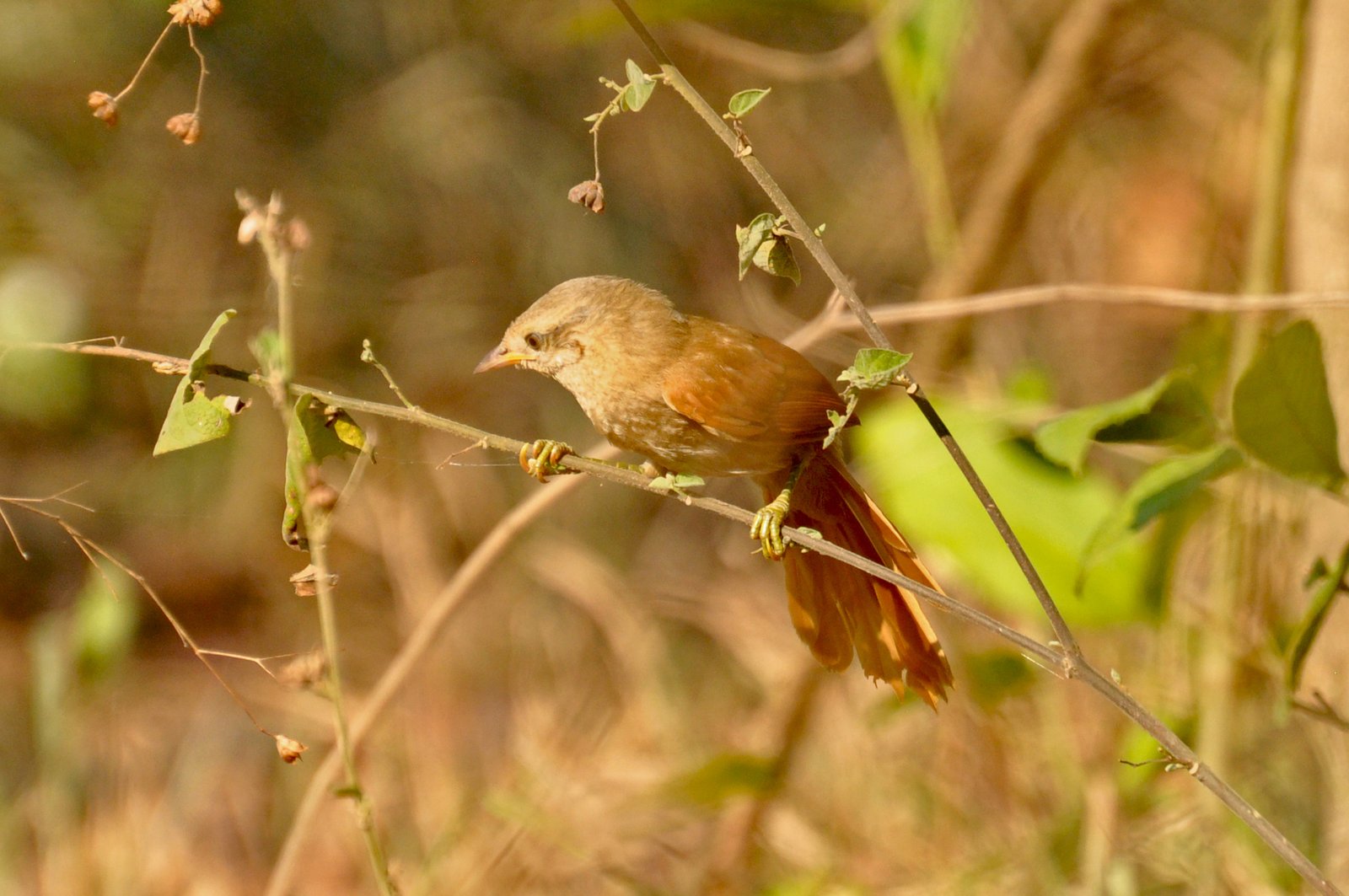
The Plain Softtail is a uniformly coloured softtail of flooded forest and forest edges in the Amazonian lowlands. The species occurs in three widely separated areas, with forms that differ in size, colour and song. Pairs keep to dense vine tangles, often high in the trees.
Voice
Differs between forms. In Bolivia the song starts with spaced, dry ticks, rises to very high notes and ends in sputtering bursts of ticks. In Ecuador and Peru a sharp, loud, descending trill.
Recording: Jacob Wijpkema — CC BY-NC-SA 4.0 · xeno-canto
Identification
16–18 cm, with a straight, pointed bill and a long, graduated tail. In the Bolivian form the head and mantle are pale greyish brown, with a faint pale supercilium and a thin dark eyeline; the wings and tail are rufous, the underparts pale brownish. The form in Ecuador and Peru is smaller and darker, with a reddish-brown back and little or no supercilium. The sexes are alike.
Confusion species
Rusty-backed Spinetail Cranioleuca vulpina and Parker's Spinetail Cranioleuca vulpecula are smaller, with a whitish throat and paler underparts, and live in scrub close to water. Speckled Spinetail Thripophaga gutturata is smaller, with a speckled throat and breast. Plain-crowned Spinetail Synallaxis gujanensis has a shorter tail and a greyish breast and forages low in thickets.
Habitat
Lowland evergreen and riverine forest, especially várzea and its transition to higher ground, locally also drier deciduous forest; it favours forest edges and dense vine tangles, between about 50 and 500 m. Pairs search for insects among vines and leaves in the mid-levels and canopy. The nest is a globe of twigs and soft plant material, with two entrance tubes on the underside, placed in a branch fork high in a tree.
Where the bird is most at home, classified by the vegetation units of the Andes and the west coast.


Range and movements
Colombia: absent. Ecuador: locally in the eastern lowlands. Peru: locally in the north-east and south-east. Bolivia: in the north, in the lowlands of Beni, La Paz and Cochabamba. Absent from the Galápagos. Outside the guide area in central Brazil, along the lower Madeira and the Amazon.
- Resident
- dark = core range, pale = thinly spread
How and when to look
Check riverbanks and forest edges in the lowlands of Beni or in eastern Ecuador for pairs in dense vine tangles. Learn the song of the local form; the birds often sit high and hidden.
Conservation status
Least Concern. The range is fragmented and the species is locally scarce; clearing of riverine forest is a local threat.
Scientific name
Thripophaga fusciceps | Sclater, 1889
Sclater described the species in 1889 and placed it straight away in the genus where it still stands. The genus Thripophaga was introduced in 1847 by Cabanis. The genus name comes from Greek thrips 'woodworm' and -phagos 'eating', meaning 'woodworm-eater'. The species name comes from Latin fuscus 'dusky' and -ceps 'headed', after the brown head. The specimen the first description was based on came from Mouth of the Río Chapare, Cochabamba, Bolivia.