All species › Passerines › Ovenbirds and woodcreepers › Orinoco Softtail
Orinoco Softtail | Thripophaga cherriei
Orinococanastero | Colasuave del Orinoco | Rabo-macio-do-orinoco
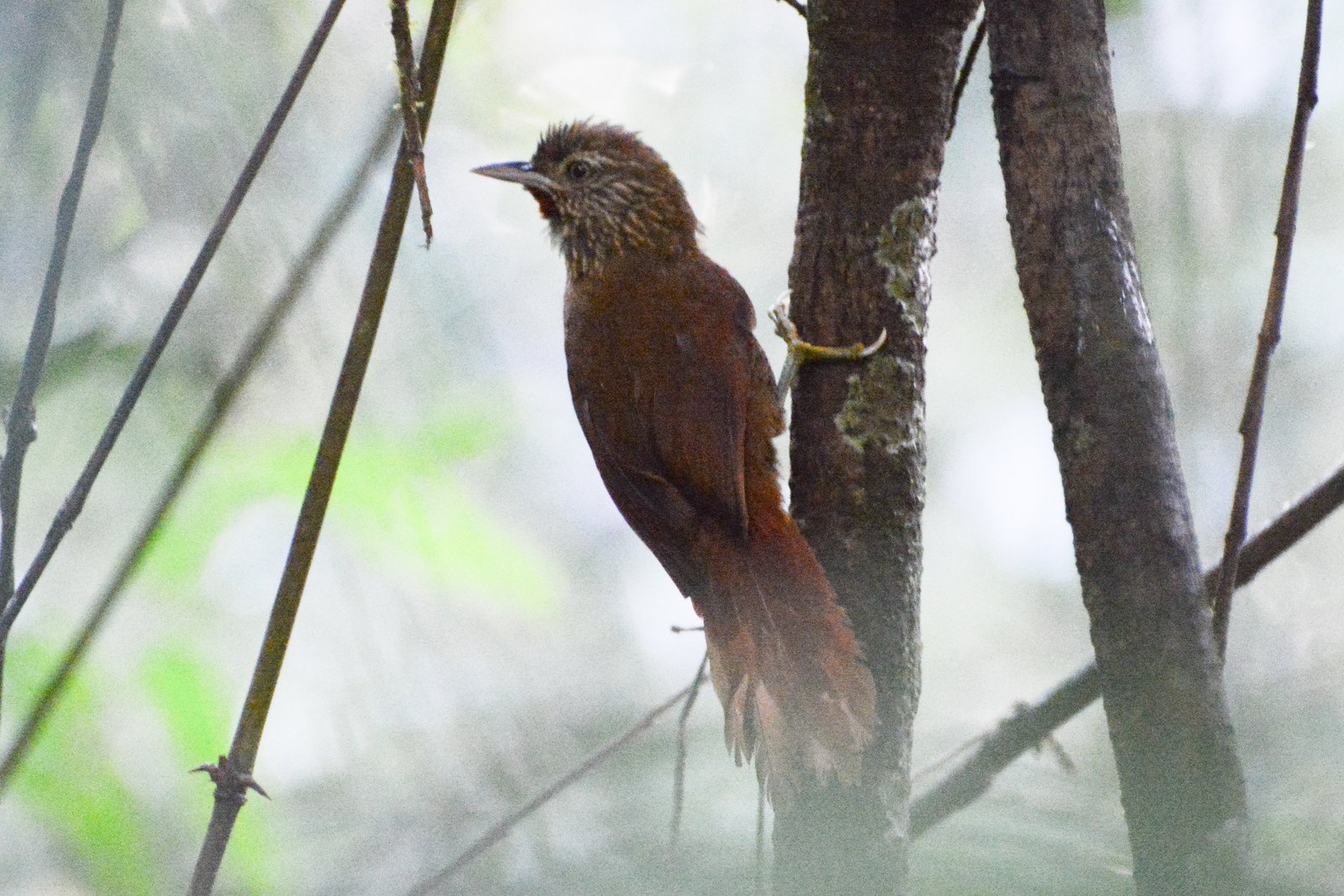
The Orinoco Softtail is a rufous ovenbird of dense riverside thickets along the upper Orinoco. It belongs to the softtails, small ovenbirds with a long tail of soft, rounded feathers. For a long time it was thought to occur only in Venezuela; since 2012 it has also been confirmed on the Colombian bank.
Voice
The song starts with two to four nasal notes, followed by a rattled series of short notes; often given as a duet, mainly early in the morning. Calls are a grating, scolding chrr and a nasal chi-tew.
Recording: Fabrice Schmitt — CC BY-NC-SA 4.0 · xeno-canto
Identification
16–17 cm, with a straight, pointed bill and a fairly long, graduated tail. The face is brown with fine buff streaks, with a faint pale supercilium. The upperparts are rufescent brown, the wings and tail rufous to chestnut. The chin is tawny orange, the rest of the underparts brownish, paler on the belly. The sexes are alike.
Confusion species
Rio Orinoco Spinetail Synallaxis beverlyae lives in the same riverside scrub, but has a rufous crown and paler, greyish underparts and lacks the tawny-orange chin. Yellow-chinned Spinetail Certhiaxis cinnamomeus is rufous above and white below, with a small yellow chin spot, and lives in marsh vegetation and along open banks.
Habitat
Dense undergrowth along watercourses in flooded forest (várzea) and riverine forest, where vines and bamboo are common, between about 100 and 150 m. It forages in pairs among vines and dense foliage for insects and other invertebrates. Little is known about the nest.
Where the bird is most at home, classified by the vegetation units of the Andes and the west coast.


Range and movements
Colombia: in the east, along the Orinoco in Vichada and Guainía, on the border with Venezuela; the exact range is still unknown. Absent from Ecuador, Peru, Bolivia and the Galápagos. Outside the guide area in southern Venezuela, along the upper Orinoco and its tributaries in Amazonas state.
- Resident
- dark = core range, pale = thinly spread
How and when to look
Search the dense riverside scrub along the Orinoco on the Colombian side, early in the morning, when pairs sing in duet. The birds usually stay hidden in vines just above the water; the voice is often the first sign.
Conservation status
Vulnerable. The population is estimated at 250 to 1000 mature birds and is declining. The main threat is clearing of riverine forest for shifting cultivation; no protected area lies within the known range.
Scientific name
Thripophaga cherriei | Berlepsch & Hartert, 1902
Berlepsch & Hartert described the species in 1902 and placed it straight away in the genus where it still stands. The genus Thripophaga was introduced in 1847 by Cabanis. The genus name comes from Greek thrips 'woodworm' and -phagos 'eating', meaning 'woodworm-eater'. The species name honours the American naturalist and collector George Kruck Cherrie (1865–1948), who collected the first specimens on the Orinoco in 1899. The specimen the first description was based on came from Capuana, Orinoco, Venezuela.