All species › Passerines › Ovenbirds and woodcreepers › Speckled Spinetail
Speckled Spinetail | Thripophaga gutturata
Gespikkelde stekelstaart | Colaespina jaspeada | João-pintado
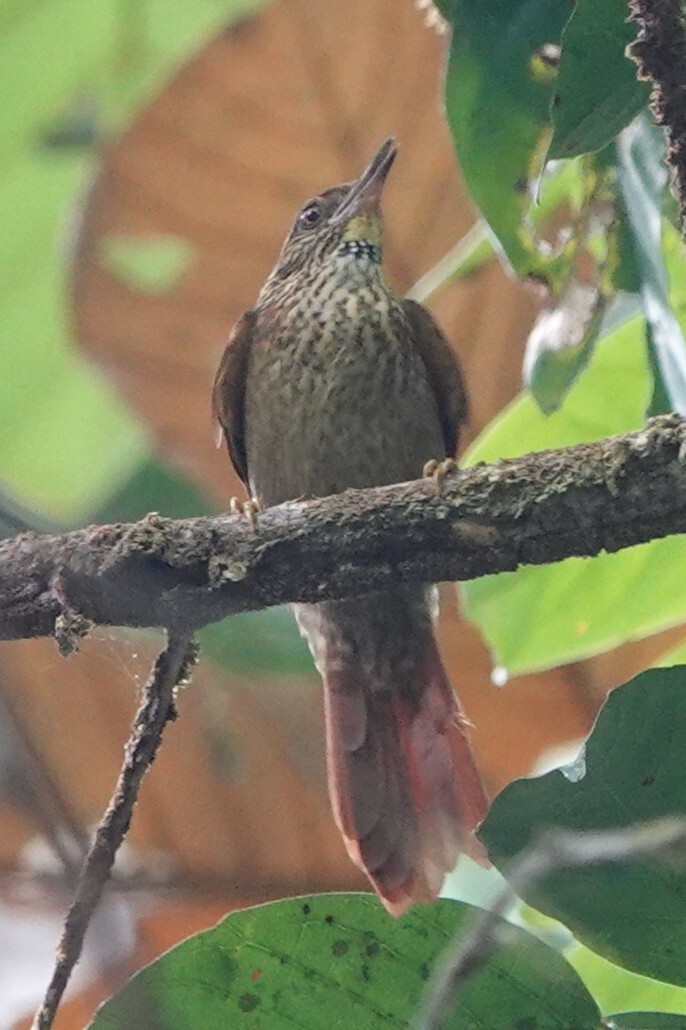
The Speckled Spinetail is a small ovenbird of the Amazon basin, with finely dark-speckled, buff underparts. It climbs through vines and along branches in the middle and upper levels of the forest, usually in mixed flocks. The species was long placed in Cranioleuca.
Voice
A high, thin, descending trill, and high, sharp calls.
No recording with a suitable Creative Commons licence is available for this species yet.
Identification
14 cm, with a straight, pointed bill and a graduated tail with spiny tips. The crown is rufous, with a narrow, buff eyebrow. The back is olive-brown, the wings and tail rufous. The throat is pale yellow to buff, the breast and flanks buff with fine, dark speckles. The sexes are alike. Juveniles are less speckled.
Confusion species
Parker's Spinetail Cranioleuca vulpecula has plain whitish underparts without speckles and lives in young scrub on river islands. Rusty-backed Spinetail Cranioleuca vulpina has a rufous back and plain, pale underparts. Plain Softtail Thripophaga fusciceps is larger and plainer brown, without speckles.
Habitat
Várzea, swamp forest and riverside forest, also terra firme forest near water and forest edges, in the lowlands, mostly below 600 m. It forages in mixed flocks, climbing along branches, vines and dead leaves, for insects and other invertebrates. Little is known about the nest.
Where the bird is most at home, classified by the vegetation units of the Andes and the west coast.


Range and movements
Colombia: in the Amazonian lowlands in the south-east. Ecuador: in the eastern lowlands. Peru: in the eastern lowlands throughout. Bolivia: in the north, in Pando, Beni and the lowlands of La Paz. Absent from the Galápagos. Outside the guide area in the Amazon basin of Brazil and in southern Venezuela and the Guianas.
- Resident
- dark = core range, pale = thinly spread
How and when to look
Follow mixed flocks in várzea and riverside forest along the large rivers of eastern Ecuador and Peru; the bird often climbs through dense vines at mid-levels. Listen for the high, descending trill.
Conservation status
Least Concern. The species has a very large range; forest loss in the Amazon basin may reduce numbers in the long term.
Scientific name
Thripophaga gutturata | (d'Orbigny, ACVMD & de Lafresnaye, 1838) (GBIF: Cranioleuca gutturata)
D'Orbigny, ACVMD & de Lafresnaye described the species in 1838 as Anabates gutturatus; because it was later moved to another genus, the author and year stand in brackets. The genus Thripophaga was introduced in 1847 by Cabanis. The genus name comes from Greek thrips 'woodworm' and -phagos 'eating', meaning 'woodworm-eater'. The species name comes from New Latin gutturatus, 'of the throat', from Latin guttur, 'throat', after the marked throat. The specimen the first description was based on came from Yuracarés, Bolivia.