All species › Passerines › Ovenbirds and woodcreepers › Orange-fronted Plushcrown
Orange-fronted Plushcrown | Metopothrix aurantiaca
Oranjekopfluweelkruin | Coronifelpa frentinaranja | João-de-testa-laranja
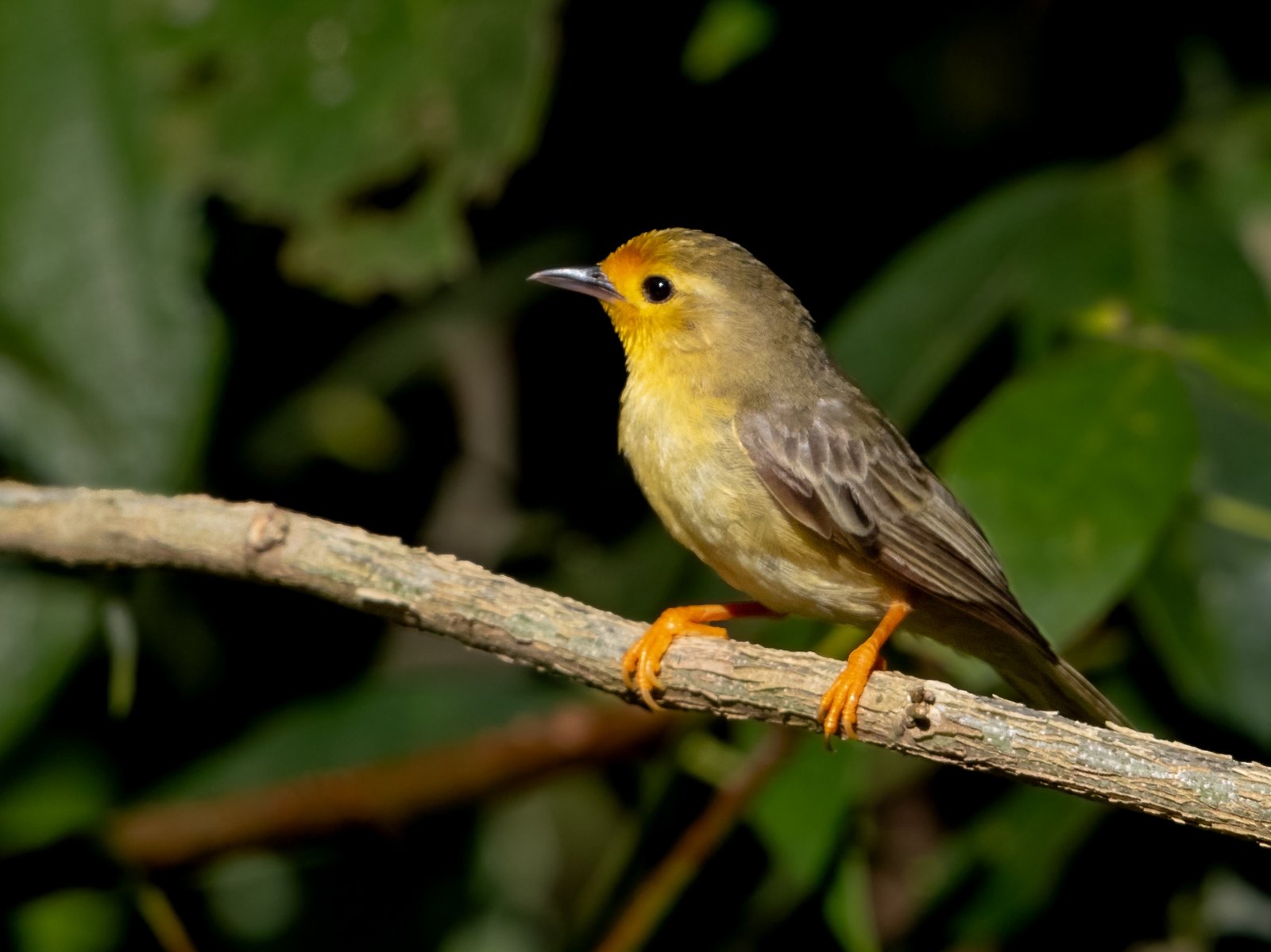
The Orange-fronted Plushcrown is a small, olive-green and yellow ovenbird that recalls a greenlet or warbler more than an ovenbird. The orange forehead has short, velvety feathers, to which the name refers. It lives in the vegetation along rivers and on river islands in the western Amazon basin.
Voice
High, thin, squeaky calls, and a short series of high, fast notes.
Recording: GABRIEL LEITE — CC BY-NC-SA 4.0 · xeno-canto
Identification
11 cm, small, with a short, pointed bill and a fairly short tail. The forehead and forecrown are orange, the face and throat bright yellow. The upperparts are olive-green, the underparts yellowish olive. The legs are conspicuously orange-yellow. The sexes are alike. Juveniles have a yellowish rather than orange forehead.
Confusion species
Ochre-crowned Greenlet Tunchiornis ochraceiceps has an ochre-brown crown, a pale eye and a greyish throat, and lives in the understorey of terra firme forest. Dusky-capped Greenlet Pachysylvia hypoxantha has a brownish cap and a whitish throat, without an orange forehead. Females of warblers and tanagers lack the combination of orange forehead and orange-yellow legs.
Habitat
Riverside forest, scrub and young woodland along rivers, river islands and várzea, also gardens and clearings with Cecropia, in the lowlands, mostly below 700 m. It forages in pairs or small groups, often in mixed flocks, nimbly and often hanging among leaves and vines for insects. Little is known about its breeding biology.
Where the bird is most at home, classified by the vegetation units of the Andes and the west coast.


Range and movements
Colombia: in the south-east, in the Amazonian lowlands. Ecuador: in the eastern lowlands. Peru: in the eastern lowlands almost throughout. Bolivia: in the north, in Pando and Beni. Absent from the Galápagos. Outside the guide area in western Brazil.
- Resident
- dark = core range, pale = thinly spread
How and when to look
Search along riverbanks and on river islands in the Amazonian lowlands of Ecuador and Peru in young woodland with Cecropia; the birds move through the middle and upper levels with mixed flocks.
Conservation status
Least Concern. The species lives in young, constantly renewed vegetation along rivers and is therefore little affected by forest loss.
Scientific name
Metopothrix aurantiaca | Sclater & Salvin, 1866
Sclater & Salvin described the species in 1866 and placed it straight away in the genus where it still stands. He introduced the genus Metopothrix in that same work. The genus name combines Greek metōpon, 'forehead', and thrix, 'hair', after the plush-like forehead feathers. The species name aurantiaca comes from New Latin aurantiacus, 'orange-coloured', after the orange forehead. The specimen the first description was based on came from Sarayacu, Ucayali, Peru.