All species › Passerines › Ovenbirds and woodcreepers › Buff-fronted Foliage-Gleaner
Buff-fronted Foliage-Gleaner | Dendroma rufa
Geelkapbladspeurder | Limpiafronda frentianteada | Limpa-folha-de-testa-baia
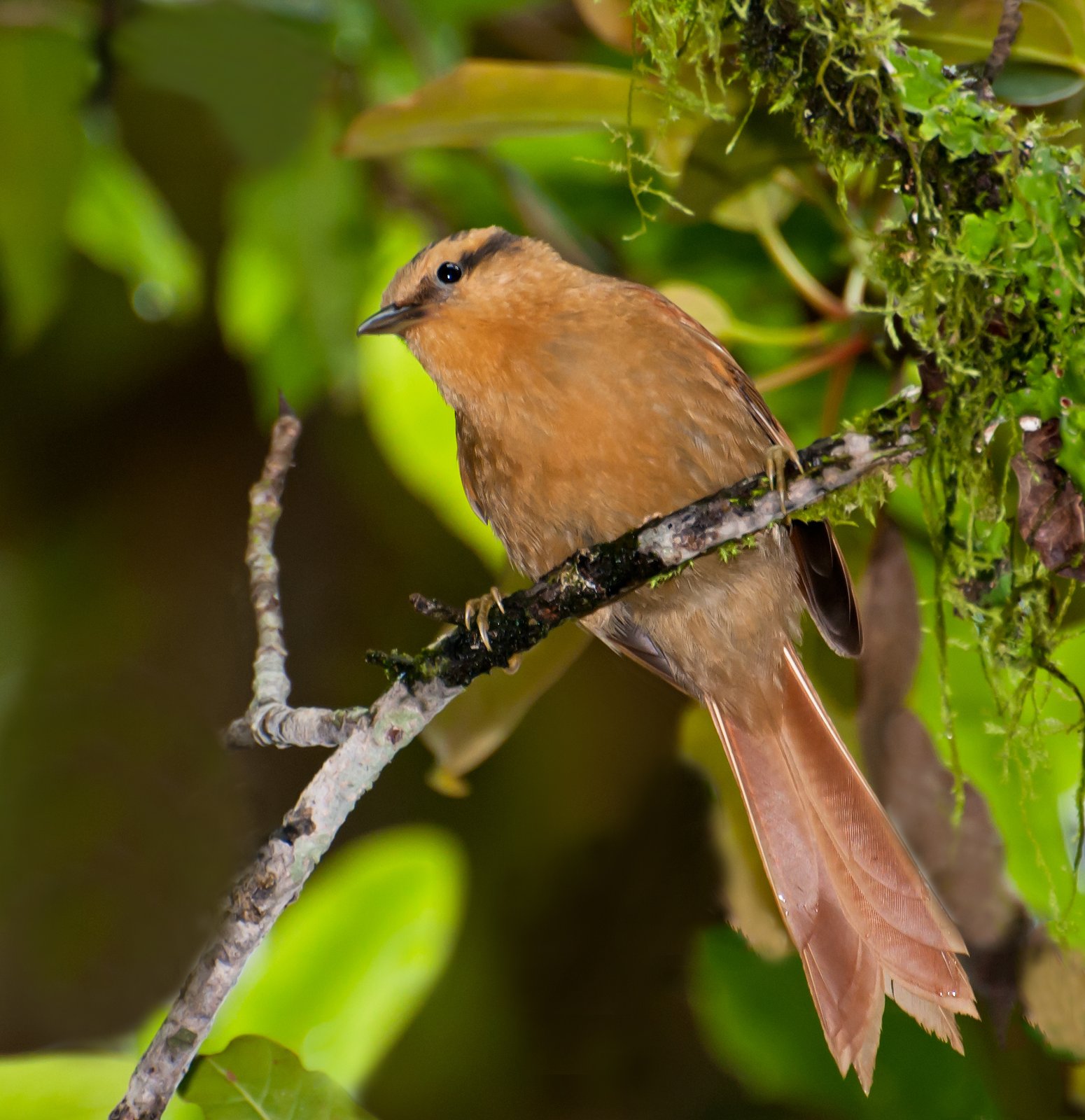
The Buff-fronted Foliage-Gleaner is a warm ochre foliage-gleaner of lower montane forest on both sides of the Andes. With its ochre forehead, supercilium and underparts and its rufous wings, it is one of the most boldly coloured foliage-gleaners of the montane forests. It forages mainly in the canopy and travels with mixed-species flocks.
Voice
The song is a fast, accelerating series of staccato, metallic notes. Calls are a harsh, squeaky shirrr or chur and a sharp, metallic skik or chik.
Recording: Daan van der Hoeven — CC BY-NC-SA 4.0 · xeno-canto
Identification
18–19 cm, with a straight, medium-length bill. The forehead and broad supercilium are bright ochre-yellow, with a dark line behind the eye. The crown is dull brownish grey and the back olive-brown. The wings and tail are mostly bright rufous. The throat and breast are glowing ochre, the belly slightly duller. The sexes are alike; juveniles have a narrower forehead band, a paler crown and darker, more rufous underparts.
Confusion species
Montane Foliage-Gleaner Anabacerthia striaticollis has a whitish eye-ring and throat and streaked neck sides, without ochre underparts. Lineated Foliage-Gleaner Syndactyla subalaris is darker, with pale streaks on the back and breast. Chestnut-winged Foliage-Gleaner Dendroma erythroptera lives in the Amazonian lowlands and has a greyer forehead and paler underparts. Rufous-tailed Foliage-Gleaner Anabacerthia ruficaudata has brown wings.
Habitat
Humid foothill and lower montane forest, also older secondary forest and forest edges, roughly from 600 to 2000 m. It searches the canopy and upper mid-storey for insects and other arthropods, often in leaf litter and epiphytes, sometimes hanging upside down. The nest is in a cavity in an earthen bank, a tree or a wall, with a chamber lined with fine grass.
Where the bird is most at home, classified by the vegetation units of the Andes and the west coast.


Range and movements
Colombia: the three Andean ranges and the Serranía de San Lucas. Ecuador: most of the west and the eastern Andean slope from Napo southwards. Peru: the eastern Andean slope along its whole length. Bolivia: the eastern slope to the centre of the country. Absent from the Galápagos. Outside the guide area in Costa Rica and Panama, Venezuela and south-eastern Brazil, Paraguay and north-eastern Argentina.
- Resident
- dark = core range, pale = thinly spread
How and when to look
Follow mixed-species flocks along forest edges and roads through lower montane forest and look up into the canopy. The ochre-yellow underparts and rufous wings stand out among the other foliage-gleaners.
Conservation status
Least Concern. The species occurs over a large area and tolerates some disturbance of the forest.
Scientific name
Dendroma rufa | (Vieillot, 1818) (GBIF: Philydor rufum)
Vieillot described the species in 1818 as Dendrocopus rufus; because it was later moved to another genus, the author and year stand in brackets. The genus Dendroma was introduced in 1836 by Swainson. The genus name is formed with Ancient Greek dendron, 'tree'; possibly from dendrōma, 'grove, plantation', or shortened with dromos, 'runner'. The species name comes from Latin rufus, 'rufous', for the plumage. The specimen the first description was based on came from Brazil (suggested: Rio de Janeiro).