All species › Passerines › Ovenbirds and woodcreepers › Chestnut-winged Foliage-Gleaner
Chestnut-winged Foliage-Gleaner | Dendroma erythroptera
Roodvleugelbladspeurder | Limpiafronda alicastaña | Limpa-folha-de-asa-castanha
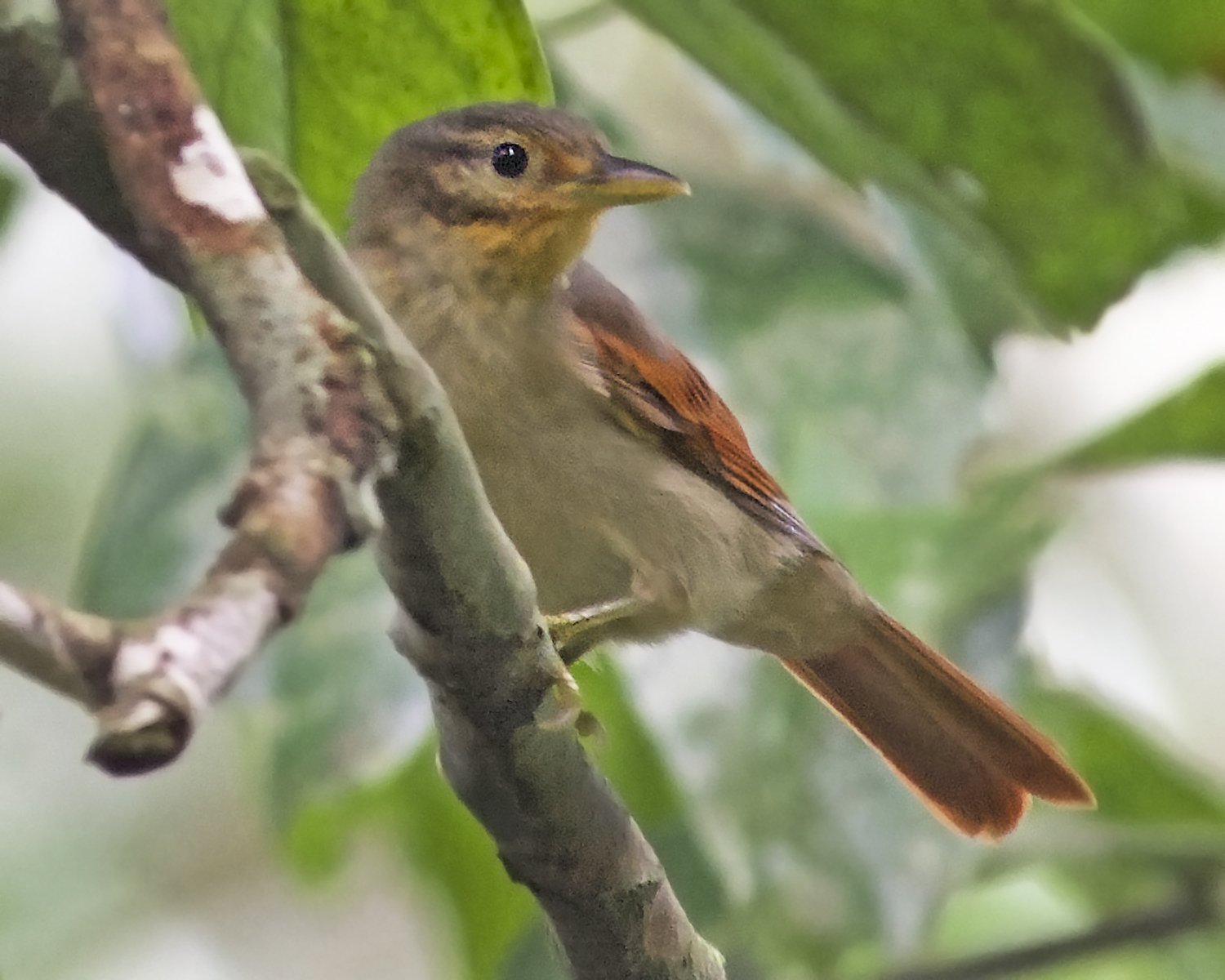
The Chestnut-winged Foliage-Gleaner is a slender foliage-gleaner of the canopy of the Amazonian lowlands, with bright rufous wings and tail that contrast with a greyish-brown back. It is a regular member of mixed-species flocks high in the forest. There it often hangs upside down from branches to search dead leaves and epiphytes.
Voice
The song is a fast, buzzy trill of two to three seconds, slightly accelerating and quavering or slightly descending.
Recording: Felipe Arantes — CC BY-NC-SA 4.0 · xeno-canto
Identification
17–19 cm, with a fairly slender, straight bill. The crown and back are greyish olive-brown. A broad tawny ring surrounds the eye, and a pale supercilium runs backwards. The wing coverts and flight feathers are bright rufous and the tail is dark rufous. The throat is yellowish ochre, the breast and belly pale brownish with faint tawny streaks. The sexes are alike; juveniles are duller and almost unstreaked.
Confusion species
Rufous-rumped Foliage-Gleaner Neophilydor erythrocercum has brown wings and a rufous rump, without the contrast between back and wing. Chestnut-winged Hookbill Ancistrops strigilatus is streaked and has a heavier, hooked bill. Buff-fronted Foliage-Gleaner Dendroma rufa has an ochre forehead and entirely ochre underparts and lives mainly in montane forest. Rufous-tailed Foliage-Gleaner Anabacerthia ruficaudata has brown wings and only a rufous tail.
Habitat
Humid evergreen lowland forest, mainly terra firme and locally várzea, mostly below 500 m and locally up to about 1200 m. It searches dead leaves and epiphytes in the canopy and upper mid-storey for insects and spiders. Almost nothing is known about its breeding biology.
Where the bird is most at home, classified by the vegetation units of the Andes and the west coast.


Range and movements
Colombia: the south-east, in the Amazonian lowlands. Ecuador: the eastern lowlands. Peru: the eastern lowlands along the whole length of the country. Bolivia: the north and north-east. Absent from the Galápagos. Outside the guide area in southern Venezuela and Amazonian Brazil.
- Resident
- dark = core range, pale = thinly spread
How and when to look
Search mixed-species flocks in the canopy of terra firme forest, for example from a canopy tower or a clearing along a river. Look for a foliage-gleaner with bright rufous wings hanging from dead leaves.
Conservation status
Least Concern. The species is tied to tall, closed lowland forest, but this is still extensive in western Amazonia.
Scientific name
Dendroma erythroptera | (Sclater, 1856) (GBIF: Philydor erythropterum)
Sclater described the species in 1856 as Anabates erythropterus; because it was later moved to another genus, the author and year stand in brackets. The genus Dendroma was introduced in 1836 by Swainson. The genus name is formed with Ancient Greek dendron, 'tree'; possibly from dendrōma, 'grove, plantation', or shortened with dromos, 'runner'. The species name comes from Ancient Greek eruthros, 'red', and pteron, 'wing', for the chestnut wings. The specimen the first description was based on came from Bogotá, Colombia.