All species › Passerines › Ovenbirds and woodcreepers › Sharp-tailed Streamcreeper
Sharp-tailed Streamcreeper | Lochmias nematura
Beekstekelstaart | Riachuelero | João-porca
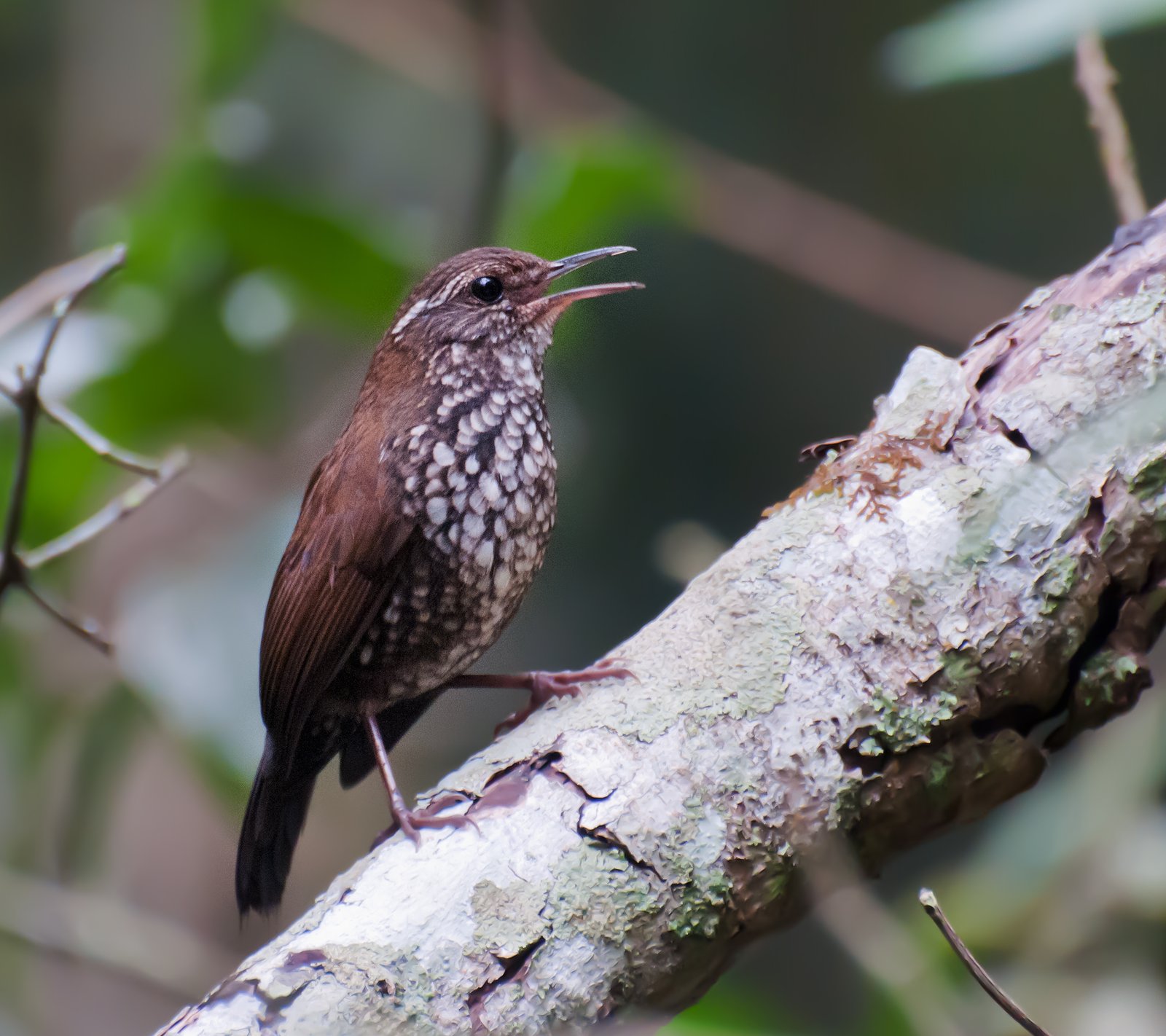
The Sharp-tailed Streamcreeper is a dark, white-spotted ovenbird of forest streams in the Andes. It walks over wet stones, banks and roots along the water and flips over leaves with its bill. The short tail ends in stiff, spiny points.
Voice
The song is a long, dry trill of rapidly repeated notes, first accelerating and then fading. Also gives a sharp chip.
Recording: Christiana Fattorelli — CC BY-NC-SA 4.0 · xeno-canto
Identification
14–15 cm, with a fairly long, slightly decurved, blackish bill. The upperparts are dark rufous-brown, the tail blackish, short and with spiny tips. A narrow white supercilium, not equally obvious in all birds. The throat is scaled white and the dark brown breast and belly are covered in white, drop-shaped spots. The sexes are alike.
Confusion species
Leaftossers, such as Grey-throated Leaftosser Sclerurus albigularis, lack the white spots, have a plain breast and live on the forest floor, not specifically along water. Buff-winged Cinclodes Cinclodes fuscus lives higher in open terrain, has a pale wing band and lacks the white spots.
Habitat
Streams and small rivers in humid montane forest, especially in shady ravines, locally also along watercourses in secondary forest, in the Andes roughly between 900 and 2500 m. It forages on the ground, among wet stones and roots along the water, for insects and larvae. The nest is a globular structure at the end of a tunnel in a steep bank.
Where the bird is most at home, classified by the vegetation units of the Andes and the west coast.


Range and movements
Colombia: locally in the Andes. Ecuador: on the eastern slope of the Andes. Peru: along the eastern slope from north to south. Bolivia: on the eastern slope and in the Yungas, south to Tarija. Absent from the Galápagos. Outside the guide area in eastern Panama, Venezuela and a large area of south-eastern South America: eastern and central Brazil, Paraguay, Uruguay and north-eastern Argentina.
- Resident
- dark = core range, pale = thinly spread
How and when to look
Walk along streams in shady montane forest in the early morning and check banks and wet stones. The bird often stays under overhanging vegetation and gives itself away by its trill.
Conservation status
Least Concern. The species depends on streams with forested banks and disappears where these are cleared or polluted.
Scientific name
Lochmias nematura | (Lichtenstein, 1823)
Lichtenstein described the species in 1823 as Myiothera nematura; because it was later moved to another genus, the author and year stand in brackets. The genus Lochmias was introduced in 1827 by Swainson. The genus name comes from Greek lokhmē, 'thicket, brushwood': 'bird of the thicket'. The species name nematura combines Greek nēma, 'thread', and oura, 'tail', after the spiny tail tips. The specimen the first description was based on came from São Paulo, Brazil.