All species › Passerines › Wrens › Peruvian Wren
Peruvian Wren | Cinnycerthia peruana
Peruaanse winterkoning | Cucarachero peruano | Garrinchão-peruano
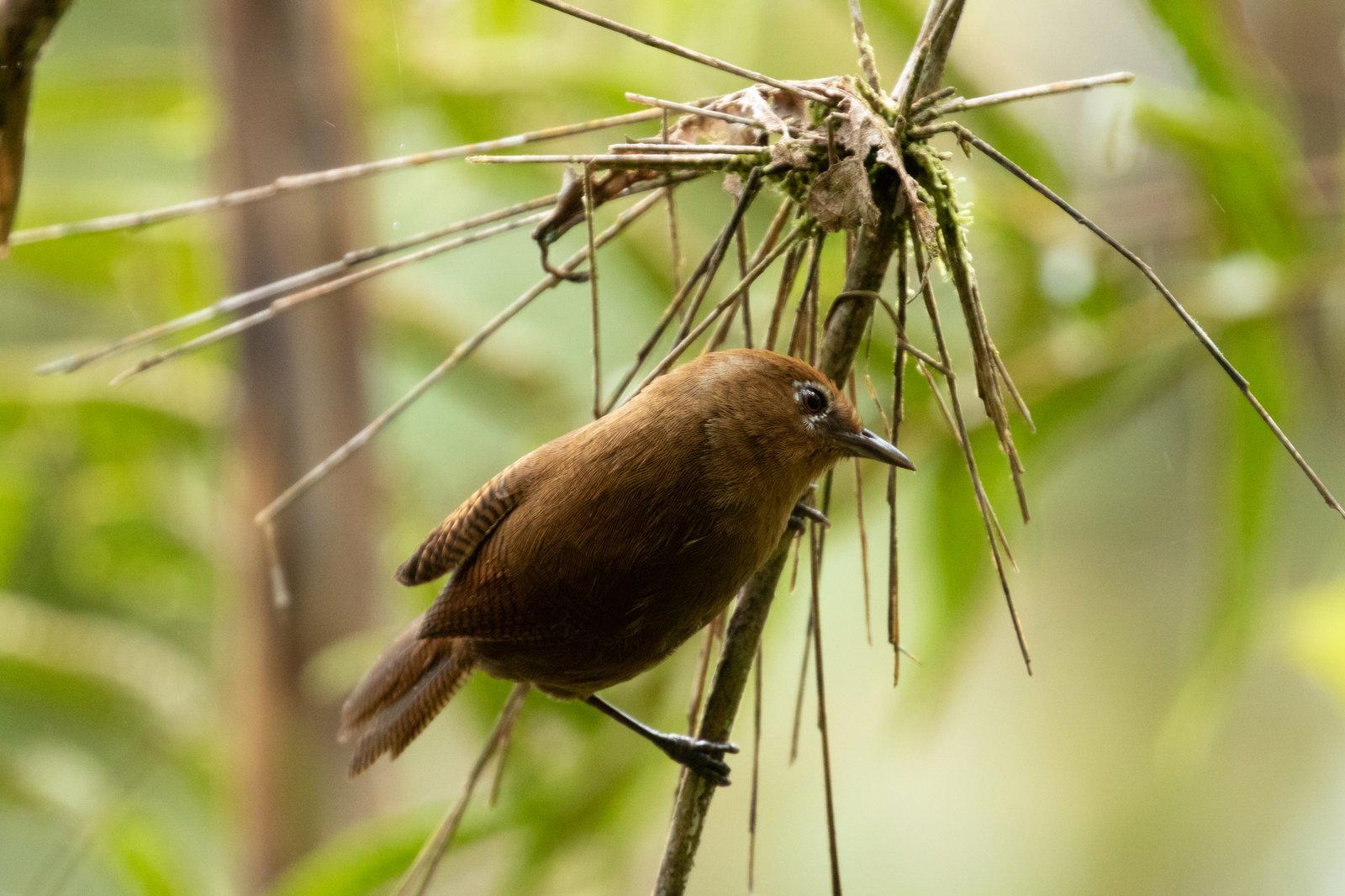
The Peruvian Wren is a brown wren found only in Peru, on the eastern slope of the Andes south of the Marañón. It lives in groups in the undergrowth of cloud forest and sings in fast choruses. It replaces Sepia-brown Wren south of the Marañón.
Voice
Fast, rich choruses of whistled and ringing phrases, sung together by the group; also hoarse, scraping contact calls.
Recording: Ross Gallardy — CC BY-NC-SA 4.0 · xeno-canto
Identification
15 cm, with a straight, dark bill and a fairly long tail. The plumage is warm rufous-brown, the underparts slightly paler and more buffy. Wings and tail with fine dark bars. Many birds have white feathers on the forehead, around the bill or around the eye, to a varying degree. The sexes are alike; young birds are duller, usually without white.
Confusion species
Fulvous Wren Cinnycerthia fulva is smaller and paler, more buffy, with a clear pale supercilium, and replaces this species in south-eastern Peru. Sepia-brown Wren Cinnycerthia olivascens is very similar, but occurs only north and west of the Marañón. Rufous Wren Cinnycerthia unirufa is larger, with blackish lores, and also lives north of the Marañón.
Habitat
Undergrowth, bamboo and edges of humid montane forest and cloud forest on the eastern slope of the Andes, roughly between 1500 and 3300 m. Groups forage low in dense growth for insects and spiders, often with mixed flocks. The nest is a globular structure of moss and fibres.
Where the bird is most at home, classified by the vegetation units of the Andes and the west coast.


Range and movements
Only in Peru, on the eastern slope of the Andes from southern Amazonas and San Martín south to about Junín and Ayacucho. Absent from Colombia, Ecuador, Bolivia and the Galápagos. Not known outside the guide area.
- Resident
- dark = core range, pale = thinly spread
How and when to look
Walk mountain roads through east-slope cloud forest in central and northern Peru and listen for the chorus of a group in the undergrowth; the birds sometimes cross an opening briefly.
Conservation status
Least Concern. East-slope cloud forest is locally being cleared, but large areas are still forested.
Scientific name
Cinnycerthia peruana | (Cabanis, 1873)
Cabanis described the species in 1873 as Presbys peruanus; because it was later moved to another genus, the author and year stand in brackets. The genus Cinnycerthia was introduced in 1844 by Lesson. The genus name combines Cinnyris, a genus of sunbirds, with Certhia, the treecreeper genus. The species name refers to Peru. The specimen the first description was based on came from Maraynioc, Junín, Peru.