All species › Passerines › Wrens › Sepia-brown Wren
Sepia-brown Wren | Cinnycerthia olivascens
Sharpes winterkoning | Cucarachero sepia | Garrinchão-sépia
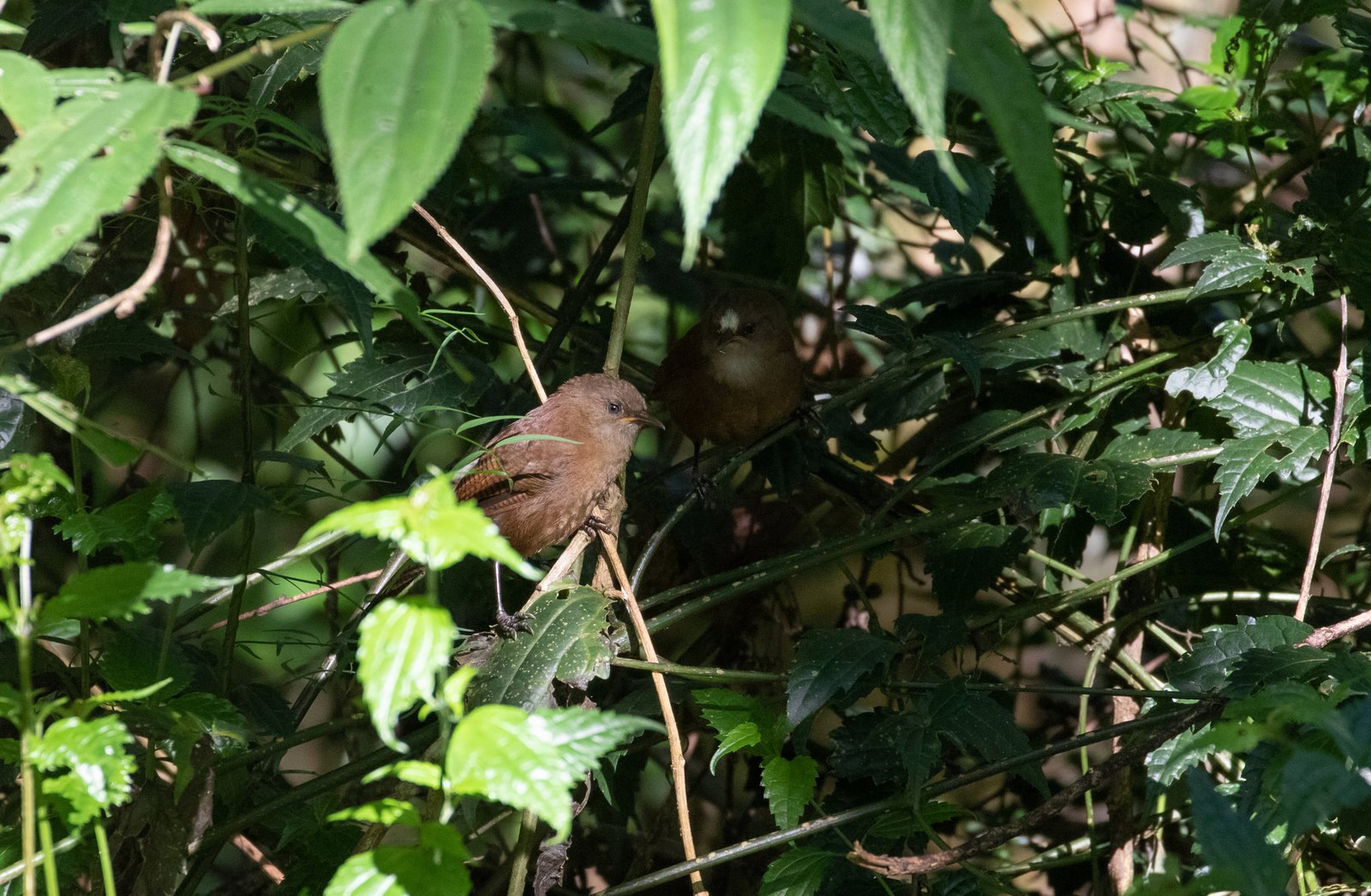
The Sepia-brown Wren is a medium-sized, brown wren of humid montane forest in the northern Andes. Like its relatives it lives in groups that move together through the undergrowth and sing in chorus. Some birds show white feathers on the forehead or cheeks, to a varying degree.
Voice
Fast, rich choruses of whistled and ringing phrases, sung together by the group, with much repetition; also hoarse, scraping contact calls.
Recording: Brian Cox — CC BY-NC-SA 4.0 · xeno-canto
Identification
16 cm, with a straight, dark bill and a fairly long tail. The plumage is warm sepia-brown to rufous-brown, the underparts slightly paler and greyer brown. Wings and tail with fine dark bars. Some birds have white feathers around the bill, on the forehead or around the eye, from a few spots to a white front of the head. The sexes are alike; young birds are duller.
Confusion species
Rufous Wren Cinnycerthia unirufa is larger and more uniformly rufous, with blackish lores, and lives higher, up to the treeline. Peruvian Wren Cinnycerthia peruana is very similar, but occurs only south of the Marañón. Grey-breasted Wood Wren Henicorhina leucophrys is much smaller and has a striped head and a grey breast.
Habitat
Undergrowth, bamboo and edges of humid montane forest and cloud forest, also older secondary forest, roughly between 1500 and 3000 m. Groups forage low in dense growth and among bamboo for insects and spiders, often with mixed flocks. The nest is a globular structure of moss and fibres.
Where the bird is most at home, classified by the vegetation units of the Andes and the west coast.


Range and movements
In Colombia in all three Andean ranges. In Ecuador on both slopes of the Andes. In Peru only in the far north, north and west of the Marañón. Absent from Bolivia and the Galápagos. Not known outside the guide area.
- Resident
- dark = core range, pale = thinly spread
How and when to look
Listen in the undergrowth of cloud forest at middle elevations for the chorus of a group; the birds stay low in the thickets and come briefly into view now and then at a clearing or forest edge.
Conservation status
Least Concern. Montane forest is locally being cleared, but the species tolerates older secondary forest.
Scientific name
Cinnycerthia olivascens | Sharpe, 1882
Sharpe described the species in 1882 and placed it straight away in the genus where it still stands. The genus Cinnycerthia was introduced in 1844 by Lesson. The genus name combines Cinnyris, a genus of sunbirds, with Certhia, the treecreeper genus. The species name comes from Latin olivascens, 'becoming olive', from oliva, 'olive'. The specimen the first description was based on came from Santa Elena, Antioquia, Colombia.