All species › Passerines › Wrens › Rufous Wren
Rufous Wren | Cinnycerthia unirufa
Rossige winterkoning | Cucarachero rufo | Garrinchão-ruivo
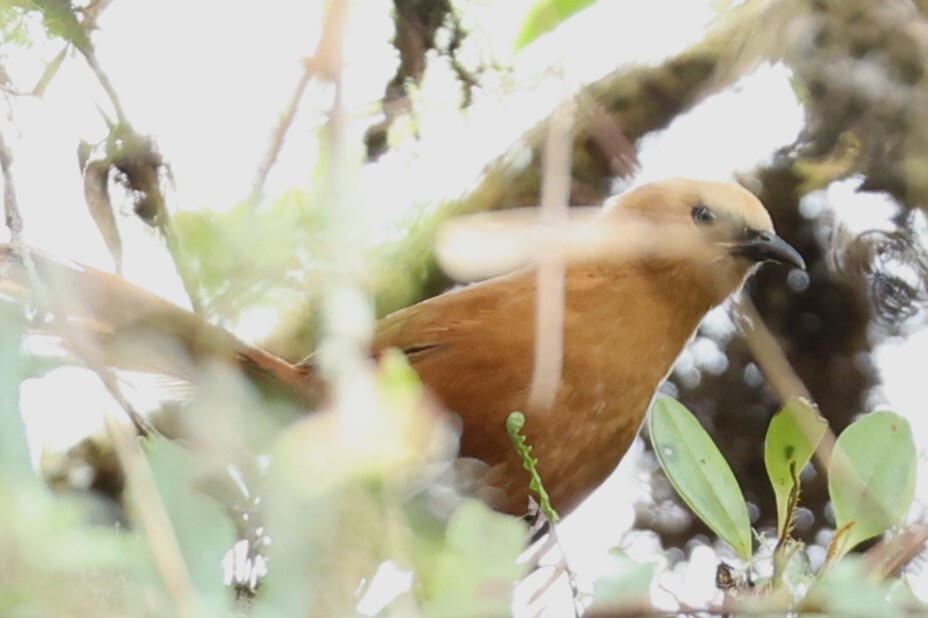
The Rufous Wren is a large, uniformly rufous-brown wren of the highest montane forest in the northern Andes. It lives in noisy groups of four to ten birds that move together through bamboo and dense undergrowth. Group members sing in fast, ringing choruses.
Voice
Fast, rich choruses of ringing and whistled phrases, with group members joining in; also hoarse, scraping calls and dry chirps with which the group keeps contact.
Recording: Daan van der Hoeven — CC BY-NC-SA 4.0 · xeno-canto
Identification
18 cm, with a fairly long tail and a straight, dark bill. The entire plumage is warm rufous-brown to chestnut, the underparts slightly paler. The lores are blackish, giving the head a dark front. Wings and tail with fine dark bars, visible only at close range. Iris reddish brown. The sexes are alike; young birds are duller brown.
Confusion species
Sepia-brown Wren Cinnycerthia olivascens is smaller and duller brown, without black lores, sometimes shows white feathers on the forehead and cheeks and usually lives lower. Peruvian Wren Cinnycerthia peruana occurs only south of the Marañón. Mountain Wren Troglodytes solstitialis is much smaller, with a clear pale supercilium.
Habitat
Dense undergrowth of upper cloud forest and elfin forest near the treeline, especially in Chusquea bamboo, also at the edge of páramo, roughly between 2300 and 3800 m. Groups forage low in thickets and among bamboo for insects and other invertebrates. The nest is a globular structure of moss and fibres.
Where the bird is most at home, classified by the vegetation units of the Andes and the west coast.


Range and movements
In Colombia in the Eastern and Central Andes and locally in the Western Andes, also in the Serranía de Perijá. In Ecuador in the Andes on both slopes. In Peru only in the far north, north and west of the Marañón. Absent from Bolivia and the Galápagos. Outside the guide area in western Venezuela.
- Resident
- dark = core range, pale = thinly spread
How and when to look
Walk trails through upper cloud forest with plenty of bamboo, such as at Yanacocha above Quito in Ecuador; a group gives itself away by its chorus and by the rustling in the bamboo, and then moves past quickly.
Conservation status
Least Concern. Forest near the treeline is locally affected by fire and grazing, but large parts of its habitat are intact.
Scientific name
Cinnycerthia unirufa | (de Lafresnaye, 1840)
De Lafresnaye described the species in 1840 as Limnornis unirufus; because it was later moved to another genus, the author and year stand in brackets. The genus Cinnycerthia was introduced in 1844 by Lesson. The genus name combines Cinnyris, a genus of sunbirds, with Certhia, the treecreeper genus. The species name comes from Latin unus, 'one', and rufus, 'red' or 'rufous', for the uniformly rufous plumage. The specimen the first description was based on came from Bogotá, Colombia.