All species › Passerines › Wrens › Black-throated Wren
Black-throated Wren | Pheugopedius atrogularis
Zwartkeelwinterkoning | Cucarachero gorjinegro | Garrinchão-de-garganta-preta
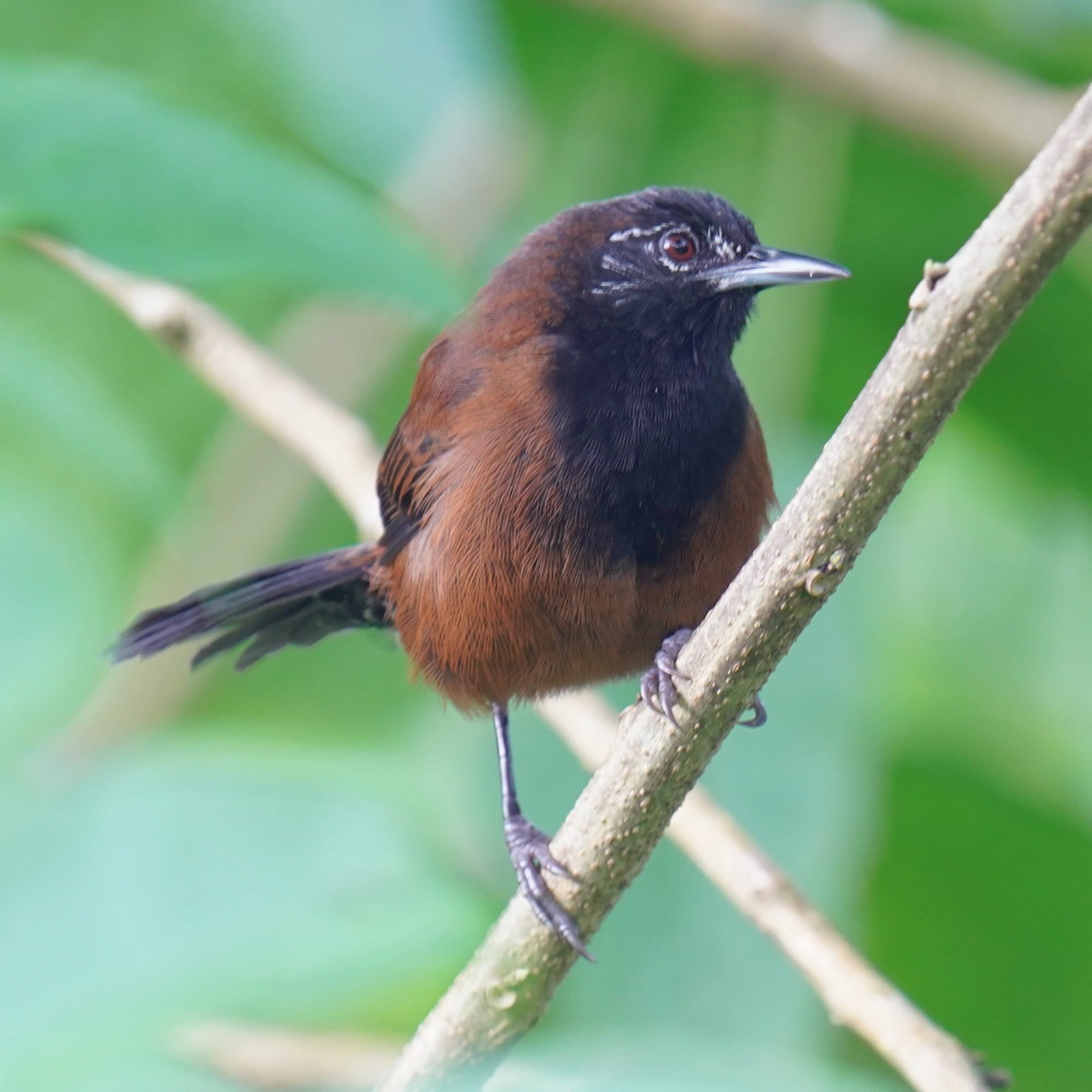
The Black-throated Wren is a dark wren of the Caribbean lowlands of Central America, with a black throat and breast and a rufous-brown body. It lives in pairs in dense growth along forest edges and clearings. Its occurrence in the guide area is not certain: the range ends in western Panama.
Voice
Rich, whistled phrases, each repeated a few times, often in duet. Also short, hard calls and a dry rattle.
Recording: Jelle Scharringa — CC BY-NC-SA 4.0 · xeno-canto
Identification
14 cm, with a fairly short tail. Upperparts warm rufous-brown. Throat and breast black, the sides of the head black with fine white streaks; no clear supercilium. Belly and flanks dark olive-brown. Tail rufous-brown with narrow black bars. The sexes are alike; young birds are duller, with a greyer throat.
Confusion species
Black-bellied Wren Pheugopedius fasciatoventris has a white throat and upper breast and a black belly with white bars. Sooty-headed Wren Pheugopedius spadix also has a black throat, but a greyer crown and a chestnut rather than black breast, and lives in the foothill and montane forest of the Chocó.
Habitat
Dense growth at the edges of humid lowland forest, secondary forest, overgrown clearings, riverbanks and abandoned fields, mainly below about 1000 m. Pairs forage low in thickets for insects and spiders. The nest is a globular structure with a side entrance.
Where the bird is most at home, classified by the vegetation units of the Andes and the west coast.


Range and movements
Not established with certainty in the guide area; reports from north-western Colombia are unconfirmed. Not known from Ecuador, Peru, Bolivia or the Galápagos. Outside the guide area in the Caribbean lowlands of eastern Nicaragua, Costa Rica and western Panama.
- Resident
- dark = core range, pale = thinly spread
How and when to look
A wren with an entirely black throat and breast in north-western Colombia needs photographs and sound recordings; compare carefully with Black-bellied Wren.
Conservation status
Least Concern. Within its range the species is fairly common in forest edges and secondary forest.
Scientific name
Pheugopedius atrogularis | (Salvin, 1865)
Salvin described the species in 1865 as Thryothorus atrogularis; because it was later moved to another genus, the author and year stand in brackets. The genus Pheugopedius was introduced in 1851 by Cabanis. The genus name comes from Greek pheugō, 'to flee, to shun', and pedion, 'plain, open country', meaning 'shunning open country'. The species name comes from Latin ater, 'black', and gula, 'throat'. The specimen the first description was based on came from Tucurrique, Costa Rica.