All species › Passerines › Wrens › Speckle-breasted Wren
Speckle-breasted Wren | Pheugopedius sclateri
Marañónwinterkoning | Cucarachero jaspeado | Garrinchão-de-peito-salpicado
The Speckle-breasted Wren is a speckled wren of dry forest and scrub on the western side of the Andes and in the dry valleys, from Colombia to northern Peru. It forms three separate groups: in the valleys of Colombia, in the Tumbesian dry forest of Ecuador and Peru, and in the Marañón Valley. Pairs sing loudly in duet from dense thickets.
Voice
Loud, rich, whistled phrases, each repeated a few times, often in duet between the partners. Also dry, rattling and scolding calls.
Recording: Juan Freile — CC BY-NC-SA 4.0 · xeno-canto
Identification
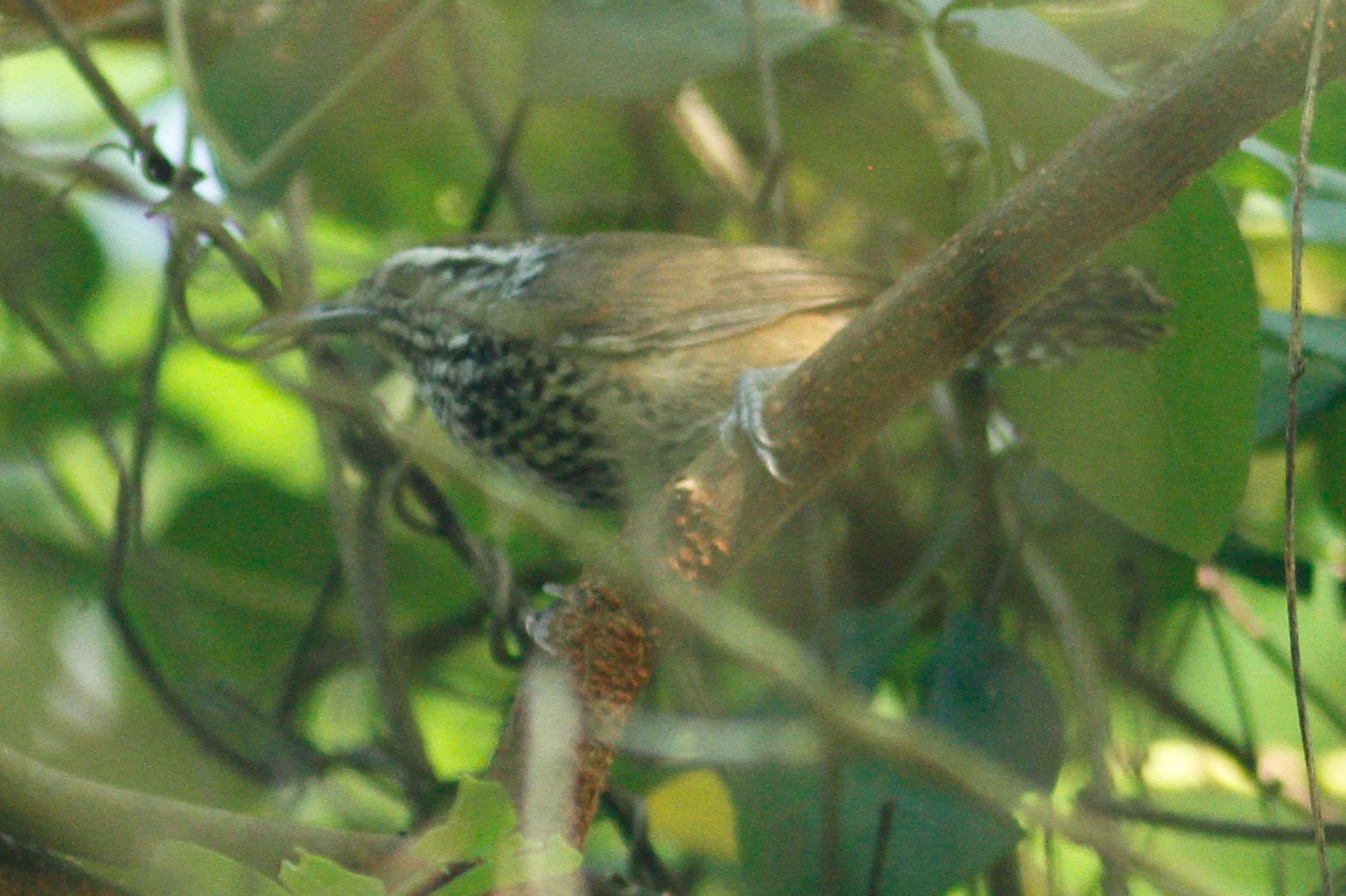
14 cm. Upperparts brown to greyish brown, the crown slightly warmer brown. White supercilium; sides of the head streaked black and white. Throat, breast and belly white with fine, dense black speckles and small bars, less dense in birds from the Tumbesian region. Flanks and undertail coverts buff with black barring. Tail brown with black bars. The sexes are alike; young birds are more faintly spotted.
Confusion species
Superciliated Wren Cantorchilus superciliaris shares the Tumbesian dry forest, but has plain white underparts without speckles and a more rufous back. Rufous-breasted Wren Pheugopedius rutilus in Colombia has an orange-rufous breast and only a speckled throat. Fasciated Wren Campylorhynchus fasciatus is much larger, with a heavier bill and entirely barred plumage.
Habitat
Dry and semi-humid deciduous forest, thorn scrub, forest edges, rough slopes and scrub along streams, from the lowlands to about 2000 m. Pairs forage in dense growth for insects and spiders, low to mid-level. The nest is a globular structure with a side entrance in a shrub.
Where the bird is most at home, classified by the vegetation units of the Andes and the west coast.


Range and movements
In Colombia locally in the dry valleys of the Cauca and Magdalena. In Ecuador in the west, mainly in the dry south-west (Manabí to El Oro and Loja). In Peru in the north-west (Tumbes to Lambayeque and western Cajamarca) and in the Marañón Valley. Absent from Bolivia and the Galápagos. Not known outside the guide area.
- Resident
- dark = core range, pale = thinly spread
How and when to look
In the dry forest of south-western Ecuador and north-western Peru pairs give themselves away by their loud duets from dense thickets; wait at the edge of a clump of shrubs until they show themselves.
Conservation status
Not Evaluated: the species in this circumscription has not yet been assessed separately. The dry forest it inhabits is fragmented in many places, but it tolerates secondary scrub.
Scientific name
Pheugopedius sclateri | (Taczanowski, 1879)
Taczanowski described the species in 1879 as Thryothorus sclateri; because it was later moved to another genus, the author and year stand in brackets. The genus Pheugopedius was introduced in 1851 by Cabanis. The genus name comes from Greek pheugō, 'to flee, to shun', and pedion, 'plain, open country', meaning 'shunning open country'. The species name honours Philip Lutley Sclater (1829–1913), British zoologist and ornithologist. The specimen the first description was based on came from Guajango, Río Marañón, Cajamarca, Peru.