All species › Passerines › Wrens › Rufous-breasted Wren
Rufous-breasted Wren | Pheugopedius rutilus
Roodborstwinterkoning | Cucarachero pechirrufo | Garrinchão-de-peito-ruivo
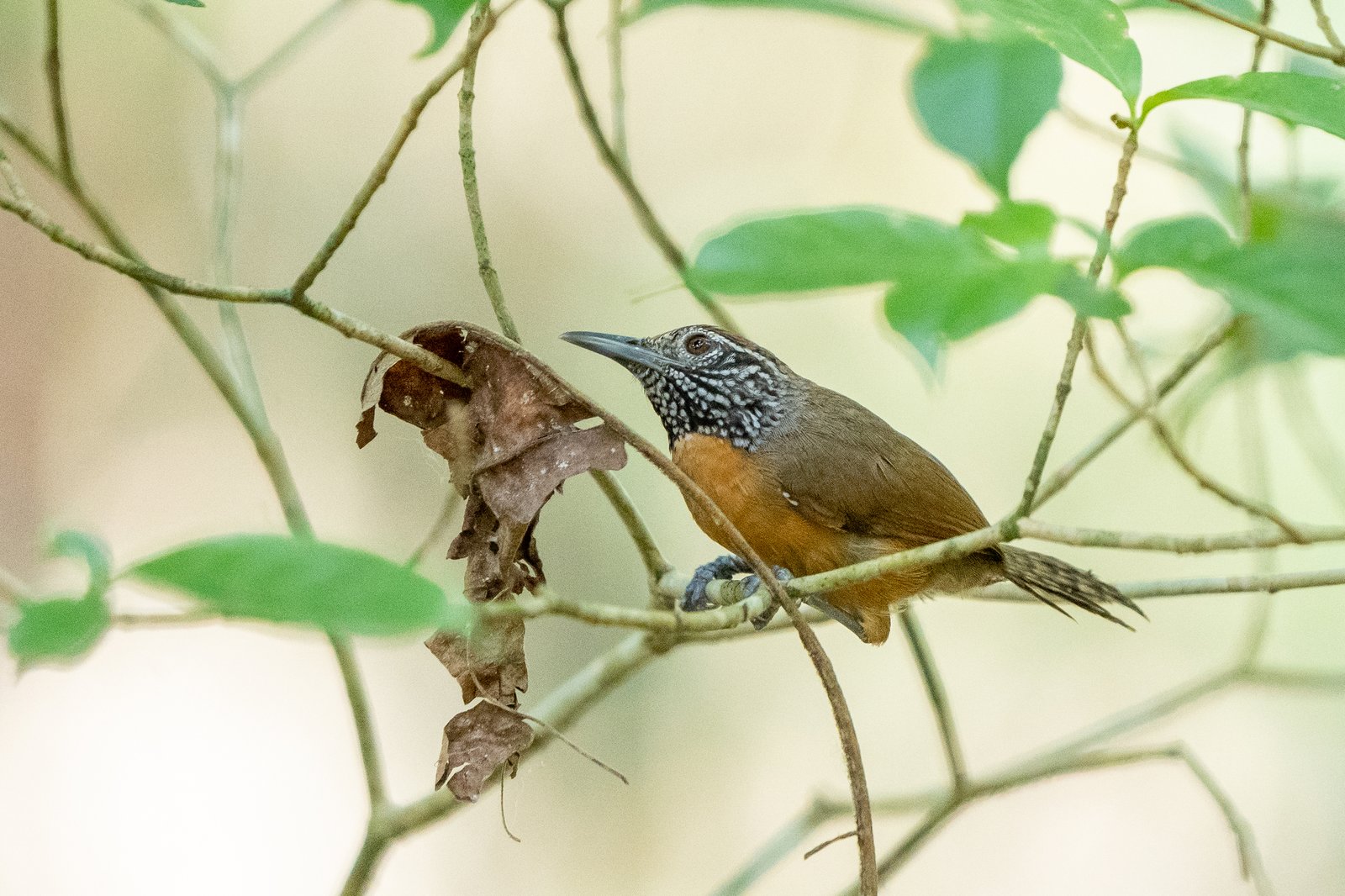
The Rufous-breasted Wren is a wren of forest edges and vine-tangled scrub in northern Colombia and Venezuela, with an orange-rufous breast and a black-and-white speckled head. Pairs often sing in duet, with clear, whistled phrases. In the guide area it occurs only in Colombia.
Voice
Clear, rich phrases of whistles, such as chewee-chee-chewee, each repeated a few times before a new phrase follows; pairs sing in duet. Also short, rasping calls.
Recording: Sue Riffe — CC BY-NC-SA 4.0 · xeno-canto
Identification
14 cm, with a fairly short, slightly decurved bill and a tail often cocked. Upperparts warm brown, the crown slightly more rufous. White supercilium; sides of the head and throat densely speckled black and white. Breast orange-rufous to rufous-brown, the belly greyish to buff, the flanks browner. Tail greyish brown with narrow black bars. The sexes are alike; young birds are duller, with less sharply defined speckling on the head.
Confusion species
Speckle-breasted Wren Pheugopedius sclateri has a white breast densely spotted black and no orange-rufous on the underparts. Whiskered Wren Pheugopedius mystacalis is larger, with a greyish head, a clear black malar stripe and a plain rufous-brown back, without a speckled throat. Bay Wren Cantorchilus nigricapillus has a black head with a white patch on the cheek and a chestnut body, and lives lower.
Habitat
Forest edges, vine-tangled scrub, secondary forest, open woodland and the edges of coffee plantations, in humid and fairly dry areas, roughly between 500 and 2000 m. Pairs forage low to mid-level in dense growth for insects and spiders. The nest is a globular structure of grass and fibres with a side entrance, low in a shrub or among vines.
Where the bird is most at home, classified by the vegetation units of the Andes and the west coast.


Range and movements
In Colombia in the north and centre: the Sierra Nevada de Santa Marta, the Serranía de Perijá and the Eastern Andes, locally also in the Magdalena Valley and on the margins of the other ranges. Absent from Ecuador, Peru, Bolivia and the Galápagos. Outside the guide area in Costa Rica and Panama, northern Venezuela and Trinidad and Tobago.
- Resident
- dark = core range, pale = thinly spread
How and when to look
Listen along forest edges and rough slopes with vines at middle elevations, for example in the Sierra Nevada de Santa Marta; pairs answer each other's song and then often come briefly to the edge of the thicket.
Conservation status
Least Concern. The species tolerates secondary forest and the edges of farmland well.
Scientific name
Pheugopedius rutilus | (Vieillot, 1819)
Vieillot described the species in 1819 as Thryothorus rutilus; because it was later moved to another genus, the author and year stand in brackets. The genus Pheugopedius was introduced in 1851 by Cabanis. The genus name comes from Greek pheugō, 'to flee, to shun', and pedion, 'plain, open country', meaning 'shunning open country'. The species name comes from Latin rutilus, 'reddish, ruddy'. The specimen the first description was based on came from Trinidad.