All species › Passerines › Wrens › Coraya Wren
Coraya Wren | Pheugopedius coraya
Corayawinterkoning | Cucarachero coraya | Garrinchão-coraia
The Coraya Wren is a dark wren with an almost black head of the Amazonian lowlands. Pairs live in dense vine tangles inside the forest and at forest edges, and sing loud duets of whistles. Several subspecies are recognised, differing mainly in the colour of the underparts.
Voice
Loud, rapid duets of clear, repeated whistles and rolling phrases; also harsh, rattling calls. The duet is often the first sign of a pair.
Recording: Juan Freile — CC BY-NC-SA 4.0 · xeno-canto
Identification
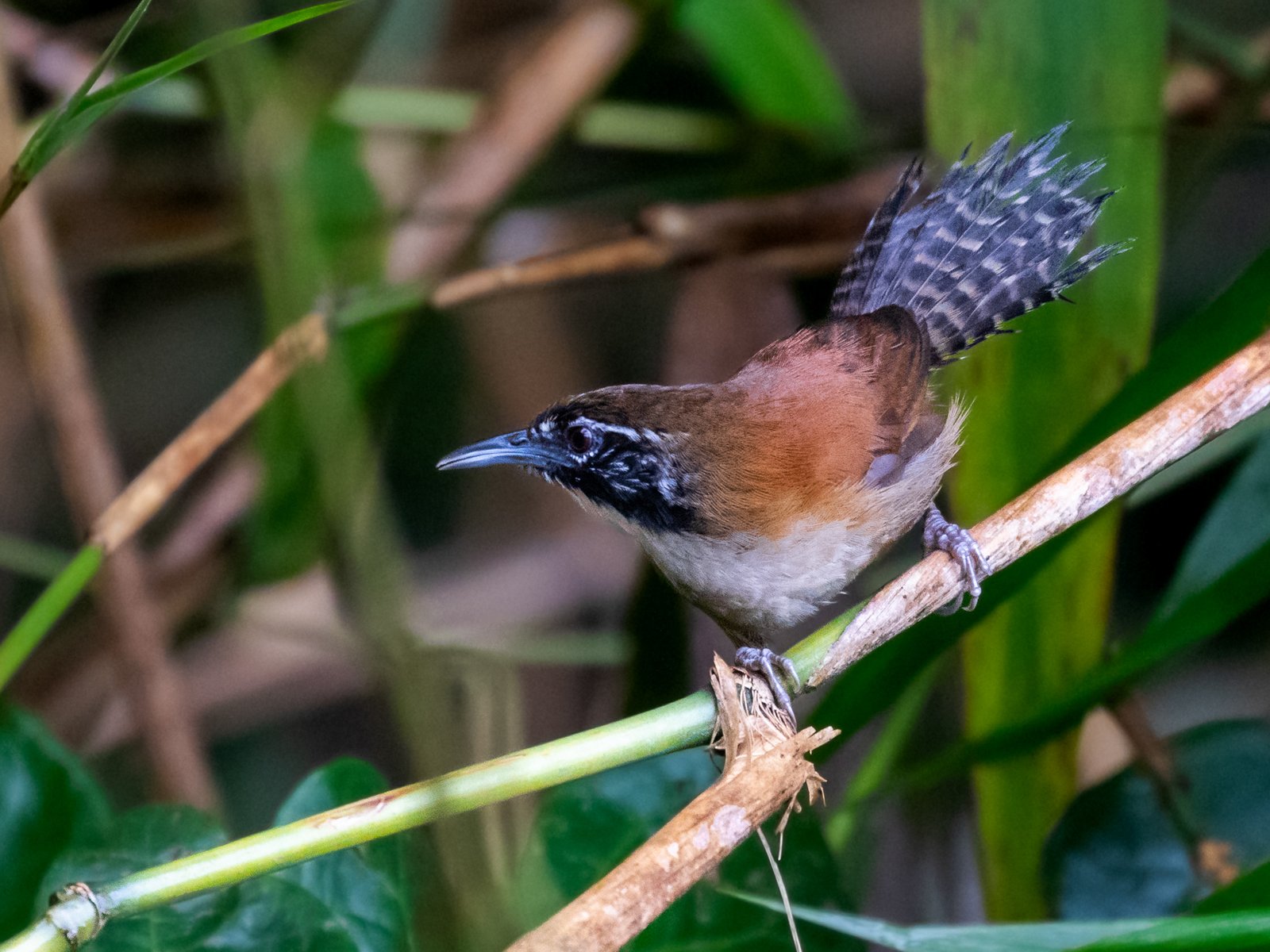
14–15 cm, with a fairly long, slightly decurved black bill. The head is black with fine white streaks on the cheeks, a narrow white supercilium and a white eyering. The upperparts are rufous-brown, the wings darker. The tail is grey with black bars. The throat is white, the breast white to pale buff or greyish, and the flanks pale brown. The sexes are alike; young birds are duller, with a less distinct face pattern.
Confusion species
Moustached Wren Pheugopedius genibarbis has a greyer face with a distinct white and black malar stripe, a buff lower breast and less barring in the tail, and lives mainly in bamboo and edge vegetation. Buff-breasted Wren Cantorchilus leucotis has a pale face and buff underparts and lives in várzea and riverside scrub. Thrush-like Wren Campylorhynchus turdinus is much larger, spotted, and lives in the canopy.
Habitat
Vine tangles and dense undergrowth in humid lowland forest on terra firme and in várzea, at forest edges, along rivers and in secondary forest; from the lowlands into the foothills, locally up to about 1300 m. In pairs it searches for insects and spiders in dense vegetation in the lower and middle levels. The nest is a domed structure with a side entrance.
Where the bird is most at home, classified by the vegetation units of the Andes and the west coast.


Range and movements
In Colombia in the lowlands east of the Andes, from Meta and Guainía to Amazonas. In Ecuador throughout the Amazonian lowlands and the lower foothills. In Peru in the Amazonian lowlands and foothills of the north and centre, south to about Junín and Cusco. Absent from Bolivia, west of the Andes and from the Galápagos. Outside the guide area in southern Venezuela, the Guianas and northern and western Brazil.
- Resident
- dark = core range, pale = thinly spread
How and when to look
Listen at vine-rich forest edges and along trails in lowland forest in Ecuador and northern Peru; pairs answer each other's duets and often sing from the same tangle.
Conservation status
Least Concern. Widespread and tolerates secondary forest and forest edges.
Scientific name
Pheugopedius coraya | (Gmelin, 1789)
Gmelin described the species in 1789 as Turdus coraya; because it was later moved to another genus, the author and year stand in brackets. The genus Pheugopedius was introduced in 1851 by Cabanis. The genus name comes from Greek pheugō, 'to flee, to shun', and pedion, 'plain, open country', meaning 'shunning open country'. The species name is a homophone of French queue rayée, 'barred tail': Buffon called the bird 'Coraya de Cayenne' because the tail is crossed by blackish bars. The specimen the first description was based on came from Cayenne, French Guiana.