All species › Passerines › Wrens › Moustached Wren
Moustached Wren | Pheugopedius genibarbis
Knevelwinterkoning | Cucarachero bigotudo | Garrinchão-pai-avô
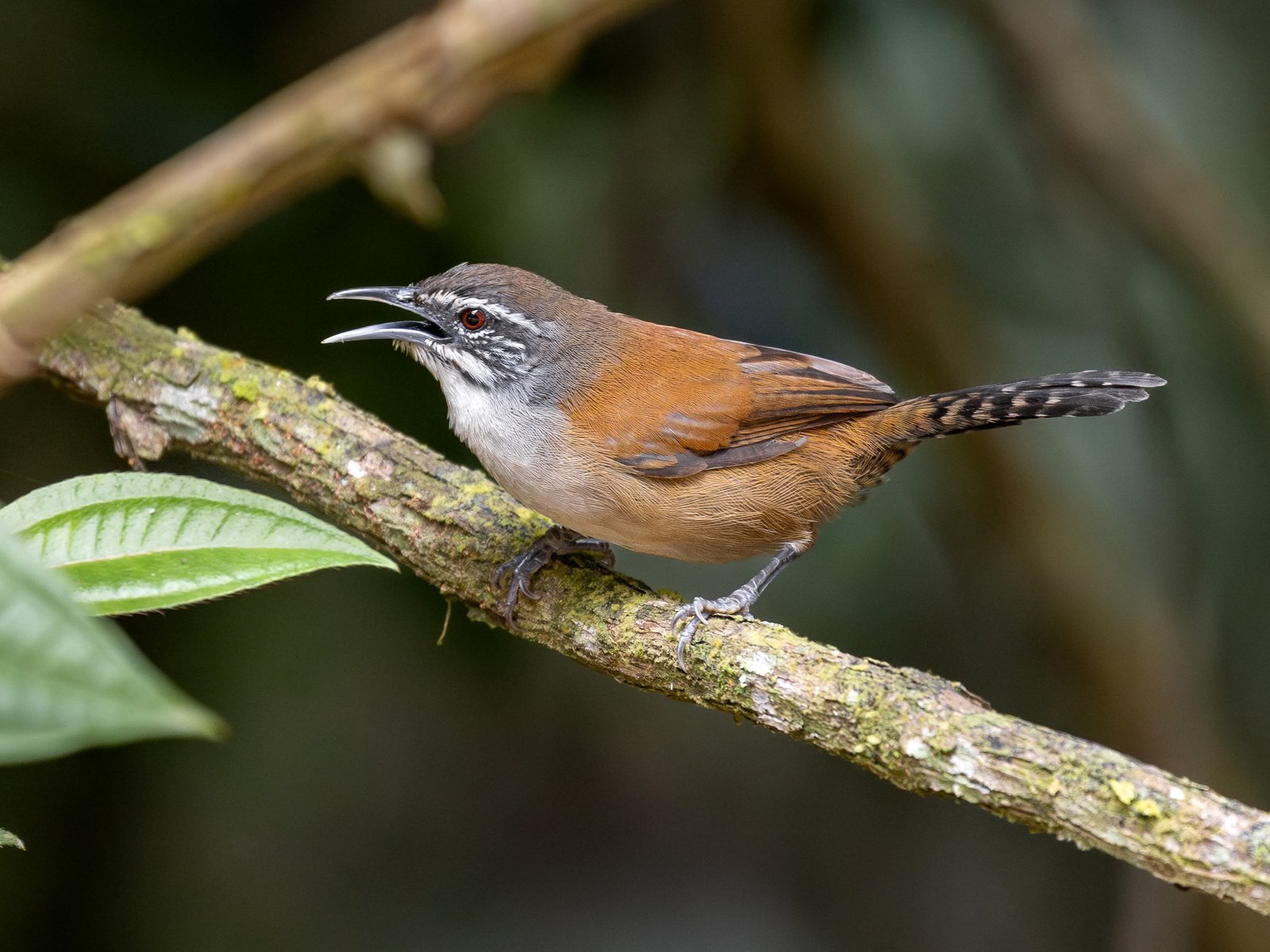
The Moustached Wren is the lowland counterpart of the Whiskered Wren: a large, rufous-brown wren with a black-and-white streaked face and a white and a black malar stripe. It lives in dense edge vegetation and bamboo in the southern Amazon basin. For a long time it was treated as one species with the Whiskered Wren.
Voice
Loud, rich duets of whistled phrases, often repeated, and harsh, rattling calls from dense vegetation.
Recording: JAYRSON ARAUJO DE OLIVEIRA — CC BY-NC-SA 4.0 · xeno-canto
Identification
15–16 cm. The crown and nape are olivaceous grey-brown, with a white supercilium, a white eyering and a black eyestripe. The sides of the head are grey-black with white streaks, with a white moustachial stripe and a black malar stripe. The back and rump are bright chestnut, the tail dull brown with narrow blackish bars. The throat and upper breast are white, the lower breast buff, and the flanks and belly deeper brown. The sexes are alike; young birds have a browner crown and a less distinct face pattern. Birds in Santa Cruz (subspecies bolivianus) are deeper buff below.
Confusion species
Coraya Wren Pheugopedius coraya has an almost entirely black face without a distinct malar stripe and a more heavily barred tail, and lives more inside the forest. Whiskered Wren Pheugopedius mystacalis is very similar, but lives in the northern Andes. Fawn-breasted Wren Cantorchilus guarayanus of eastern Bolivia has a paler face without a black malar stripe.
Habitat
Forest edges, riverside forest, dense thickets and especially bamboo forest in the lowlands; from sea level into the foothills, in Bolivia up to about 1500 m. In pairs it searches for insects and spiders low to mid-height in dense vegetation. The nest is a domed structure with a side entrance.
Where the bird is most at home, classified by the vegetation units of the Andes and the west coast.


Range and movements
In Peru in the Amazonian lowlands and the foothills of the eastern slope, mainly in the centre and south. In Bolivia in the lowlands of the north and west and in northern Santa Cruz. Absent from Colombia, Ecuador and the Galápagos. Outside the guide area in much of Brazil south of the Amazon, east to the Atlantic coast.
- Resident
- dark = core range, pale = thinly spread
How and when to look
Search riverbanks and bamboo-rich forest edges in Madre de Dios, for example around Puerto Maldonado; pairs sing in duet from dense vegetation.
Conservation status
Least Concern. The species tolerates edge vegetation and secondary forest well.
Scientific name
Pheugopedius genibarbis | (Swainson, 1838)
Swainson described the species in 1838 as Thryothorus genibarbis; because it was later moved to another genus, the author and year stand in brackets. The genus Pheugopedius was introduced in 1851 by Cabanis. The genus name comes from Greek pheugō, 'to flee, to shun', and pedion, 'plain, open country', meaning 'shunning open country'. The species name comes from Latin gena, 'cheek', and barba, 'beard', for the moustachial stripe. The specimen the first description was based on came from Bahia, Brazil.