All species › Passerines › Wrens › Whiskered Wren
Whiskered Wren | Pheugopedius mystacalis
Andeswinterkoning | Cucarachero bigotudo andino | Garrinchão-bigodudo
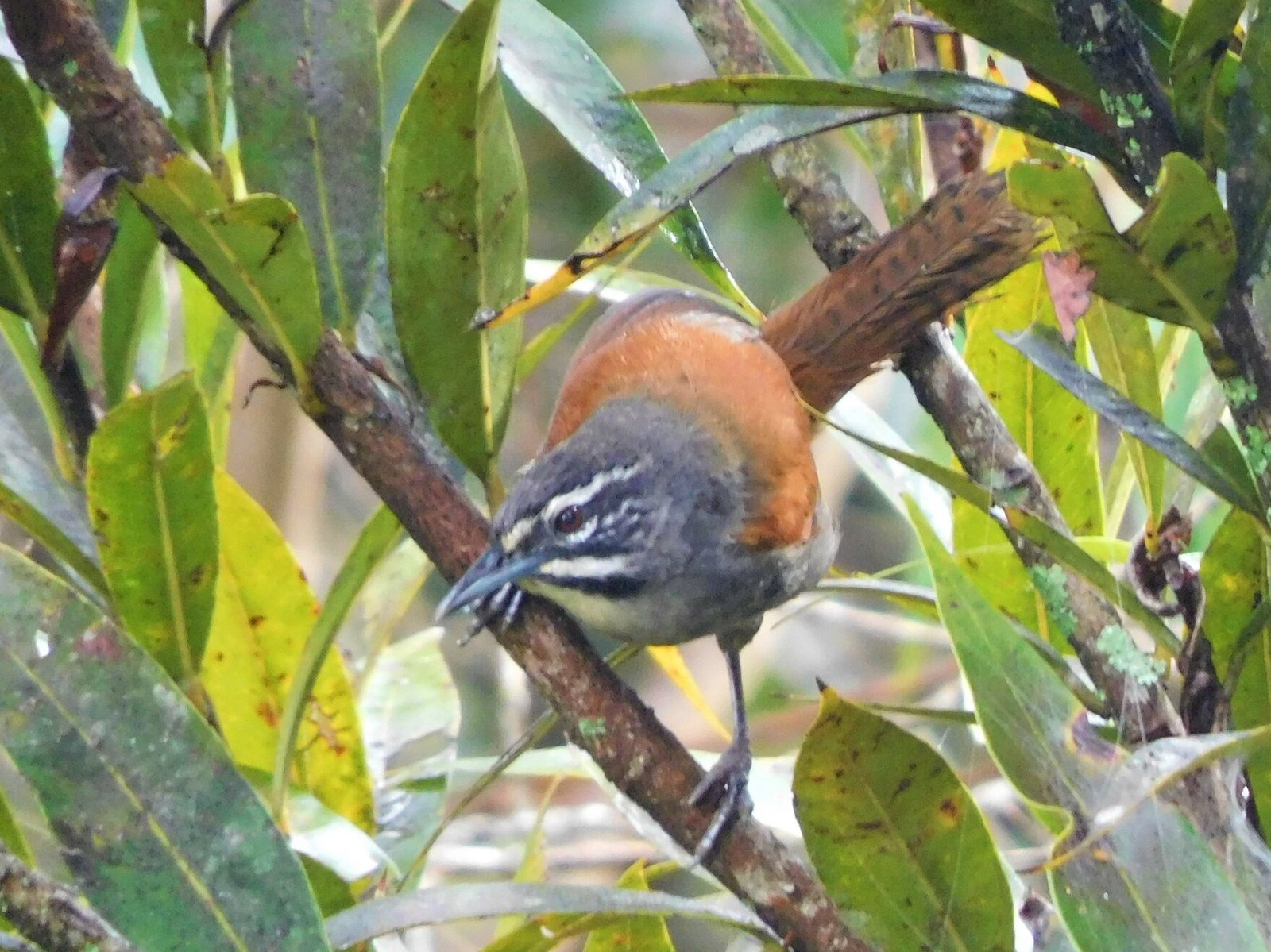
The Whiskered Wren is a large wren of forest edges and vine tangles in the northern Andes. It has a distinct black malar stripe beside the white throat. Its loud, rhythmic duets of whistles often ring out from dense vegetation, while the birds themselves usually stay hidden.
Voice
Loud, rhythmic duets of rich, hollow whistles, often in groups of three or four, such as hoo-hoo-poo-hoo; also harsh, rattling calls.
Recording: José María Loaiza B. — CC BY-NC-SA 4.0 · xeno-canto
Identification
16–17 cm, with a fairly long, slightly decurved bill. The crown and nape are greyish to rufous-brown, with a white supercilium; the sides of the head are streaked black and white, with a white moustachial stripe and below it a black malar stripe. The back and wings are rufous-brown, the tail grey-brown with broad black bars. The throat is white, the breast greyish to pale brown, and the belly and flanks warm buffy brown. The sexes are alike.
Confusion species
Moustached Wren Pheugopedius genibarbis is very similar, but lives in the Amazonian lowlands of Peru and Bolivia, far from this species. Plain-tailed Wren Pheugopedius euophrys lives higher in bamboo and has an almost unbarred tail. Rufous-breasted Wren Pheugopedius rutilus is smaller, with a black-and-white speckled face and throat and a rufous breast. Speckle-breasted Wren Pheugopedius sclateri has a black-and-white spotted breast.
Habitat
Dense edge vegetation, vine tangles and scrub at the edges of humid montane forest and secondary forest, also in shade coffee and overgrown gardens; from the foothills to about 2400 m. In pairs it searches for insects and spiders in dense vegetation in the lower and middle levels. The nest is a domed structure with a side entrance.
Where the bird is most at home, classified by the vegetation units of the Andes and the west coast.


Range and movements
In Colombia in all three Andean ranges and the valleys between them. In Ecuador mainly on the western slope and in the lower parts of the Andes. In Peru only in the far north-west. Absent from Bolivia and the Galápagos. Outside the guide area in western Venezuela.
- Resident
- dark = core range, pale = thinly spread
How and when to look
Listen at forest edges and overgrown farmyards in the coffee zone of the Colombian Andes, for example in Antioquia; the duets can be heard all year.
Conservation status
Least Concern. The species tolerates secondary forest and small-scale farmland with forest remnants.
Scientific name
Pheugopedius mystacalis | (Sclater, 1860)
Sclater described the species in 1860 as Thryothorus mystacalis; because it was later moved to another genus, the author and year stand in brackets. The genus Pheugopedius was introduced in 1851 by Cabanis. The genus name comes from Greek pheugō, 'to flee, to shun', and pedion, 'plain, open country', meaning 'shunning open country'. The species name comes from Greek mustax, 'moustache', for the moustachial stripe. The specimen the first description was based on came from Pallatanga, Chimborazo, Ecuador.