All species › Passerines › Wrens › Inca Wren
Inca Wren | Pheugopedius eisenmanni
Incawinterkoning | Cucarachero inca | Garrinchão-inca
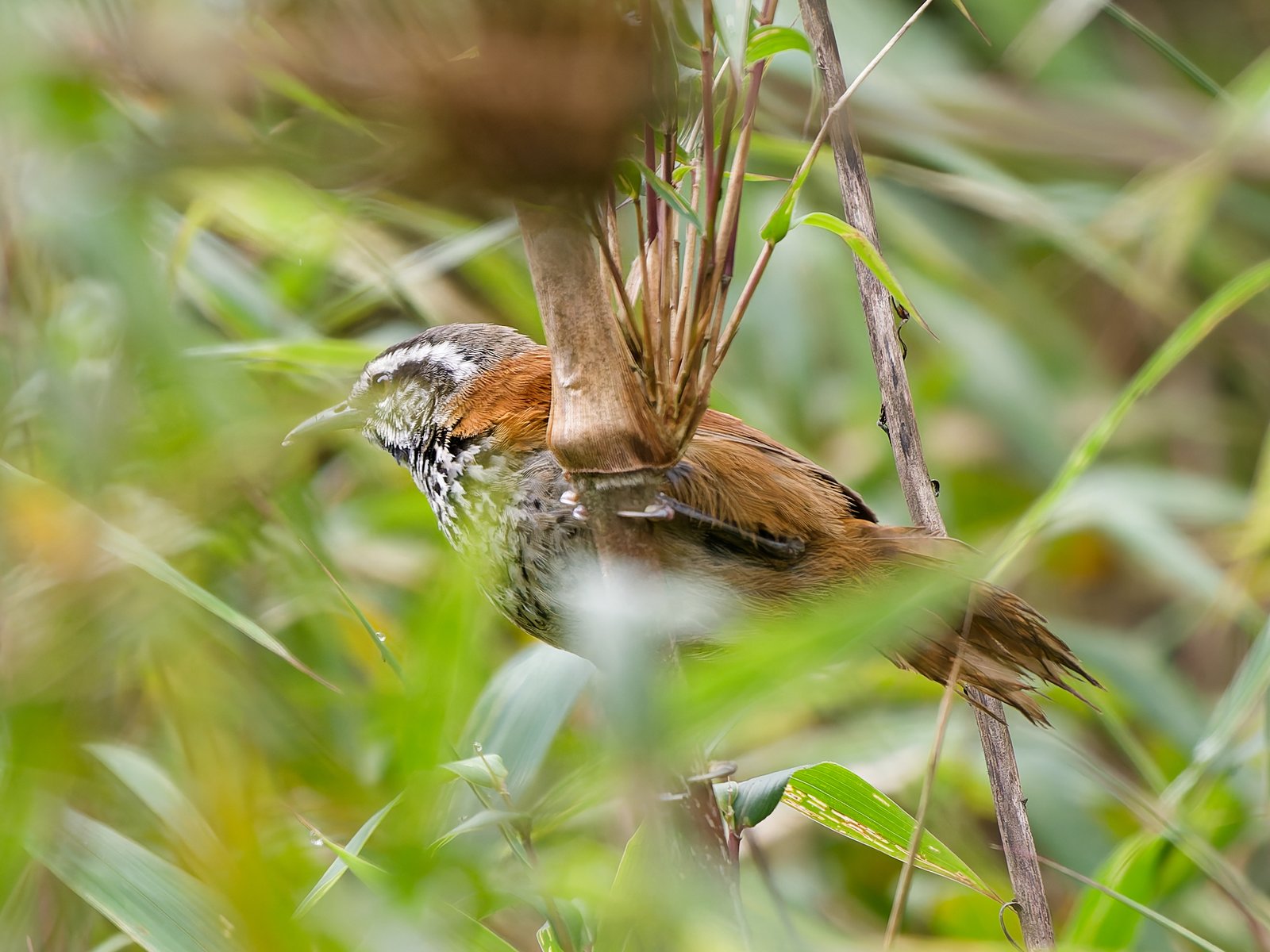
The Inca Wren is a wren of bamboo in the montane forests around the Urubamba valley in Cusco, and occurs nowhere else in the world. It was described only in 1985, although it is common in the bamboo around Machu Picchu. Pairs and family groups sing loud duets from dense bamboo.
Voice
Loud, rapid duets of clear, rolling whistles, alternated between the partners at a tight tempo; also rasping and rattling calls.
Recording: Ross Gallardy — CC BY-NC-SA 4.0 · xeno-canto
Identification
15 cm. The crown and nape are dark rufous-brown, with a white supercilium; the sides of the head are streaked black and white. The back and wings are rufous-brown, the tail rufous-brown with black bars. The throat and breast are white with heavy black spots, which may merge on the breast; the belly and flanks are rufous-brown. The sexes are alike; young birds are less heavily spotted.
Confusion species
Plain-tailed Wren Pheugopedius euophrys has an almost unbarred tail and fewer or no spots on the breast, and lives further north. Moustached Wren Pheugopedius genibarbis has an unspotted white and buff breast and lives in the lowlands and foothills.
Habitat
Bamboo (Chusquea) and dense undergrowth in humid montane forest and at forest edges, also in bamboo-rich scrub along rivers and on partly cleared slopes; roughly between 1800 and 3300 m. In pairs or family groups it searches for insects and spiders among bamboo and vines. The nest is a domed structure with a side entrance.
Where the bird is most at home, classified by the vegetation units of the Andes and the west coast.


Range and movements
In Peru only in the department of Cusco, mainly in the Urubamba valley and adjacent valleys and the Vilcabamba range. Absent from Colombia, Ecuador, Bolivia and the Galápagos. Does not occur outside the guide area.
- Resident
- dark = core range, pale = thinly spread
How and when to look
Along the trails in and around Machu Picchu and along the road over Abra Málaga the duets can regularly be heard in bamboo.
Conservation status
Least Concern. Its range is small, but the species is fairly common there and persists on bamboo-rich, partly cleared slopes.
Scientific name
Pheugopedius eisenmanni | (Parker & O'Neill, 1985)
Parker & O'Neill described the species in 1985 as Thryothorus eisenmanni; because it was later moved to another genus, the author and year stand in brackets. The genus Pheugopedius was introduced in 1851 by Cabanis. The genus name comes from Greek pheugō, 'to flee, to shun', and pedion, 'plain, open country', meaning 'shunning open country'. The species name honours Eugene Eisenmann (1906–1981), Panamanian-American ornithologist at the American Museum of Natural History. The specimen the first description was based on came from Peru.