All species › Passerines › Wrens › Plain-tailed Wren
Plain-tailed Wren | Pheugopedius euophrys
Wenkbrauwwinterkoning | Cucarachero coliliso | Garrinchão-de-cauda-lisa
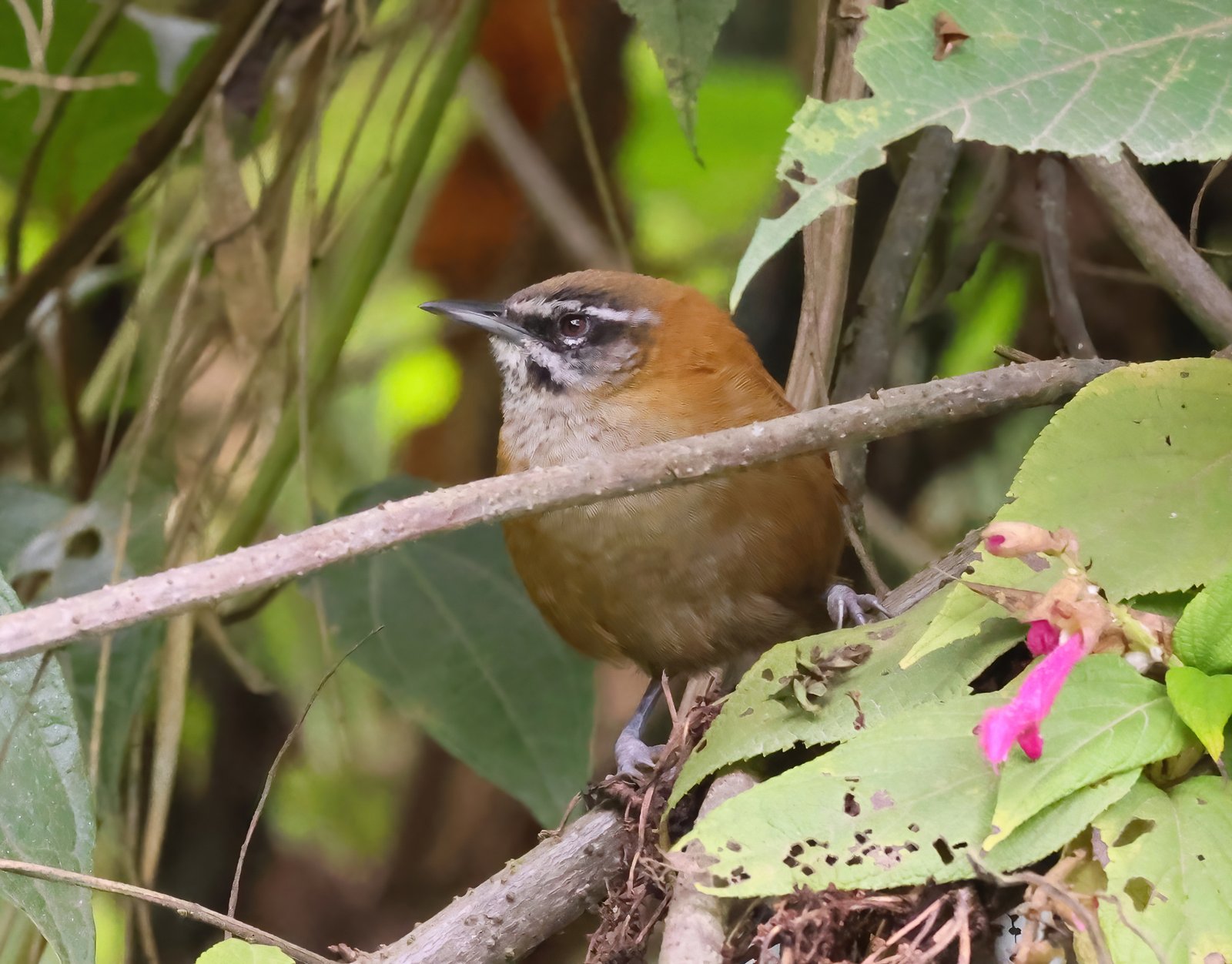
The Plain-tailed Wren is a large wren of bamboo in the high cloud forest of the northern Andes. Pairs and small groups sing rapid duets in which male and female alternate so precisely that it sounds like a single song; the species has been studied widely as an example of duet singing. Unlike most of its relatives, its tail is almost unbarred.
Voice
Rapid, loud duets of clear whistles and rolling phrases, with male and female alternating at a tight tempo; in groups more birds sometimes join in. The birds in Peru have different calls.
Recording: Juan Freile — CC BY-NC-SA 4.0 · xeno-canto
Identification
16 cm. The crown is grey to brownish grey, with a long white supercilium and a black eyestripe; the sides of the head are streaked black and white, with a black malar stripe. The back, wings and tail are warm rufous-brown, the tail without or almost without barring. The throat is white; the breast is greyish white with black spots in some subspecies, plain grey in others. The belly and flanks are rufous-brown. The sexes are alike.
Confusion species
Inca Wren Pheugopedius eisenmanni is very similar, but has a black-barred tail and heavy black spotting on the throat and breast; it lives only in Cusco, far to the south of this species. Whiskered Wren Pheugopedius mystacalis has a barred tail, lives lower and rarely in bamboo. Rufous Wren Cinnycerthia unirufa and Sepia-brown Wren Cinnycerthia olivascens also live in bamboo, but are almost plain rufous-brown, without a streaked face.
Habitat
Dense Chusquea bamboo in the interior and at the edges of cloud forest and upper montane forest, also in bamboo-rich scrub after clearance; roughly between 2000 and 3500 m. In pairs or family groups it searches for insects and spiders among bamboo stems and dead leaves. The nest is a domed structure with a side entrance in dense vegetation.
Where the bird is most at home, classified by the vegetation units of the Andes and the west coast.


Range and movements
In Colombia in the south-west, in the Andes of Nariño. In Ecuador on both slopes of the Andes along the whole country. In Peru in the northern Andes and on the eastern slope south to Junín. Absent from Bolivia and the Galápagos. Does not occur outside the guide area.
- Resident
- dark = core range, pale = thinly spread
How and when to look
Listen in bamboo-rich cloud forest on the slopes above Quito, such as in the Yanacocha and Pululahua reserves; the duets carry far, but the birds usually stay in dense bamboo.
Conservation status
Least Concern. The birds in Peru are sometimes treated as a separate species, and the population in Junín, with a different song and darker underparts, may be an undescribed species.
Scientific name
Pheugopedius euophrys | (Sclater, 1860)
Sclater described the species in 1860 as Thryothorus euophrys; because it was later moved to another genus, the author and year stand in brackets. The genus Pheugopedius was introduced in 1851 by Cabanis. The genus name comes from Greek pheugō, 'to flee, to shun', and pedion, 'plain, open country', meaning 'shunning open country'. The species name comes from Greek eu, 'well, distinctly', and ophrus, 'eyebrow', for the conspicuous eyebrow stripe. The specimen the first description was based on came from Lloa, Pichincha, Ecuador.