All species › Passerines › Wrens › Black-bellied Wren
Black-bellied Wren | Pheugopedius fasciatoventris
Zwartbuikwinterkoning | Cucarachero ventrinegro | Garrinchão-de-barriga-preta
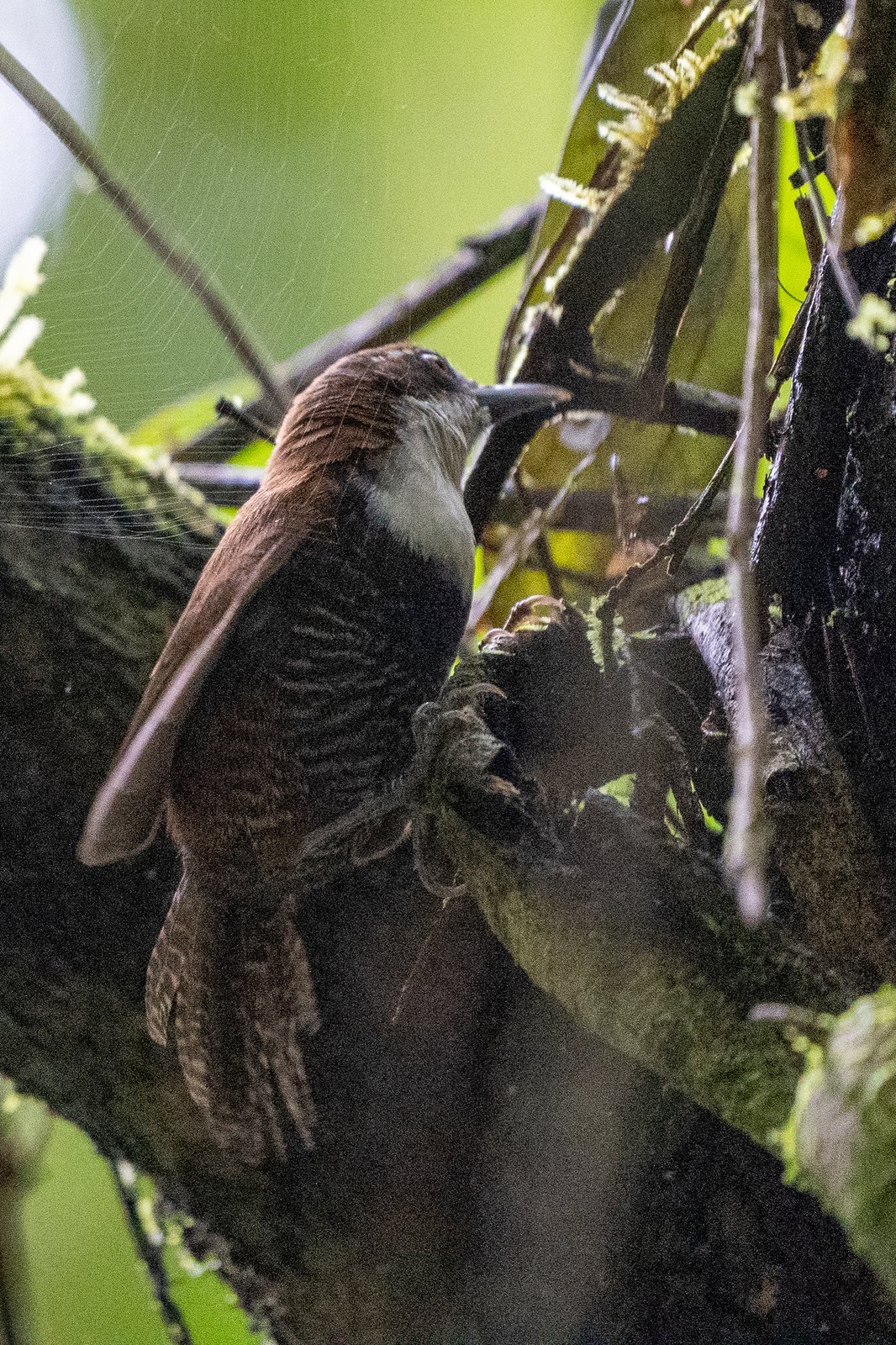
The Black-bellied Wren is a large, chestnut wren of the humid lowlands and valleys of northern and western Colombia. Its white throat and breast change abruptly into a black belly. Both sexes have a large repertoire of loud, whistled songs.
Voice
Loud, rich and fairly low whistled phrases, often repeated and alternated between the partners; one bird may have dozens of different songs. Also harsh, rattling alarm calls.
Recording: Michael Castaño — CC BY-NC-SA 4.0 · xeno-canto
Identification
15 cm, with a stout, slightly decurved bill. The back, wings and tail are rich chestnut, the tail with black bars. There is a white supercilium of variable width; the sides of the head are greyish with fine streaks. The chin, throat and breast are white and sharply demarcated from the black belly, which is finely barred white in most subspecies. The sexes are alike; males are heavier on average.
Confusion species
Sooty-headed Wren Pheugopedius spadix has a black head and throat and a chestnut breast, and lives higher. Bay Wren Cantorchilus nigricapillus has a black head with white cheek patches and black-barred underparts without a plain black belly. Rufous-and-white Wren Thryophilus rufalbus has white underparts without black and lives in drier forest.
Habitat
Dense undergrowth, vine tangles and thickets in the interior and at the edges of humid primary and secondary forest, often along streams; in the lowlands and foothills, mostly below 1000 m. It searches for insects and spiders from the undergrowth up to the middle levels. The nest is a domed structure with a side entrance, made of strips of palm and sugar-cane leaves, low in a vine tangle at the forest edge; the clutch is two eggs, incubated by the female alone.
Where the bird is most at home, classified by the vegetation units of the Andes and the west coast.


Range and movements
In Colombia in the north and west: the Pacific lowlands of Chocó, Urabá, the Caribbean lowlands and the base of the Sierra Nevada de Santa Marta, and the Cauca and Magdalena valleys. Absent from Ecuador, Peru, Bolivia and the Galápagos. Outside the guide area in Panama and Costa Rica.
- Resident
- dark = core range, pale = thinly spread
How and when to look
Listen along streamside forest edges and thickets in the middle Magdalena valley or in Antioquia; the birds sing from dense vine tangles.
Conservation status
Least Concern. The population is suspected to be declining through clearance and fragmentation of lowland forest.
Scientific name
Pheugopedius fasciatoventris | (de Lafresnaye, 1845)
De Lafresnaye described the species in 1845 as Thriothorus fasciato-ventris; because it was later moved to another genus, the author and year stand in brackets. The genus Pheugopedius was introduced in 1851 by Cabanis. The genus name comes from Greek pheugō, 'to flee, to shun', and pedion, 'plain, open country', meaning 'shunning open country'. The species name comes from Latin fasciatus, 'banded', and venter, 'belly'. The specimen the first description was based on came from Bogotá, Colombia.