All species › Passerines › Wrens › Sooty-headed Wren
Sooty-headed Wren | Pheugopedius spadix
Roetkopwinterkoning | Cucarachero cabecigrís | Garrinchão-de-cabeça-fuliginosa
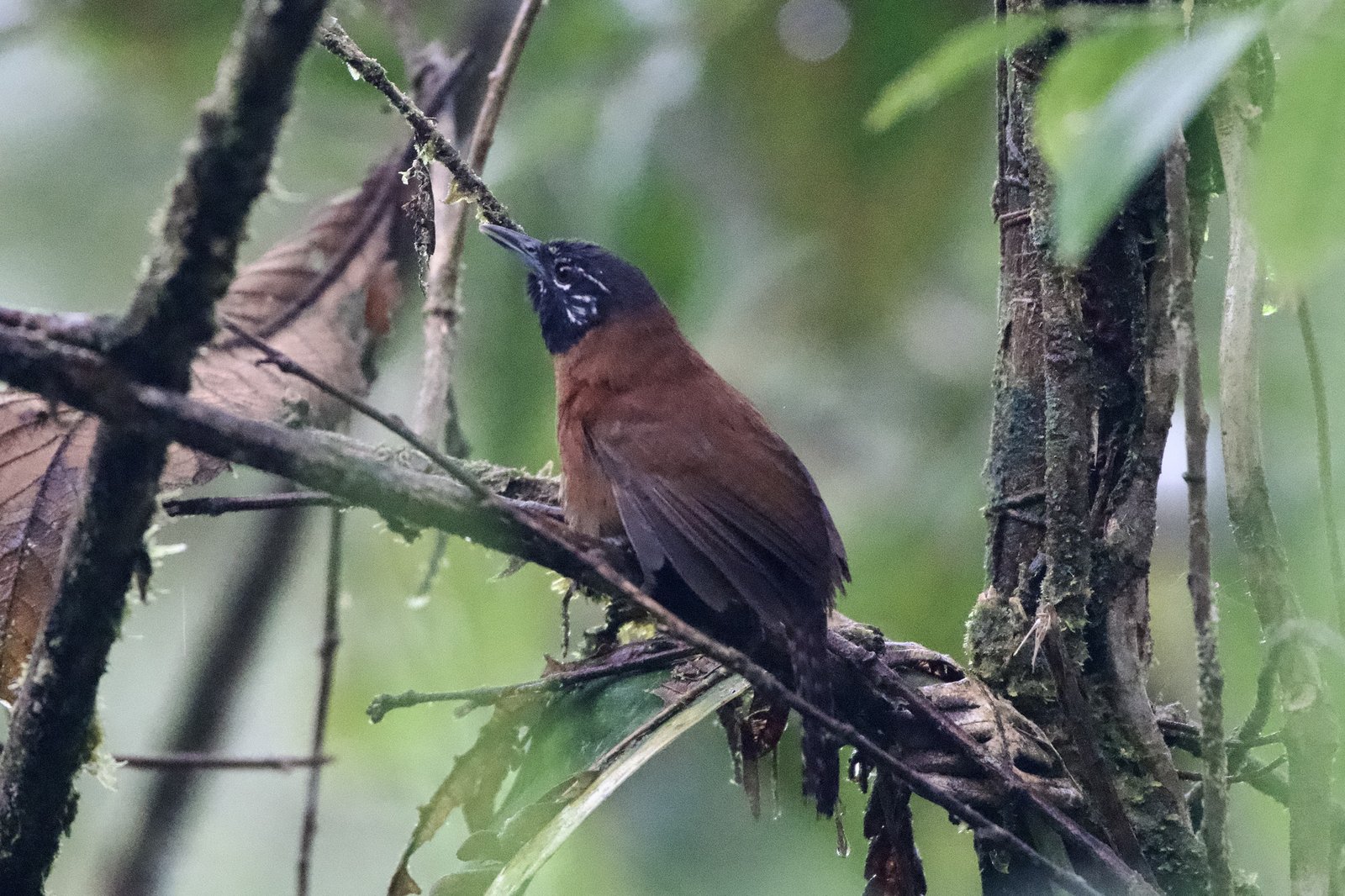
The Sooty-headed Wren is a dark wren of wet montane forest on the Pacific side of the Colombian Andes. Its sooty-black head and throat contrast with the chestnut breast. Pairs keep to dense, mossy vegetation, where they sing loud duets.
Voice
Both sexes sing series of gurgling, rich whistles, often as a duet in which the partners alternate rapidly. Also harsh, rattling calls.
Recording: David Tan — CC BY-NC-SA 4.0 · xeno-canto
Identification
14–15 cm, with a fairly long, slightly decurved bill. The crown, nape and upper back are dull sooty black, the rump and tail bright chestnut, the tail with broad black bars. The face is mostly black with fine white streaks; the chin and throat are black and sharply demarcated from the chestnut lower throat and breast. The belly is greyish brown, the flanks rufous-brown. The sexes are alike; young birds are duller, with less contrast.
Confusion species
Bay Wren Cantorchilus nigricapillus also has a black head, but with white patches on the cheeks, a white throat and black-barred underparts, and lives lower. Black-bellied Wren Pheugopedius fasciatoventris has a white throat and breast and a black belly. Whiskered Wren Pheugopedius mystacalis has a grey face with a white supercilium, a black malar stripe and a pale throat.
Habitat
The interior and edges of humid montane forest and cloud forest and dense secondary forest, especially where moss and epiphytes are abundant; mostly between 800 and 1800 m, in Colombia locally down to 400 m. It searches tangles of vines, moss and dead leaves for insects and spiders. The nest is a ball of coarse plant material and leaves with a side entrance.
Where the bird is most at home, classified by the vegetation units of the Andes and the west coast.


Range and movements
In Colombia on the Pacific side of the Western Andes, from southern Chocó to Nariño, and in the north east to the outliers of the Central Andes and the middle Magdalena valley. Absent from Ecuador, Peru, Bolivia and the Galápagos. Outside the guide area only in the far east of Panama (Darién).
- Resident
- dark = core range, pale = thinly spread
How and when to look
Listen along roads through wet, mossy forest on the Pacific side of the Western Andes, in Chocó and Valle del Cauca; the duet is usually the first sign of a pair.
Conservation status
Least Concern. Much of its habitat lies on steep, forested slopes; forest clearance threatens the species locally.
Scientific name
Pheugopedius spadix | Bangs, 1910
Bangs described the species in 1910 and placed it straight away in the genus where it still stands. The genus Pheugopedius was introduced in 1851 by Cabanis. The genus name comes from Greek pheugō, 'to flee, to shun', and pedion, 'plain, open country', meaning 'shunning open country'. The species name comes from Latin spadix, 'date-brown, chestnut'. The specimen the first description was based on came from Naranjito, Río Dagua, Valle del Cauca, Colombia.