All species › Tubenoses › Petrels, shearwaters and diving petrels › Pink-footed Shearwater
Pink-footed Shearwater | Ardenna creatopus
Chileense grote pijlstormvogel | Pardela pata rosada | Pardela-de-pés-rosados
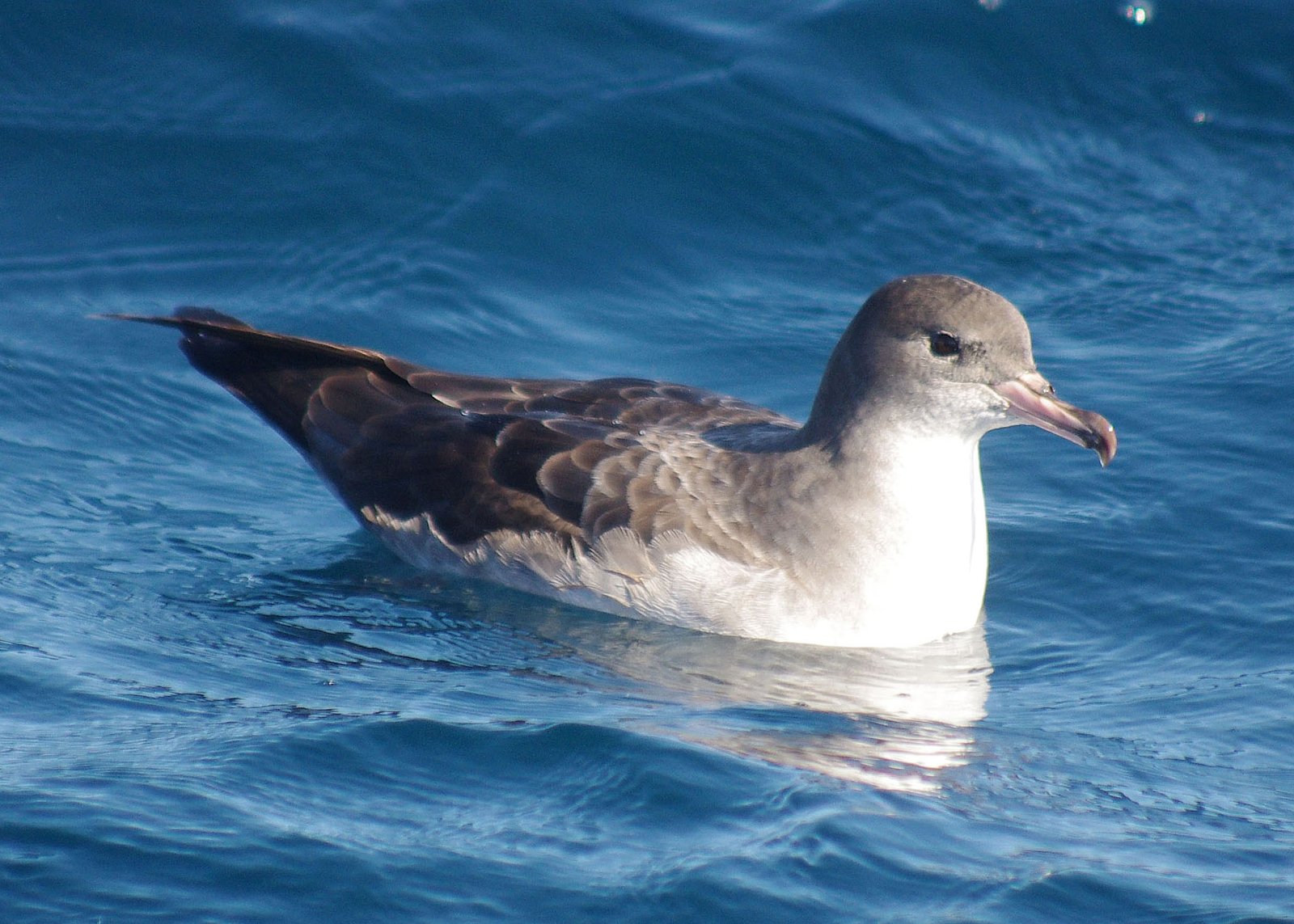
The Pink-footed Shearwater is a large, heavily built shearwater with a pink bill and pink feet. It breeds only on the Juan Fernández Islands and Isla Mocha off Chile and outside the breeding season migrates north along the west coast of South and North America, as far as off Canada. Off the coasts of Peru and Ecuador it is a common seabird.
Voice
Silent at sea. At the breeding colonies moaning, wailing calls at night.
Recording: Ignacio Escobar — CC BY-NC-SA 4.0 · xeno-canto
Identification
46–49 cm, a bulky shearwater with broad wings, a short, rounded tail and a thick, pink bill with a dark tip. The upperparts are grey-brown, the head slightly darker, without a sharp cap. The underparts are white to dirty white with grey-brown mottled flanks, breast sides and undertail coverts; some birds are almost entirely greyish below. The underwing is white in the centre, with broad, diffuse dark margins. The legs are pink. It flies with slow, powerful wingbeats and long glides. The sexes are alike.
Confusion species
Buller's Shearwater Ardenna bulleri has pale grey upperparts with a sharp black M, pure white underparts and a grey bill. The light morph of Wedge-tailed Shearwater Ardenna pacifica is slimmer, with a long, wedge-shaped tail and a grey bill. Sooty Shearwater Ardenna grisea is smaller and entirely dark with a dark bill. Juan Fernandez Petrel Pterodroma externa has pure white underparts, a white forehead, a short black bill and a high, arcing flight.
Habitat
Cool waters over the Humboldt Current and the continental shelf, usually a few to tens of kilometres offshore. It feeds on fish, especially anchovies and sardines, and squid, taken from the surface while swimming or in short dives, and follows fishing boats for waste. It breeds in colonies in burrows in the soil of forest and grassland on the Juan Fernández Islands and Isla Mocha.
Where the bird is most at home, classified by the vegetation units of the Andes and the west coast.


Range and movements
In Peru common at sea off the entire coast, especially in the austral winter and on migration. In Ecuador regular, mainly as a passage migrant. In Colombia scarce off the Pacific coast. Rare around the Galápagos. Absent from Bolivia. It does not breed in the guide area. Outside the guide area it breeds on the Juan Fernández Islands and Isla Mocha (Chile); outside the breeding season north to off the west coast of the United States and Canada.
- Resident
- Summer visitor (c. Apr–Sep)
- Winter visitor (c. Oct–Mar)
- Passage (Mar–Apr, Oct–Nov)
- dark = core range, pale = thinly spread
How and when to look
On pelagic trips from harbours in Peru, such as Callao, Pucusana and Paracas, often near fishing boats; the chance is greatest between April and November.
Conservation status
Vulnerable. The species breeds on few islands. Introduced rats, cats and coatis on the breeding islands, the former harvest of chicks on Isla Mocha, erosion of the nesting ground and bycatch in fisheries along the migration route are the main threats.
Scientific name
Ardenna creatopus | (Coues, 1864) (GBIF: Puffinus creatopus)
Coues described the species in 1864 as Puffinus creatopus; because it was later moved to another genus, the author and year stand in brackets. The genus Ardenna was introduced in 1853 by Reichenbach. The genus name is a Late Medieval Latin name that Aldrovandi used in 1603 for the 'Diomedean birds'. Ardènna and Artènna are Italian dialect names for a shearwater, according to Capponi based on ardea, 'heron'. The species name comes from Greek kreas, 'flesh', and pous, 'foot', after the flesh-pink feet. The specimen the first description was based on came from San Nicolas Island, California, United States.