All species › Tubenoses › Petrels, shearwaters and diving petrels › Galapagos Shearwater
Galapagos Shearwater | Puffinus subalaris
Galápagospijlstormvogel | Pardela de Galápagos | Pardela-de-galápagos
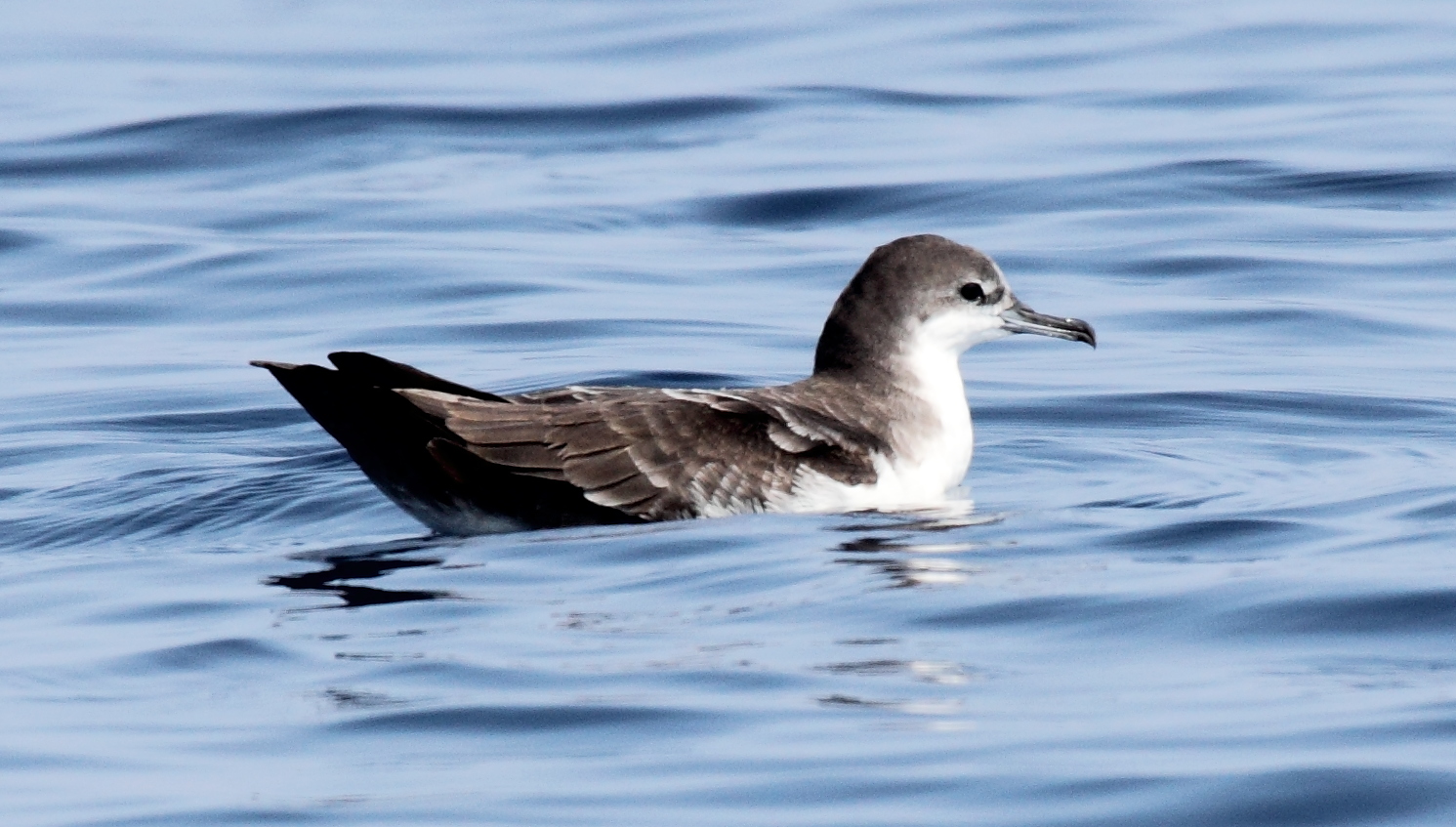
The Galapagos Shearwater is a small, dark-and-white shearwater that breeds only in the Galápagos. It was long included in Audubon's Shearwater. Around the archipelago it is the most numerous shearwater and often feeds in large flocks, together with other seabirds over schools of tuna and dolphins.
Voice
Usually silent at sea. At the breeding sites squeaking, cooing and purring calls from the nest cavity at night.
Recording: Richard Hoyer — CC BY-NC-SA 4.0 · xeno-canto
Identification
30 cm, a small, compact shearwater with short, broad wings, a fairly long tail and a slender dark bill. The upperparts are uniform dark chocolate-brown; the dark cap reaches below the eye. The throat, breast and belly are white, the undertail coverts dark. The underwing is mostly dark, with a dirty white centre. The legs are pink with dark toes. It flies low over the water with fast, fluttering wingbeats and short glides, and often rests in flocks on the water. The sexes are alike.
Confusion species
The light morph of Wedge-tailed Shearwater Ardenna pacifica is much larger, with long wings, a long, wedge-shaped tail and a slow, relaxed flight. Galapagos Petrel Pterodroma phaeopygia is larger, with a white forehead, a white underwing with dark margins and a high, arcing flight. Storm petrels, such as Wedge-rumped Storm Petrel Hydrobates tethys, are much smaller, with a white rump. In the Caribbean part of the guide area the closely related Sargasso Shearwater Puffinus lherminieri occurs; the two do not overlap.
Habitat
Warm waters around the Galápagos and in the eastern tropical Pacific, both close to the islands and far out at sea. It feeds on small fish and squid, taken from the surface or caught in short dives, often where tuna and dolphins drive prey upwards. It breeds in crevices and cavities in lava rock, cliffs and lava tubes and in burrows in the soil; the breeding season extends over much of the year.
Where the bird is most at home, classified by the vegetation units of the Andes and the west coast.


Range and movements
In the Galápagos common around the whole archipelago and breeding on many islands. In Ecuador regular at sea, mainly far offshore. In Colombia scarcer, off the Pacific coast. Hardly known from Peru. Absent from Bolivia. Outside the guide area at sea in the eastern tropical Pacific, north to off Central America and Mexico.
- Resident
- dark = core range, pale = thinly spread
How and when to look
On boat trips between the islands of the Galápagos, for example around Santa Cruz and Isabela, where flocks fly low over the water or rest on it; on the mainland on pelagic trips from Salinas or Puerto López.
Conservation status
Least Concern. Introduced rats and cats on the breeding islands, disturbance of nest sites and food shortage during El Niño years are local threats.
Scientific name
Puffinus subalaris | Ridgway, 1897
Ridgway described the species in 1897 and placed it straight away in the genus where it still stands. The genus Puffinus was introduced in 1760 by Brisson. The genus name is a Neo-Latin form of English puffin, originally the name for the cured nestlings of the Manx shearwater. The species name comes from Latin sub, 'under', and alaris, 'of the wing', for the underwing pattern. The specimen the first description was based on came from Dalrymple Rock, Isla San Cristóbal, Galápagos.