All species › Tubenoses › Petrels, shearwaters and diving petrels › Sargasso Shearwater
Sargasso Shearwater | Puffinus lherminieri
Sargassopijlstormvogel | Pardela de Sargazo | Pardela-de-asa-larga
The Sargasso Shearwater is a small, dark-and-white shearwater of the Caribbean and the western Atlantic. It was formerly treated, together with related forms in the Galápagos and the Indian Ocean, as Audubon's Shearwater; in the current, narrow definition the species comprises only the Caribbean and western Atlantic birds. In the guide area it occurs only in the Caribbean Sea off Colombia.
Voice
Silent at sea. At the breeding sites twittering and cooing calls from the nest cavity at night.
Recording: William Mackin — CC BY-NC-SA 4.0 · xeno-canto
Identification
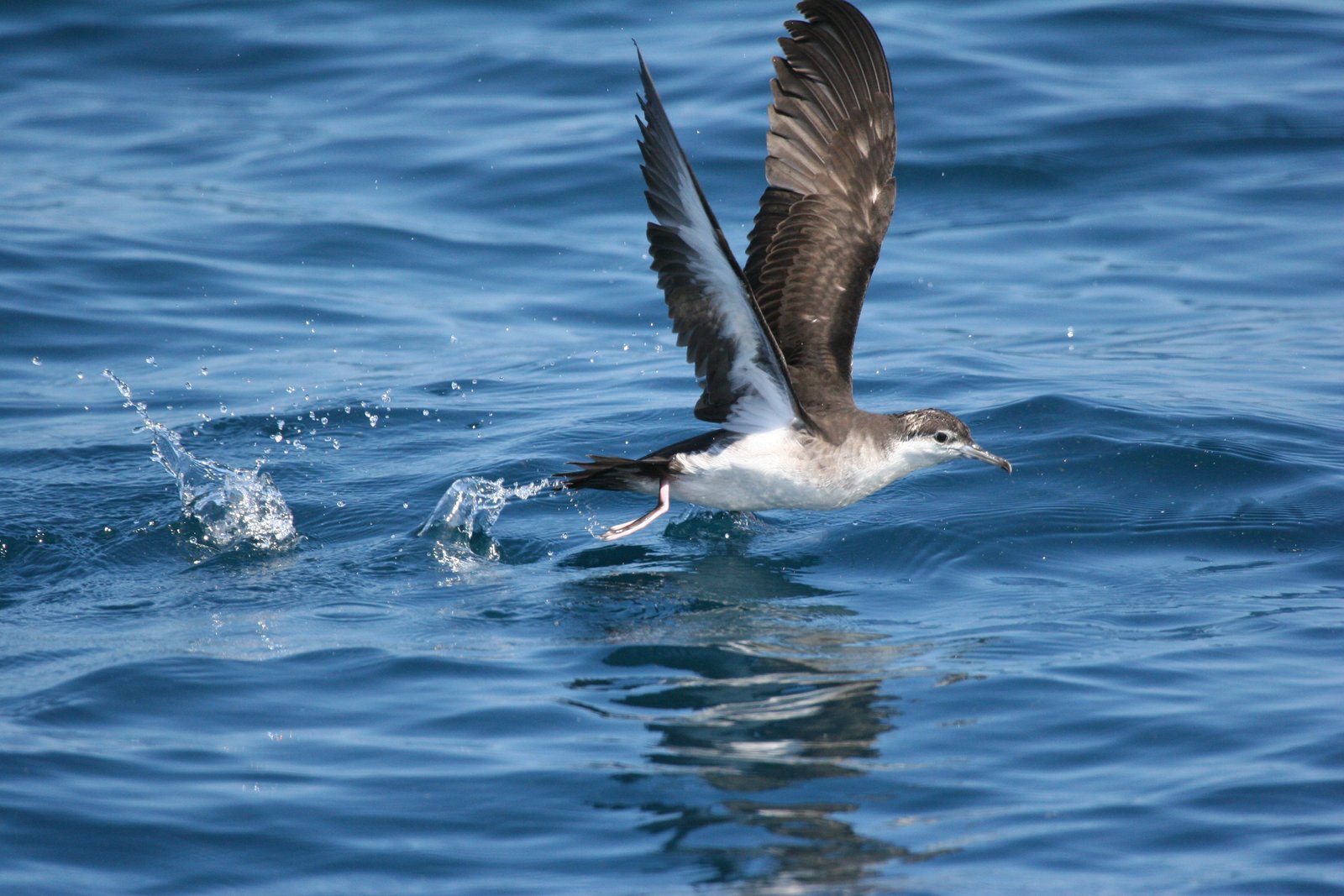
28–30 cm, a small, compact shearwater with short, rounded wings, a relatively long tail and a slender dark bill. The upperparts are dark blackish-brown; the dark cap reaches below the eye. The underparts are white, the undertail coverts dark. The underwing is white with broad dark margins. The legs are pink with dark toes. It flies low over the water with fast, fluttering wingbeats and short glides, and often rests in small groups on the water. The sexes are alike.
Confusion species
Manx Shearwater Puffinus puffinus is larger, with longer wings, blacker upperparts, white undertail coverts and stiffer wingbeats with longer glides. Storm petrels, such as Wilson's Storm Petrel Oceanites oceanicus, are much smaller and entirely dark with a white rump. The closely related Galapagos Shearwater Puffinus subalaris lives on the Pacific side of the guide area; the two do not overlap.
Habitat
Warm tropical seas, both around islands and reefs and further out at sea, often near floating sargassum weed. It feeds on small fish, squid and the larvae of fish and crustaceans, taken from the surface or caught in short dives. It breeds in rock cavities, under stones and in burrows on small islands and rocky coasts, and comes ashore only at night.
Where the bird is most at home, classified by the vegetation units of the Andes and the west coast.


Range and movements
In Colombia at sea in the Caribbean, mainly around the islands of San Andrés and Providencia and the surrounding cays, where it may breed; scarce off the mainland coast, for example near Cartagena. Absent from Ecuador, Peru, Bolivia and the Galápagos; birds there are Galapagos Shearwaters. Outside the guide area in the Caribbean, the Bahamas and Bermuda and in the Gulf Stream off the south-eastern United States.
- Resident
- dark = core range, pale = thinly spread
How and when to look
Around San Andrés and Providencia from boats or from the shore of the cays, especially in the morning and evening, when birds rest on the water close to the breeding islands.
Conservation status
Not Evaluated in the current definition. Introduced rats and cats on breeding islands, disturbance and development of nesting sites and artificial light that disorients young birds are the main threats; eggs and chicks were formerly collected.
Scientific name
Puffinus lherminieri | Lesson, 1839
Lesson described the species in 1839 and placed it straight away in the genus where it still stands. The genus Puffinus was introduced in 1760 by Brisson. The genus name is a Neo-Latin form of English puffin, originally the name for the cured nestlings of the Manx shearwater. The species name honours the French naturalist and pharmacist Félix Louis L'Herminier (1779–1833), who lived and worked on Guadeloupe. The specimen the first description was based on came from Saint Barthélemy, Lesser Antilles.