All species › Tubenoses › Petrels, shearwaters and diving petrels › Peruvian Diving-Petrel
Peruvian Diving-Petrel | Pelecanoides garnotii
Peruaanse alkstormvogel | Potoyunco peruano | Petrel-mergulhador-peruano
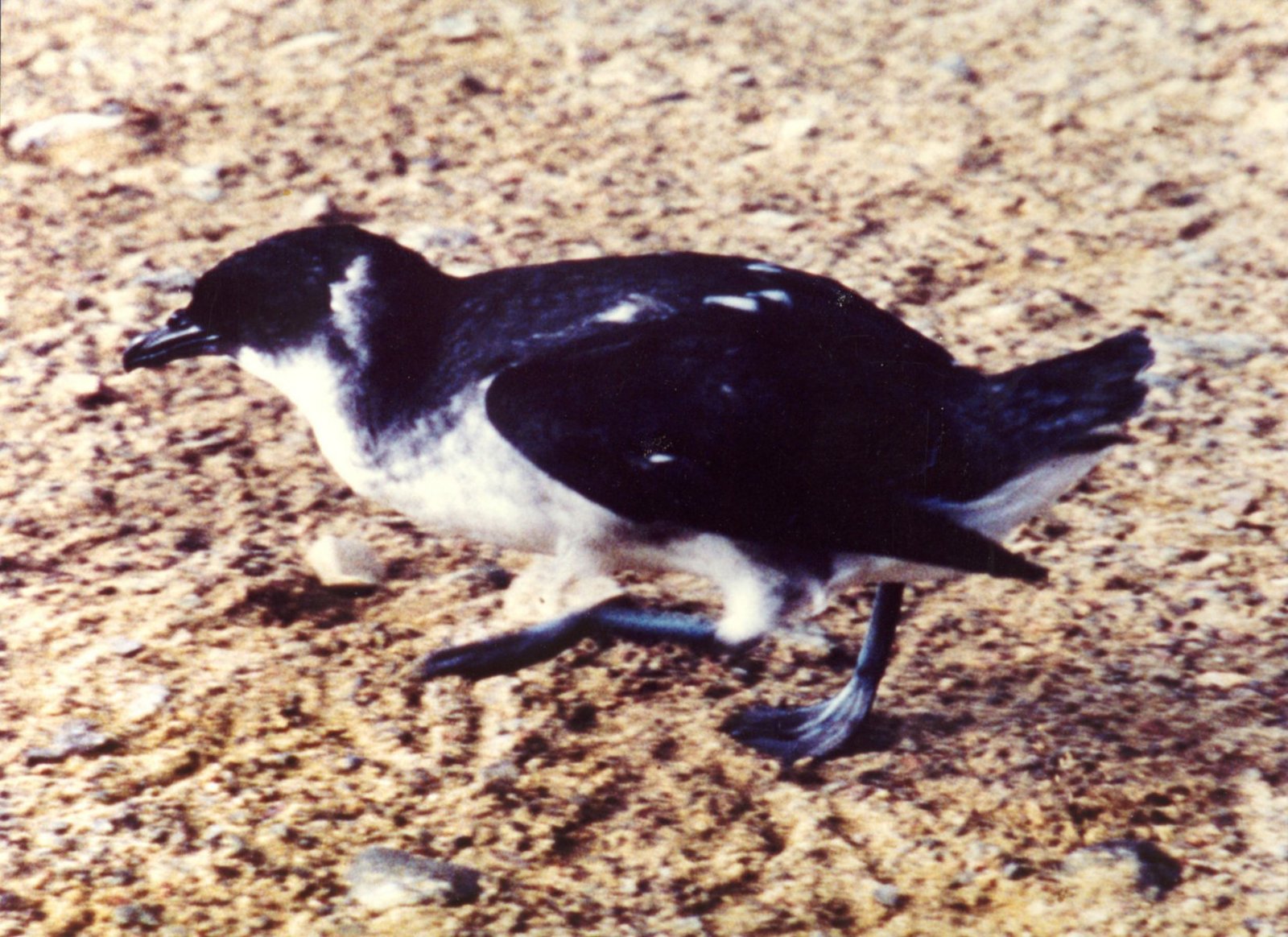
The Peruvian Diving-Petrel is a small, stocky tubenose that resembles a small auk in shape and behaviour: it flies low over the water on whirring wings and dives after its prey with half-open wings. The species occurs only in the cold Humboldt Current along the coast of Peru and Chile. Guano extraction destroyed a large part of its breeding sites in the twentieth century.
Voice
Usually silent at sea. At the breeding sites mewing and croaking calls from the burrows at night.
Recording: Romina Triviño — CC BY-NC-SA 4.0 · xeno-canto
Identification
20–24 cm, a stocky, short-winged seabird with a short tail, a thick neck and a short, broad black bill with upward-facing nostrils. The upperparts are glossy blackish, the scapulars with white fringes. The throat, breast and belly are white; the sides of the head, neck and breast are washed grey. The underwing is greyish. The legs are blue. It flies straight and fast with whirring wingbeats close to the water and often dives straight into the water from flight. The sexes are alike; juveniles are duller.
Confusion species
No other diving-petrel occurs in the guide area. Galapagos Shearwater Puffinus subalaris has longer wings and a slender bill and alternates wingbeats with glides. Storm petrels, such as Ringed Storm-Petrel Hydrobates hornbyi, are slimmer, with long wings, and flutter over the water without diving. Red Phalarope Phalaropus fulicarius also swims in small groups at sea but has a thin bill, pointed wings and pale grey upperparts.
Habitat
Cool, productive inshore waters over the Humboldt Current, usually within a few kilometres of the coast and islands. It feeds mainly on krill and other small crustaceans, also larvae and young of anchovies and other small fish, caught by diving underwater. It breeds in burrows that it digs in guano or soft soil on offshore islands, and in rock crevices; breeding takes place over much of the year.
Where the bird is most at home, classified by the vegetation units of the Andes and the west coast.


Range and movements
In Peru along the entire coast, most numerous around the breeding islands in the centre and south, such as San Gallán near Paracas and the islands of the Reserva Nacional San Fernando; scarcer in the north. A single record from Ecuador. Absent from Colombia, Bolivia and the Galápagos. Outside the guide area along the coast of northern and central Chile.
- Resident
- dark = core range, pale = thinly spread
How and when to look
On boat trips around Paracas, for example to the Islas Ballestas and San Gallán, and on pelagic trips from Pucusana; birds sit in small groups on the water and dive or fly off low as the boat approaches.
Conservation status
Near Threatened. The population declined strongly in the twentieth century because guano extraction destroyed the burrows; hunting, bycatch in gillnets and food shortage during El Niño years also played a role. Since the breeding islands were protected the population has increased again, but the breeding sites are concentrated on few islands.
Scientific name
Pelecanoides garnotii | (Lesson & Garnot, 1828)
Lesson & Garnot described the species in 1828 as Puffinuria Garnotii; because it was later moved to another genus, the author and year stand in brackets. The genus Pelecanoides was introduced in 1799 by De Lacépède. The genus name comes from Greek pelekan, 'pelican', and -oidēs, 'resembling', after the distensible throat pouch. The species name honours Prosper Garnot (1794–1838), French naval surgeon and naturalist on the voyage of the Coquille. The specimen the first description was based on came from Coast of Peru between Isla San Gallán and Lima.