All species › Tubenoses › Petrels, shearwaters and diving petrels › Slender-billed Prion
Slender-billed Prion | Pachyptila belcheri
Dunbekprion | Prión Picofino | Faigão-de-bico-fino
The Slender-billed Prion is a small, blue-grey petrel of the southern oceans with a narrow bill. It breeds on islands in the southern Atlantic and Indian Oceans and off southern Chile, and moves north with the Humboldt Current in the austral winter. In some years large numbers reach the waters off Peru, in other years almost none.
Voice
Silent at sea. In the colonies cooing calls from the burrows at night.
Recording: Kevin Guille — CC BY-NC-SA 4.0 · xeno-canto
Identification
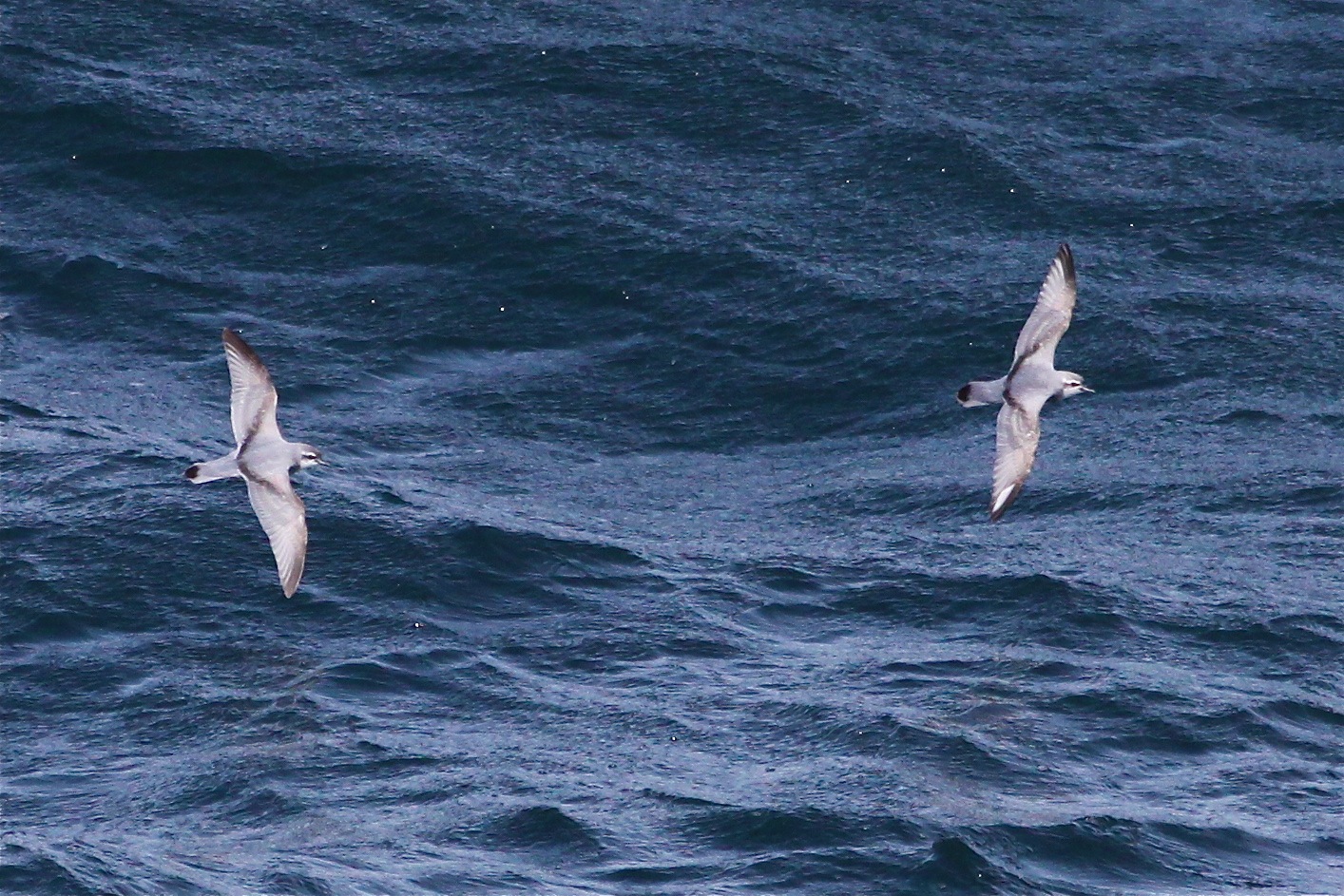
26 cm, a small petrel with a narrow, blue-grey bill. The upperparts are pale blue-grey, with a dark M across the wings and back that is less sharp than in Antarctic Prion. The head is pale, with a broad white supercilium above a dark stripe through the eye. The tail is grey with a narrow dark tip and mostly white below. The underparts are white, with a faint grey patch on the side of the breast. It flies low and fast over the waves, with frequent banking. The sexes are alike.
Confusion species
Antarctic Prion Pachyptila desolata has a broader bill, a darker head with a narrower supercilium, a sharper M and a broader dark tail band. Pintado Petrel Daption capense is larger and chequered black and white. Masatierra Petrel Pterodroma defilippiana has a dark eye mask without a white supercilium and flies in high arcs.
Habitat
Cool inshore waters and open ocean, especially over the Humboldt Current, sometimes close inshore. It feeds on small crustaceans such as amphipods and krill, and on small squid and fish, picked from the surface. It breeds in colonies in burrows on islands with grass or low vegetation, including the Falkland Islands, Kerguelen and Crozet and Isla Noir off southern Chile.
Where the bird is most at home, classified by the vegetation units of the Andes and the west coast.


Range and movements
In Peru at sea in the austral winter, mainly off the southern and central coast; numbers vary greatly from year to year. Few records off Ecuador. Not known from Colombia or Bolivia. It does not breed in the guide area. Outside the guide area it breeds on the Falkland Islands, off southern Chile and in the southern Indian Ocean; outside the breeding season north to off Peru, Uruguay and southern Brazil and in the waters around South Africa and Australia.
How and when to look
On pelagic trips from harbours in southern and central Peru between June and October, especially in cool years; prions fly past low and fast and rarely stay near boats.
Conservation status
Least Concern. The world population is large. Introduced rats, cats and mice on breeding islands are local threats.
Scientific name
Pachyptila belcheri | (Mathews, 1912)
Mathews described the species in 1912 as Heteroprion belcheri; because it was later moved to another genus, the author and year stand in brackets. The genus Pachyptila was introduced in 1811 by Illiger. The genus name comes from Greek pakhus, 'thick', and ptilon, 'feather', after the dense plumage. The species name honours Charles Frederic Belcher (1876–1970), Australian judge and amateur ornithologist, who found the first specimens near Geelong. The specimen the first description was based on came from Geelong, Victoria, Australia.