All species › Passerines › Ovenbirds and woodcreepers › Piping Long-tailed Woodcreeper
Piping Long-tailed Woodcreeper | Deconychura typica
Kleine langstaartmuisspecht | Trepatroncos colilargo pequeño | Arapaçu-rabudo-pequeno
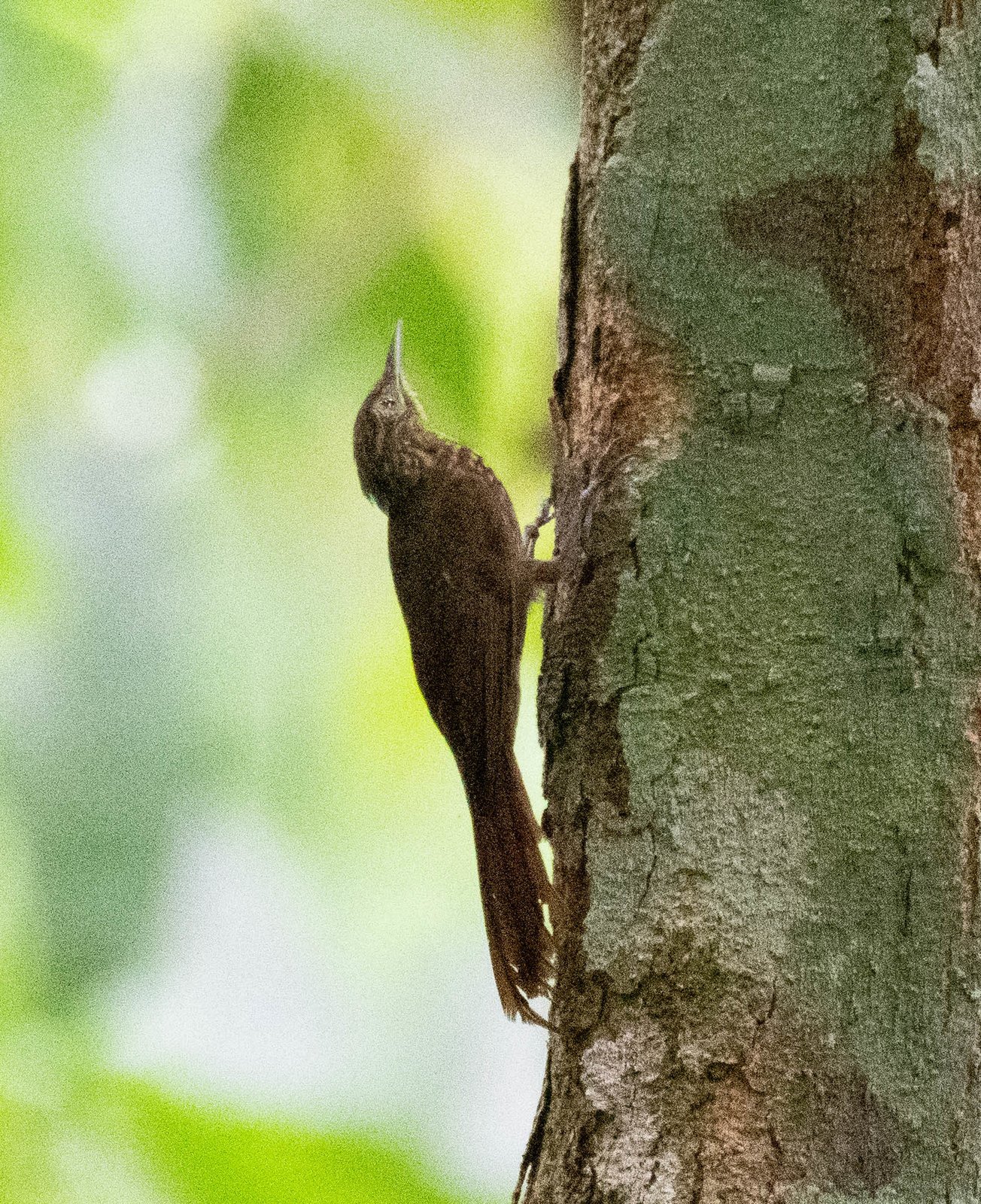
The Piping Long-tailed Woodcreeper is the northernmost of the three long-tailed woodcreepers, formerly treated as a single species. It lives from Central America to north-western Colombia. It is a slender, plainly marked woodcreeper with a long tail that moves inconspicuously through the interior of humid forest.
Voice
The song is a series of high, clear, piping whistles, to which the English name refers. The call is a short, sharp cheet.
No recording with a suitable Creative Commons licence is available for this species yet.
Identification
18–20 cm, slender, with a thin, straight bill and a long, stiff, rufous tail. The upperparts are olive-brown, and the wings, rump and tail rufous. A narrow buff supercilium runs behind the eye. The throat is buff, and the crown and breast finely streaked or spotted buff on an olive-brown ground; the belly is plain. Males are slightly larger than females; otherwise the sexes are alike.
Confusion species
Wedge-billed Woodcreeper Glyphorynchus spirurus is much smaller, with a short, wedge-shaped bill. Plain-brown Woodcreeper Dendrocincla fuliginosa is larger and bulkier, without streaks on breast and crown, and has a grey cheek. Olivaceous Woodcreeper Sittasomus griseicapillus has a plain greyish-olive head and breast and a shorter tail. Other woodcreepers in the same forest, such as Xiphorhynchus, have a longer, heavier bill and bolder streaks.
Habitat
The interior of humid lowland and foothill forest and lower montane forest, also older secondary forest, from sea level to about 1500 m. It climbs trunks in the lower and middle levels and searches bark and moss for insects and spiders, often in mixed flocks. The nest is in a cavity or crevice in a tree.
Where the bird is most at home, classified by the vegetation units of the Andes and the west coast.


Range and movements
Colombia: in the north-west, in the northern Pacific lowlands and the Chocó, around the Gulf of Urabá and in the northern foothills of the Andes. Absent from Ecuador, Peru, Bolivia and the Galápagos. Outside the guide area from Honduras to Panama.
- Resident
- dark = core range, pale = thinly spread
How and when to look
Follow mixed flocks in the interior of humid forest in north-western Colombia and watch for a slender, long-tailed woodcreeper climbing low on trunks. The piping song is heard mainly in the early morning.
Conservation status
Least Concern. The species lives in undisturbed forest and disappears where forest is cleared; much lowland forest in north-western Colombia has been lost.
Scientific name
Deconychura typica | Cherrie, 1891
Cherrie described the species in 1891 and placed it straight away in the genus where it still stands. He introduced the genus Deconychura in that same work. The genus name comes from Greek deka, 'ten', onux, 'claw', and oura, 'tail'. Cherrie believed the bird had ten tail feathers with stiff, projecting shaft tips; it was later shown to have twelve. The species name comes from Latin typicus, 'typical', because this is the type species of the genus. The specimen the first description was based on came from Pozo Azul de Pirrís, Costa Rica.