All species › Passerines › Ovenbirds and woodcreepers › Whistling Long-tailed Woodcreeper
Whistling Long-tailed Woodcreeper | Deconychura longicauda
Noordelijke langstaartmuisspecht | Trepatroncos colilargo norteño | Arapaçu-rabudo
The Whistling Long-tailed Woodcreeper is one of the three long-tailed woodcreepers, formerly treated as a single species. It lives in the north-eastern Amazon and on the Guiana Shield. It has not been confirmed in the guide area; at most it occurs in the far east of Colombia.
Voice
The song is a series of clear, whistled notes, to which the English name refers. The call is a short, sharp cheet.
Recording: Juan Freile — CC BY-NC-SA 4.0 · xeno-canto
Identification
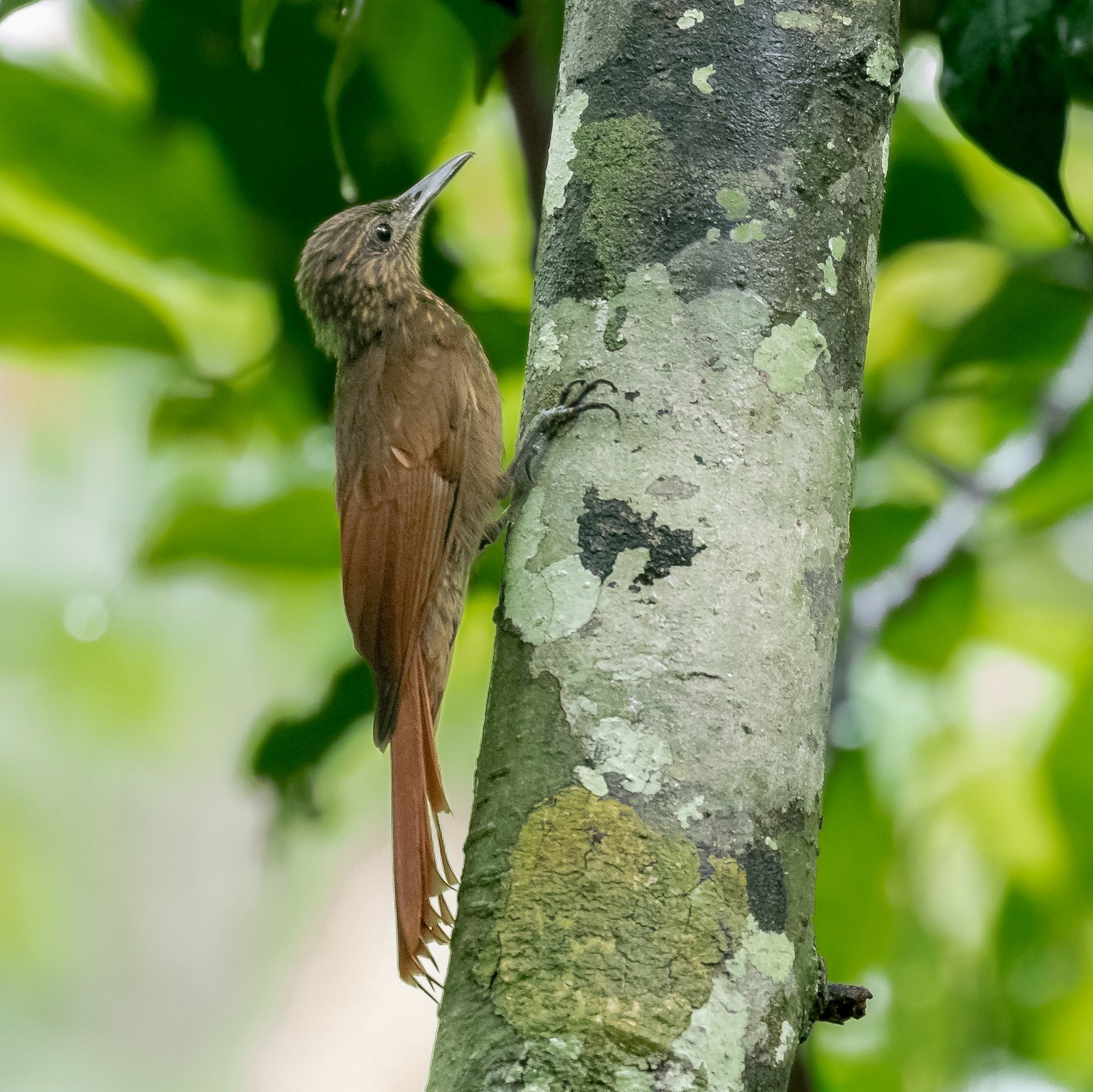
19–21 cm, slender, with a thin, straight bill and a long, stiff, rufous tail. The upperparts are olive-brown, and the wings, rump and tail rufous. A narrow buff supercilium runs behind the eye. The throat is buff, and the crown and breast finely streaked buff on an olive-brown ground; the belly is plain. Males are slightly larger than females; otherwise the sexes are alike.
Confusion species
Mournful Long-tailed Woodcreeper Deconychura pallida is very similar and is best separated by song; it lives to the south and west of this species. Spot-throated Woodcreeper Certhiasomus stictolaemus is smaller, with a shorter tail and a spotted throat. Wedge-billed Woodcreeper Glyphorynchus spirurus is much smaller, with a short, wedge-shaped bill.
Habitat
The interior of humid terra firme rainforest in the lowlands and on low hills. It climbs trunks in the lower and middle levels and searches bark and moss for insects and spiders, often in mixed flocks. The nest is in a cavity or crevice in a tree.
Where the bird is most at home, classified by the vegetation units of the Andes and the west coast.

Range and movements
Not confirmed in the guide area; possibly in the far east of Colombia, along the borders with Venezuela and Brazil. Absent from Ecuador, Peru, Bolivia and the Galápagos. Outside the guide area in southern Venezuela, the Guianas and northern Brazil north of the Amazon.
- Resident
- dark = core range, pale = thinly spread
How and when to look
Long-tailed woodcreepers in the far east of Colombia can only be assigned to species by song. A sound recording is therefore the most useful evidence of occurrence in the guide area.
Conservation status
Least Concern. The species lives in large, little-disturbed forests in the north-eastern Amazon.
Scientific name
Deconychura longicauda | (Pelzeln, 1868)
Pelzeln described the species in 1868 as Dendrocincla longicauda; because it was later moved to another genus, the author and year stand in brackets. The genus Deconychura was introduced in 1891 by Cherrie. The genus name comes from Greek deka, 'ten', onux, 'claw', and oura, 'tail'. Cherrie believed the bird had ten tail feathers with stiff, projecting shaft tips; it was later shown to have twelve. The species name comes from Latin longus, 'long', and cauda, 'tail'. The specimen the first description was based on came from Amazonas, Brazil.