All species › Passerines › Tanagers and allies › Puna Yellow Finch
Puna Yellow Finch | Sicalis lutea
Punasaffraangors | Chirigüe puneño | Canário-da-puna
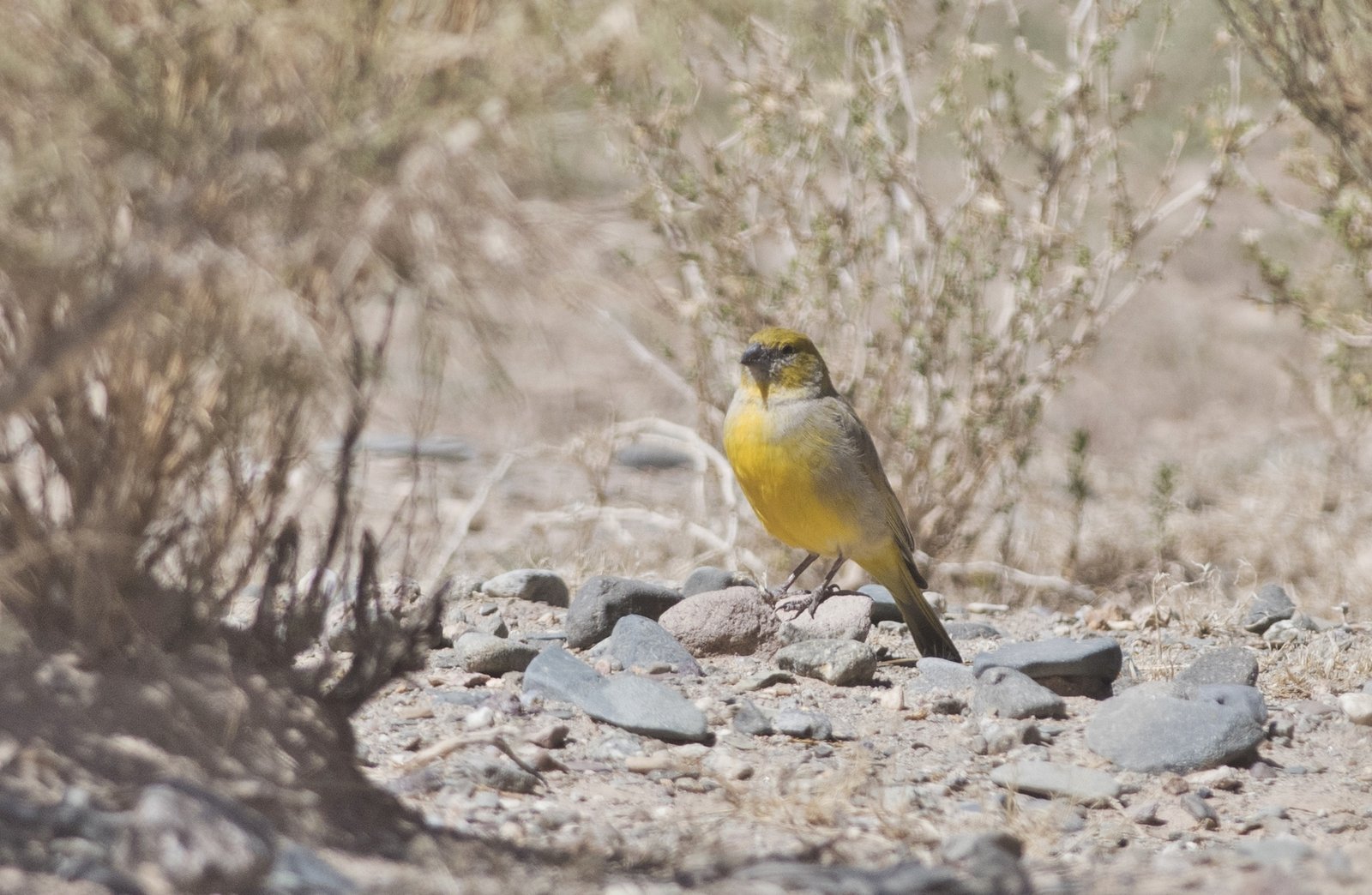
The Puna Yellow Finch is a bright yellow finch of the high plateaus of southern Peru and western Bolivia. It often lives in flocks, which outside the breeding season may number tens to hundreds of birds, on fields and grassland of the puna. Of the high-Andean yellow finches it is the yellowest.
Voice
Flocks give a constant chirping and twittering. The song is a short, varied series of chipping and buzzy notes. The call is a short chip.
Recording: Joseph Tobias and Nathalie Seddon — CC BY-NC-SA 3.0 · xeno-canto
Identification
13–14 cm, with a short, conical bill. The male is largely bright yellow: the head, rump and underparts are uniform yellow, and the mantle is yellowish olive and barely streaked. The wings and tail are dark, with yellow edges to the feathers. The female is duller, with more olive-grey upperparts and paler yellow underparts. Juveniles are drabber, with faint streaks on the back.
Confusion species
Bright-rumped Yellow Finch Sicalis uropygialis has a grey back and grey cheeks, with a contrasting yellow rump. Greenish Yellow Finch Sicalis olivascens is more olive-green and less bright yellow, and usually lives lower, in dry scrub and fields. Raimondi's Yellow Finch Sicalis raimondii has a greyer back and grey flanks and lives lower, on the western slopes. Grassland Yellow Finch Sicalis luteola is clearly streaked above.
Habitat
Puna grassland, fields and fallow land, the surroundings of villages and farms, and the edges of bofedales, mostly between about 3500 and 4600 m. It feeds in flocks on the ground on seeds. It nests in cavities, including in walls, rock crevices and banks.
Where the bird is most at home, classified by the vegetation units of the Andes and the west coast.


Range and movements
Absent from Colombia, Ecuador and the Galápagos. In Peru in the southern Andes, mainly around Lake Titicaca and in Puno, Arequipa, Moquegua and Tacna. In Bolivia on the altiplano of La Paz, Oruro and Potosí. Outside the guide area in northern Chile and north-western Argentina.
- Resident
- dark = core range, pale = thinly spread
How and when to look
Search fields and grassland around Lake Titicaca and elsewhere on the altiplano for feeding flocks. Flocks are largest outside the breeding season.
Conservation status
Least Concern. The species is locally common on the altiplano and makes use of fields and the surroundings of villages.
Scientific name
Sicalis lutea | (d'Orbigny, ACVMD & de Lafresnaye, 1837)
D'Orbigny, ACVMD & de Lafresnaye described the species in 1837 as Emberiza lutea; because it was later moved to another genus, the author and year stand in brackets. The genus Sicalis was introduced in 1828 by Boie. The genus name comes from Greek sikalis, a small black-headed bird, perhaps a warbler of the genus Sylvia. The species name comes from Latin luteus, 'yellow'. The specimen the first description was based on came from Oruro, Bolivia.