All species › Passerines › Tanagers and allies › Stripe-tailed Yellow Finch
Stripe-tailed Yellow Finch | Sicalis citrina
Witstaartsaffraangors | Chirigüe citrino | Canário-rasteiro
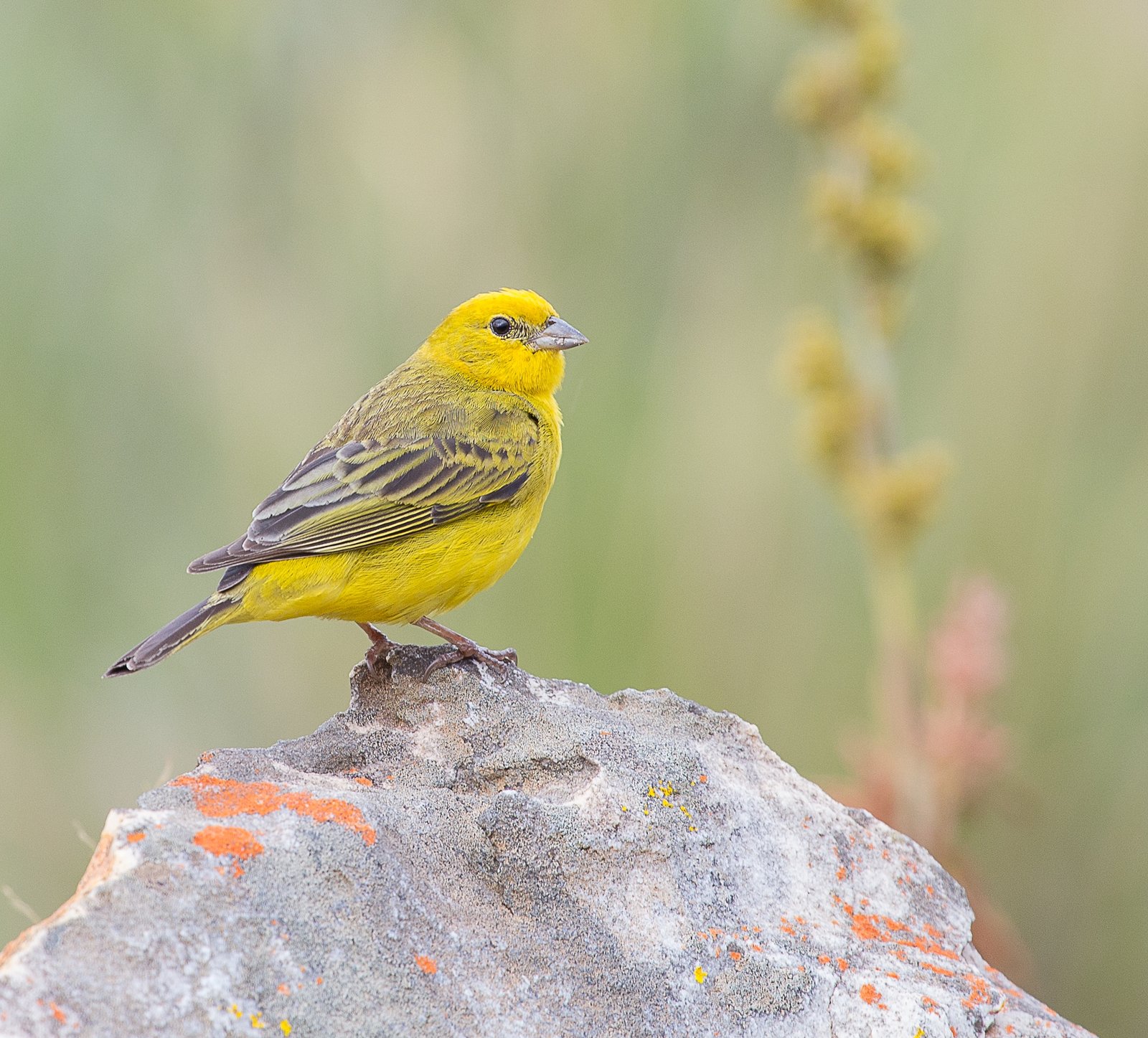
The Stripe-tailed Yellow Finch is a small yellow finch of grassy slopes and open grassland in hilly and mountainous country. Its hallmark is the white patches on the inner webs of the outer tail feathers, which show mainly in flight and from below. In the guide area the species is very local and irregular.
Voice
The song is a short series of dry, buzzy and chipping notes, often given from a shrub or post. The call is a short, metallic tsip.
Recording: JAYRSON ARAUJO DE OLIVEIRA — CC BY-NC-SA 4.0 · xeno-canto
Identification
11–12 cm, with a short, conical bill. The male is olive-yellow above with fine dark streaks on the mantle and back, and a yellower forehead and crown; the underparts are yellow, washed olive on the breast. The tail is dark, with white patches on the inner webs of the two outer pairs of tail feathers. The female is browner olive and more heavily streaked above, pale yellow to dull white below with fine streaks on the breast and flanks; she also shows white in the tail. Juveniles resemble the female.
Confusion species
Grassland Yellow Finch Sicalis luteola is more heavily streaked above, has more yellow around the eye and lacks white in the tail. Saffron Finch Sicalis flaveola is larger and more uniformly yellow, with an orange forehead and a barely streaked back. Orange-fronted Yellow Finch Sicalis columbiana lives in the lowlands, has an orange forehead and no white in the tail. Female seedeaters Sporophila have a thicker, curved bill and are unstreaked.
Habitat
Grassy slopes, open grassland with scattered shrubs, rocky pastures and field edges, in the guide area mainly between about 500 and 2800 m. It lives in pairs or small groups and feeds on the ground on grass seeds. The nest is on or near the ground, hidden in a grass tussock or among stones.
Where the bird is most at home, classified by the vegetation units of the Andes and the west coast.


Range and movements
In Colombia very local in the Andes, including the Eastern Andes and the Sierra Nevada de Santa Marta. Not confirmed with certainty in Ecuador. In Peru local in the Andes, mainly in the south. In Bolivia local on the eastern slopes and in the eastern hill country. Absent from the Galápagos. Outside the guide area in Venezuela, the Guianas, Brazil (mainly the cerrado) and northern Argentina.
- Resident
- dark = core range, pale = thinly spread
How and when to look
Search open, grassy slopes for pairs that flush and show the white tail patches as they fly. The species is local and irregular; sites with recent records offer the best chance.
Conservation status
Least Concern. The species is local and scarce, but has a large range and tolerates grazed grassland. Conversion of natural grassland to cropland and plantations reduces its habitat.
Scientific name
Sicalis citrina | Pelzeln, 1870
Pelzeln described the species in 1870 and placed it straight away in the genus where it still stands. The genus Sicalis was introduced in 1828 by Boie. The genus name comes from Greek sikalis, a small black-headed bird, perhaps a warbler of the genus Sylvia. The species name comes from Latin citrinus, 'lemon-yellow'. The specimen the first description was based on came from Jaguariaíva, Paraná, Brazil.