All species › Passerines › Tanagers and allies › Swallow Tanager
Swallow Tanager | Tersina viridis
Zwaluwtangare | Tangara golondrina | Saí-andorinha
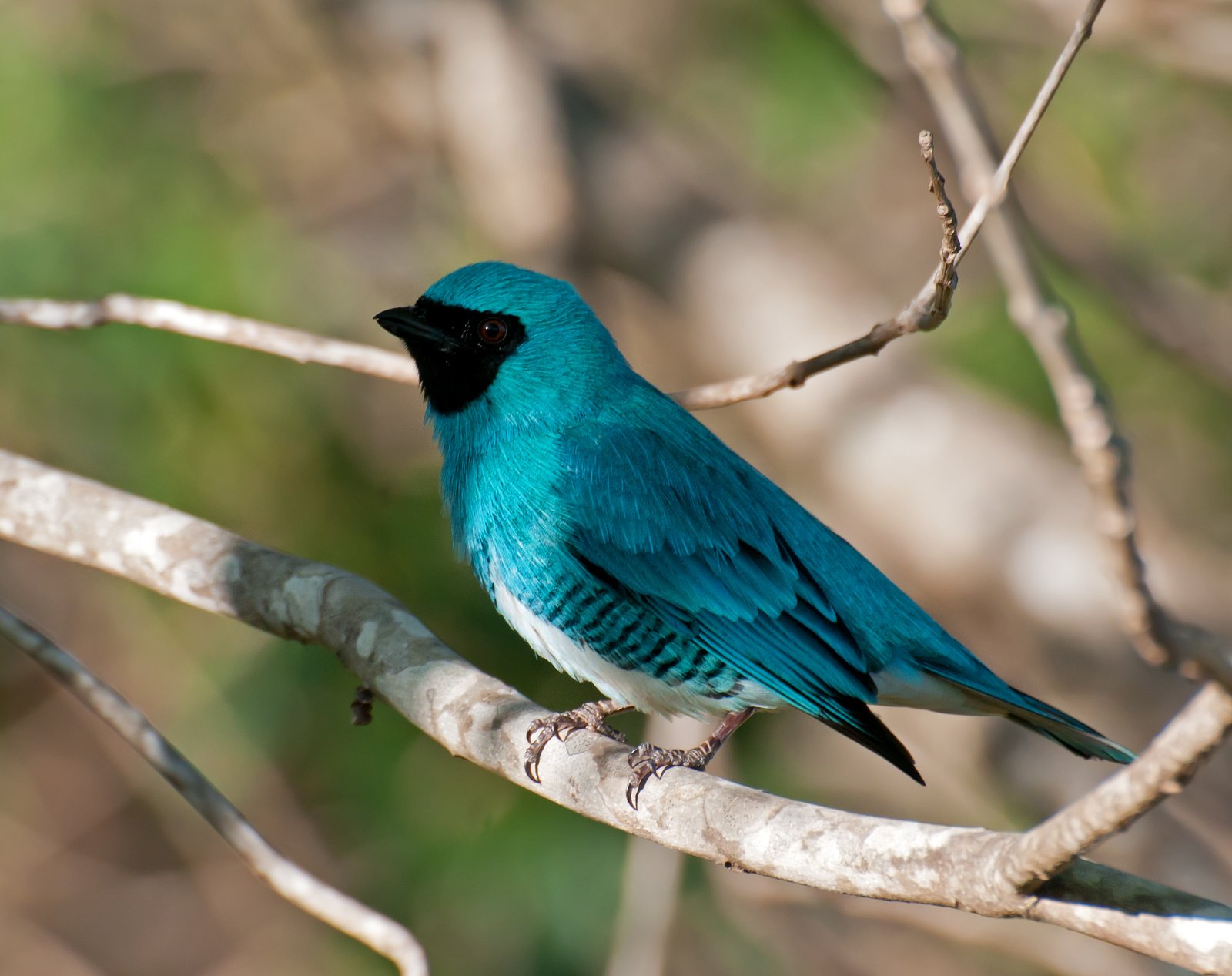
The Swallow Tanager is an aberrant tanager with a broad, flat bill and long wings, which it uses to catch insects in the air from a bare branch like a swallow or flycatcher. It also eats a lot of fruit. Unlike almost all other tanagers it nests in a tunnel it digs in a steep bank or roadcut.
Voice
Gives sharp, metallic tseet or cheep notes, often in flight; the song is a soft, twittering series.
Recording: Jacob Wijpkema — CC BY-NC-SA 4.0 · xeno-canto
Identification
14–15 cm, with a broad, flat black bill and long, pointed wings. The male is glossy turquoise-blue with a black mask over the forehead, face and throat; the belly is white and the flanks are barred black; the flight feathers and tail are black with blue edges. The female is bright grass-green, with a greyish-brown face and throat, a yellow belly and green-barred flanks. Young males are green with blue patches.
Confusion species
Male Blue Dacnis Dacnis cayana is smaller, with a pointed bill, a black back and black throat, but lacks the white, barred belly. The female resembles female honeycreepers and dacnises, but the broad bill, barred flanks and upright posture on an exposed perch separate her. Turquoise Tanager Tangara mexicana is dark blue with a yellow belly.
Habitat
Edges of humid forest in the foothills and on the lower slopes, clearings with scattered tall trees, forest edges along rivers and roads, and coffee and cacao plantations, mainly between 300 and 1800 m, also lower. It perches upright on an exposed perch, makes sallies after insects and also eats fruit. It nests in a tunnel in an earth bank; outside the breeding season sometimes in groups.
Where the bird is most at home, classified by the vegetation units of the Andes and the west coast.


Range and movements
In Colombia widespread in the Andes and adjacent lowlands, on both sides of the ranges. In Ecuador on both sides of the Andes, mainly in the foothills. In Peru mainly on the eastern slope of the Andes and in the adjacent lowlands. In Bolivia along the eastern base of the Andes and in the northern lowlands. Does not occur on the Galápagos. Outside the guide area from eastern Panama to Venezuela, the Guianas, Brazil, Paraguay and north-eastern Argentina.
- Resident
- dark = core range, pale = thinly spread
How and when to look
Along foothill roads, look for an upright bird on a bare branch above a forest edge; in the breeding season pairs fly to and from steep earth roadcuts.
Conservation status
Least Concern. Widespread and locally fairly common; benefits in part from semi-open landscapes with forest remnants.
Scientific name
Tersina viridis | (Illiger, 1811)
Illiger described the species in 1811 as Hirundo viridis; because it was later moved to another genus, the author and year stand in brackets. The genus Tersina was introduced in 1819 by Vieillot. The genus name comes from French Tersine, an unidentified bird described by Buffon. The species name is Latin viridis, 'green'. The specimen the first description was based on came from eastern Brazil.