All species › Passerines › Tanagers and allies › Red-shouldered Tanager
Red-shouldered Tanager | Tachyphonus phoenicius
Roodschoudertangare | Tangara de galones | Tem-tem-de-dragona-vermelha
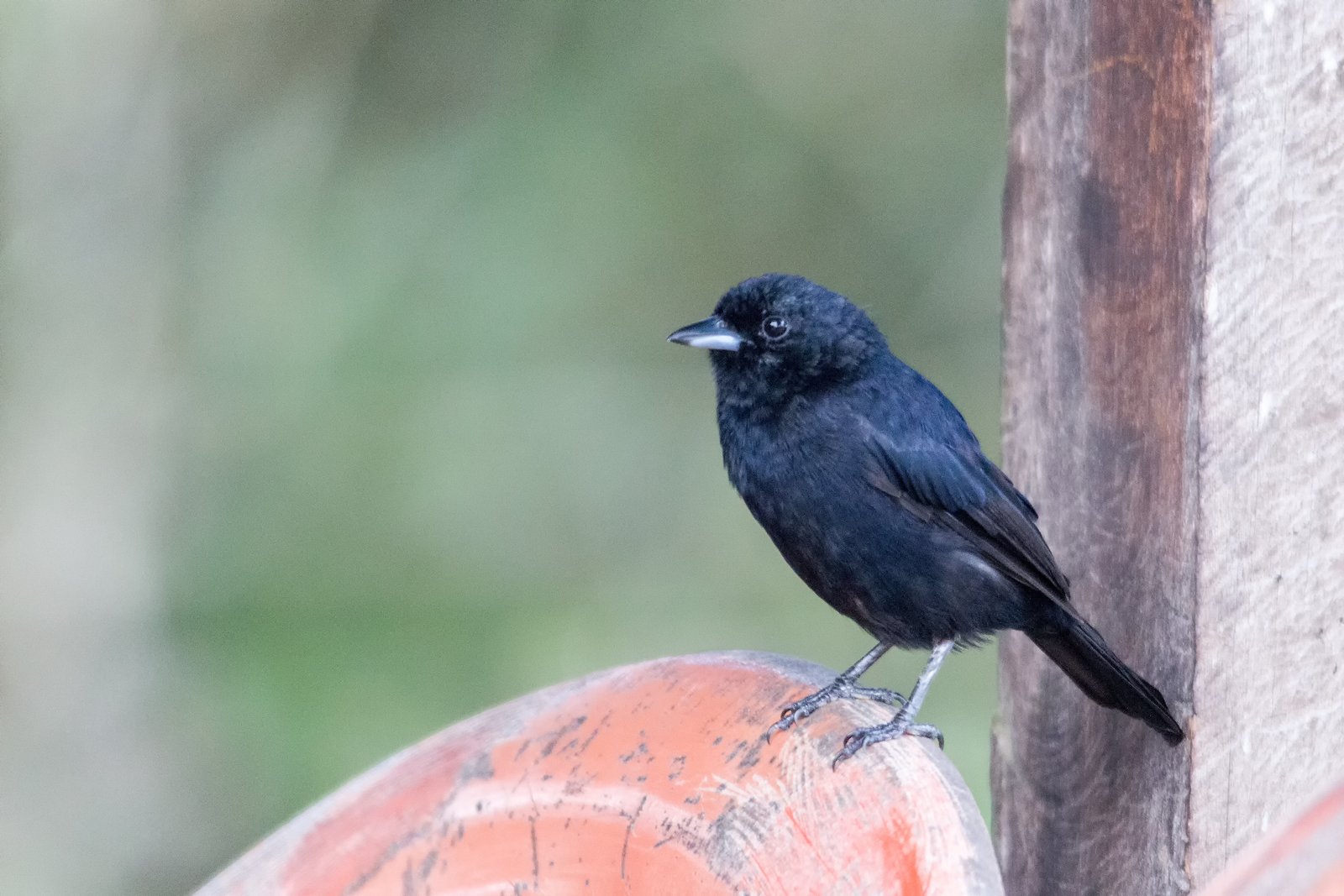
The Red-shouldered Tanager is a tanager of savannas and open scrub on poor, sandy soils in northern South America. The male is glossy black with a small red and white shoulder patch that usually stays concealed. In the guide area the species occurs only locally, in isolated savanna areas east of the Andes.
Voice
Gives a dry chip; the song is a simple series of high, chirping notes, often given from an exposed perch on top of a shrub.
Recording: Mauricio Cuéllar Ramírez — CC BY-NC-SA 4.0 · xeno-canto
Identification
15–16 cm, with a pointed, dark bill. The male is entirely glossy blue-black, with a small shoulder patch that is red above and white below; it is usually largely concealed and becomes visible when the bird lifts its wings. The female is dark grey-brown above, with a greyish head, and pale grey to dull white below. Juveniles resemble the female.
Confusion species
The male White-lined Tanager Tachyphonus rufus is larger, has a blue-grey bill with a dark tip and no red on the shoulder; the female is uniform rufous. The male White-shouldered Tanager Loriotus luctuosus has a large white shoulder patch and lives in forest. Black seedeaters such as Blue-black Grassquit Volatinia jacarina are much smaller and have a conical bill.
Habitat
Open savanna with scattered shrubs, scrub on white-sand soils and the edges of low woodland in savanna areas, in the guide area in the lowlands. It searches shrubs and low trees in pairs for insects and fruit. The nest is a cup of grasses near or on the ground.
Where the bird is most at home, classified by the vegetation units of the Andes and the west coast.


Range and movements
In Colombia in savannas and on sandy soils in the east, mainly in Vichada, Guainía and Vaupés. Absent from Ecuador. In Peru very local in isolated savannas in the east, including the Pampas del Heath in Madre de Dios. In Bolivia in savannas and cerrado in the north and east, mainly in Beni and north-eastern Santa Cruz. Absent from the Galápagos. Outside the guide area in Venezuela, the Guianas and locally in northern and central Brazil.
- Resident
- dark = core range, pale = thinly spread
How and when to look
In open savanna with scattered shrubs, look for a black tanager perched on top of a bush; the red shoulder patch is mainly visible when it moves its wings or takes off.
Conservation status
Least Concern. The species is widespread, but in the guide area it is tied to isolated savannas, which are locally converted to farmland or frequently burnt.
Scientific name
Tachyphonus phoenicius | Swainson, 1838
Swainson described the species in 1838 and placed it straight away in the genus where it still stands. The genus Tachyphonus was introduced in 1816 by Vieillot. The genus name combines Greek takhus, 'fast', and phōneō, 'to speak' or 'to make a sound'. The specific name comes from Greek phoinikeos, 'crimson', referring to the red shoulder patch. The specimen the first description was based on came from Eastern Peru.