All species › Passerines › Tanagers and allies › White-lined Tanager
White-lined Tanager | Tachyphonus rufus
Zwarte tangare | Tangara filiblanca | Pipira-preta
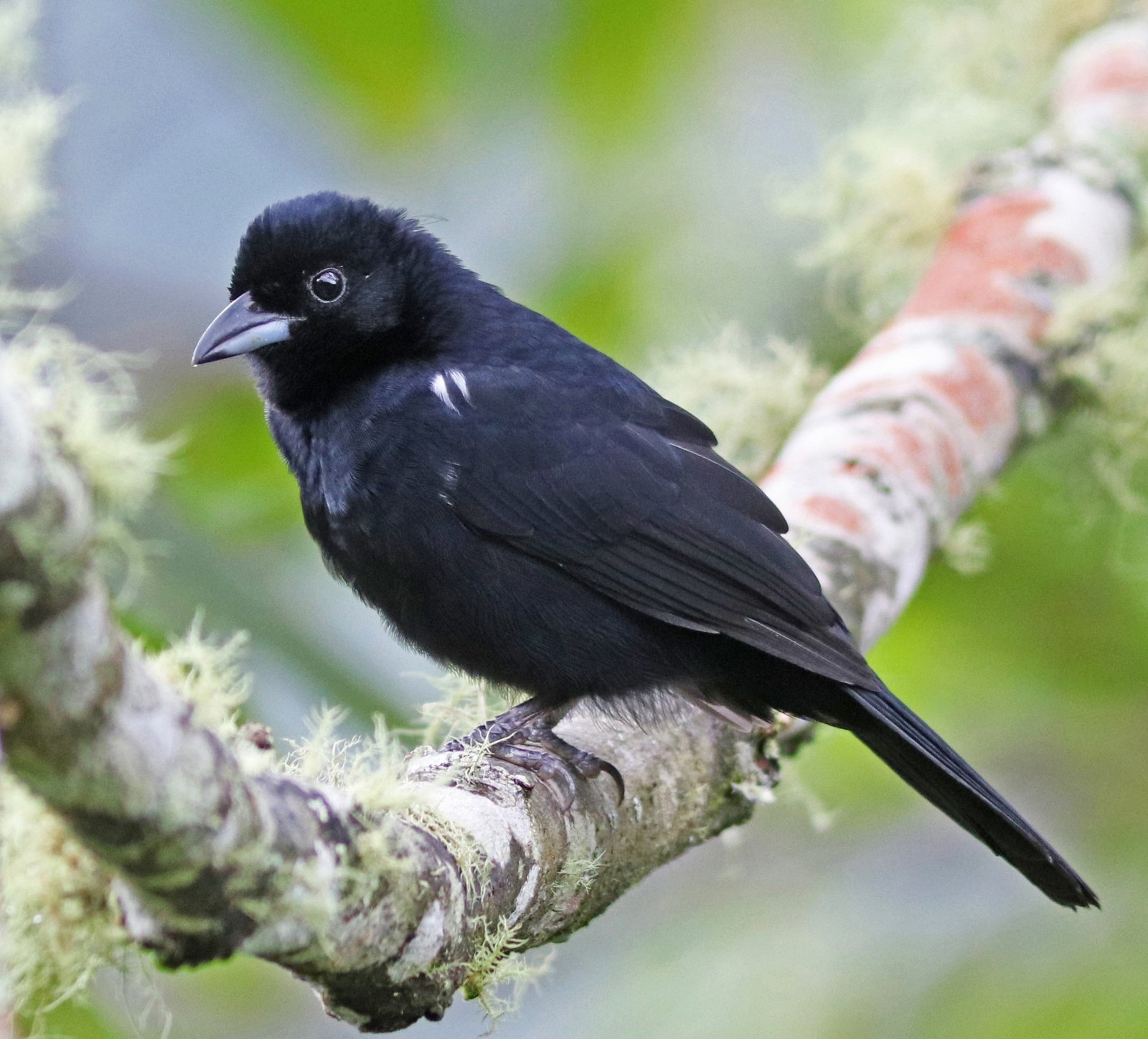
The White-lined Tanager is a tanager of forest edges, clearings and gardens in the lowlands. Male and female differ strongly: the male is glossy black, the female uniform rufous. The name refers to the white underwing coverts of the male, which are mainly visible in flight.
Voice
Gives a sharp chek; the song is a cheerful, repeated series of short, chirping notes, often in the early morning.
Recording: JAYRSON ARAUJO DE OLIVEIRA — CC BY-NC-SA 4.0 · xeno-canto
Identification
18–19 cm, with a fairly stout, pointed bill that is blue-grey with a dark tip. The male is entirely glossy blue-black, with a small white shoulder patch (often concealed) and white underwing coverts, which show as white flashes in flight. The female is uniform rufous to cinnamon-brown, slightly paler below. Juveniles resemble the female.
Confusion species
The male White-shouldered Tanager Loriotus luctuosus is smaller, has a large white shoulder patch and lives in the forest canopy. The female Silver-beaked Tanager Ramphocelus carbo is dark reddish-brown with a redder belly, not uniformly rufous. Red-shouldered Tanager Tachyphonus phoenicius is smaller; the male has a red and white shoulder patch, the female is grey-brown with pale underparts.
Habitat
Forest edges, clearings, scrub, plantations, gardens and parks in the lowlands and lower slopes, mostly up to roughly 1800 m, locally higher. It lives in pairs and searches shrubs and trees for fruit, nectar and insects; it avoids closed forest. The nest is a cup low in a shrub.
Where the bird is most at home, classified by the vegetation units of the Andes and the west coast.


Range and movements
In Colombia widespread in the lowlands and lower slopes, both west and east of the Andes. In Ecuador mainly in the west, locally also in the east. In Peru mainly in the north and along the eastern foothills of the Andes. In Bolivia in the lowlands of the north and east. Absent from the Galápagos. Outside the guide area from Costa Rica to Venezuela, Trinidad, the Guianas, much of Brazil, Paraguay and north-eastern Argentina.
- Resident
- dark = core range, pale = thinly spread
How and when to look
In gardens, along roadsides and at forest edges, look for a pair consisting of a black and a rufous bird moving together; in flight watch for the white underwing of the male.
Conservation status
Least Concern. The species is widespread and benefits from open, human-shaped landscapes.
Scientific name
Tachyphonus rufus | (Boddaert, 1783)
Boddaert described the species in 1783 as Tangara rufa; because it was later moved to another genus, the author and year stand in brackets. The genus Tachyphonus was introduced in 1816 by Vieillot. The genus name combines Greek takhus, 'fast', and phōneō, 'to speak' or 'to make a sound'. The specific name comes from Latin rufus, 'rufous', referring to the rufous female; the male is black. The specimen the first description was based on came from Cayenne, French Guiana.