All species › Passerines › Tanagers and allies › Tawny-crested Tanager
Tawny-crested Tanager | Tachyphonus delatrii
Taankuiftangare | Tangara crestinaranja | Tem-tem-de-crista-fulva
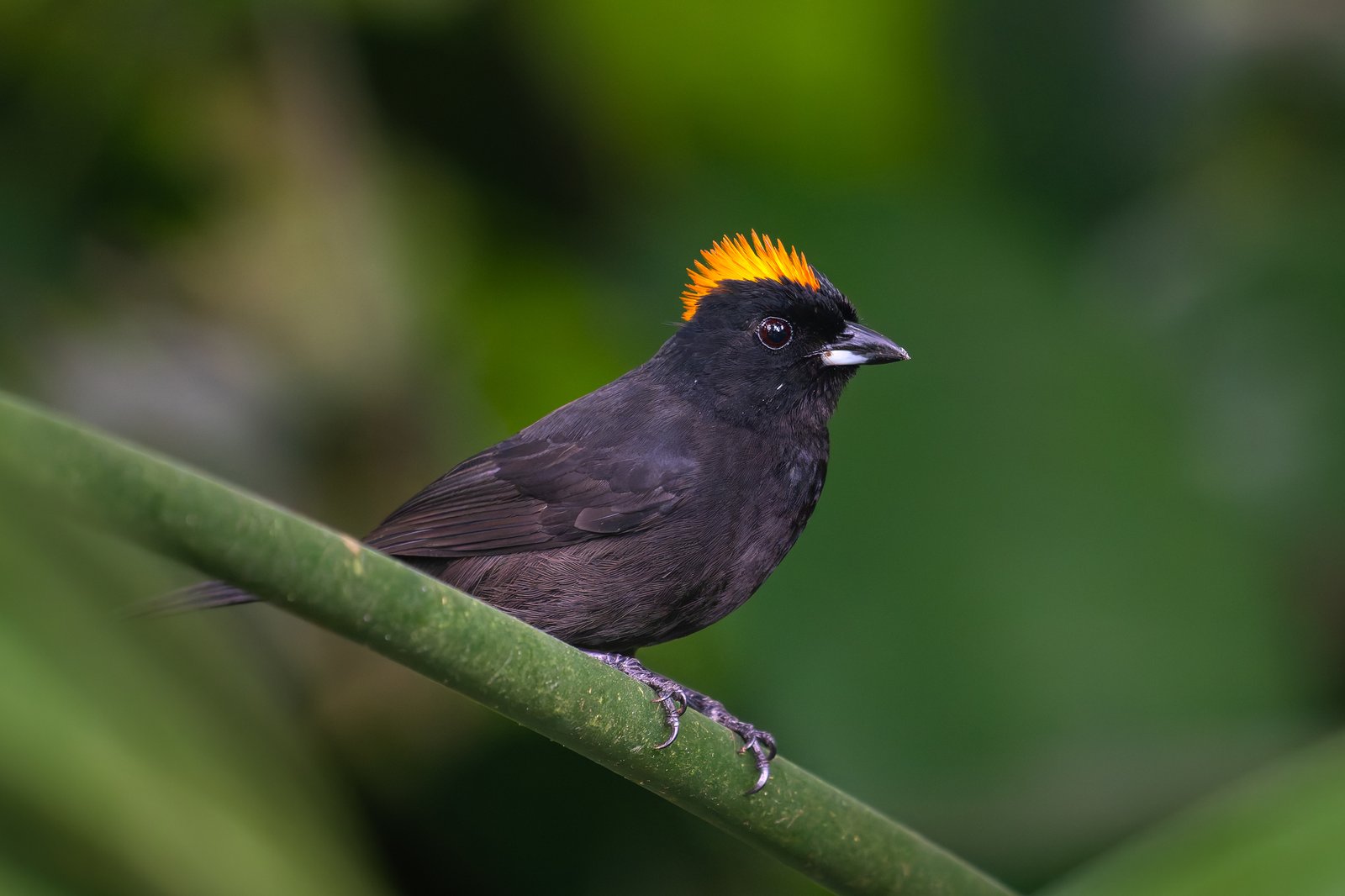
The Tawny-crested Tanager is a small black tanager of humid forest on the Pacific side of Colombia and Ecuador. The male has a pointed, orange-yellow crest. The species lives in noisy flocks of sometimes dozens of birds that move rapidly through the lower and middle levels of the forest.
Voice
Flocks give constant sharp, metallic chip and tseet calls; a true song is rarely reported.
Recording: rudy gelis — CC BY-NC-SA 4.0 · xeno-canto
Identification
14 cm, with a fairly short, pointed, black bill. The male is entirely dull black, with a conspicuous, pointed crest of tawny orange-yellow on the crown. The female is uniform dark olive-brown, slightly paler below and without a crest. Juveniles resemble the female.
Confusion species
The male White-shouldered Tanager Loriotus luctuosus has a large white shoulder patch and no coloured crest. The male White-lined Tanager Tachyphonus rufus is larger, has a pale bill base and white underwing coverts, and lives in open and semi-open country rather than the forest interior. Females of ant tanagers (Habia, Driophlox) are larger, more reddish-brown and do not move in fast, noisy flocks.
Habitat
The interior and edges of humid lowland and foothill forest, also tall secondary forest, from sea level to roughly 1200 m. It moves in its own fast-moving flocks through the lower and middle levels, often with other species following, and searches foliage and branches for insects; it also eats fruit. The nest is a cup low in the vegetation.
Where the bird is most at home, classified by the vegetation units of the Andes and the west coast.


Range and movements
In Colombia in the Pacific lowlands and foothills of the Chocó, and locally at the northern end of the Andes. In Ecuador in the north-west, south to about Pichincha and Cotopaxi, locally further south. Absent from Peru, Bolivia and the Galápagos. Outside the guide area from Honduras through Nicaragua and Costa Rica to Panama.
- Resident
- dark = core range, pale = thinly spread
How and when to look
In humid Chocó forest, watch for a flock of small black birds moving through the undergrowth with many calls; the orange-yellow crest of the males is often the first thing you see.
Conservation status
Least Concern. The species is locally common, but depends on forest and disappears where the lowland forest of the Chocó and western Ecuador is cleared.
Scientific name
Tachyphonus delatrii | de Lafresnaye, 1847
De Lafresnaye described the species in 1847 and placed it straight away in the genus where it still stands. The genus Tachyphonus was introduced in 1816 by Vieillot. The genus name combines Greek takhus, 'fast', and phōneō, 'to speak' or 'to make a sound'. The specific name honours Adolphe Delattre (1805–1854), a French naturalist and collector in Mexico, Central America and Colombia. The specimen the first description was based on came from Buenaventura, Colombia.